Jamaica has second-longest average work week in the Americas
Key Points(5)
- Jamaica has been listed as the country with the second-longest average work week in the Americas and the longest in the Caribbean for 2026, according to a report shared by the World Population Review.
- Eclipsed only by 28th-placed Honduras, whose population works an average of 44.20 hours per week, Jamaica placed 35th on the list, with locals working an average of 43.45 hours per week.
- Career & Education Raising a reader, nurturing a champion September 27, 2026 Men put in slightly more time than women, with their average listed as 44.55 and women at 42.14 hours per week.
- Guyana was directly below Jamaica in 36th spot, with its population spending an average of 43.29 hours at work per week; far down the list at 61, with an average of 41.46 hours per week, was Haiti.
- News, Western Green demands action plan from Caribbean agriculture conference September 29, 2026 The three countries outpaced the global average of 38.67 hours per week.
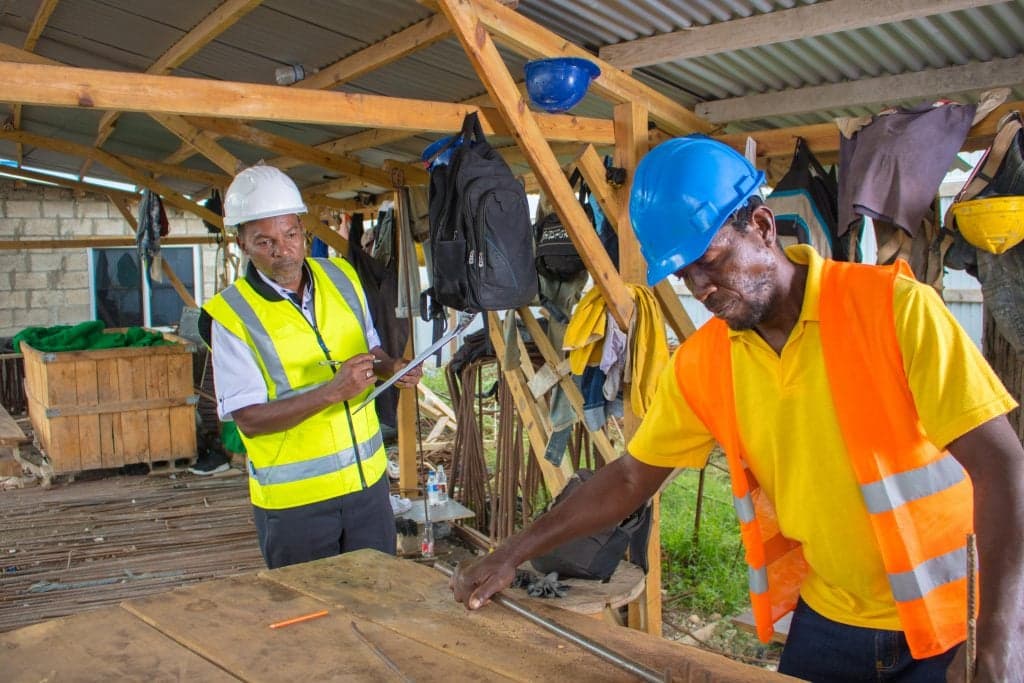
Jamaica has the second-longest average work week in the Americas and the longest in the Caribbean, according to 2026 data published by World Population Review.
Jamaica ranks 35th globally, with workers putting in an average of 43.45 hours per week. Only Honduras, ranked 28th globally, has a longer average work week in the Americas, at 44.20 hours.
Men in Jamaica work slightly more hours than women, with an average of 44.55 hours per week, compared with 42.14 hours for women. The difference amounts to about 2.4 hours per week.
Guyana ranks directly behind Jamaica, with an average work week of 43.29 hours, while Haiti ranks 61st globally, with workers putting in an average of 41.46 hours per week.
Several other Caribbean countries recorded shorter average work weeks. Workers in Saint Lucia averaged 40.29 hours per week, followed by Suriname at 40.13, Saint Vincent and the Grenadines at 40.04, and Belize at 40.02. The Dominican Republic recorded an average of 39.13 hours, while Trinidad and Tobago averaged 38.29 hours. Barbados had the shortest average work week in the Caribbean, at 34.47 hours.
Jamaica’s average work week was also nearly five hours longer than the global average of 38.67 hours.
How Jamaica compares globally
Jamaica is not among the countries with the longest work weeks globally.
Bhutan recorded the highest average at 54.68 hours per week, followed by Lesotho at 49.98, Sao Tome and Principe at 49.00, the Republic of the Congo at 48.86 and Jordan at 48.49 hours.
At the other end of the scale, Yemen recorded the shortest average work week at 22.95 hours. Canada had the shortest average in the Americas, at 31.86 hours, while the United States recorded an average of 36.27 hours.
The data also show a significant gender difference in some countries. In Jamaica, the gap is relatively modest, but in countries such as India, men averaged 49.69 hours per week compared with 35.60 hours for women. In Sao Tome and Principe, women actually recorded a higher average than men, at 50.12 hours compared with 47.89.
Longer hours do not necessarily mean higher pay
World Population Review cautions against interpreting longer work weeks as an automatic sign of greater economic prosperity or productivity.
The site notes that people who work longer hours do not necessarily earn higher annual wages than those working fewer hours. It cites the Netherlands and Portugal as an example: the average worker in the Netherlands earns more annually while working fewer hours per week than the average worker in Portugal.
The data also show that developing countries tend to have longer average work weeks than developed countries, according to World Population Review. The organization points to workplace laws, cultural attitudes, economic conditions and individual financial needs as factors that can influence how many hours people work.
What the data measure
The figures are based on data from the International Labour Organization (ILO). World Population Review identifies them as projected 2025 values based on the latest available data as of November 2024.
The figures include both full- and part-time employees in traditional employment arrangements, as well as self-employed workers. The site cautions that people living subsistence-type lifestyles outside conventional employment arrangements may not be included.
World Population Review also distinguishes the ILO figures from data supplied by the Organisation for Economic Cooperation and Development (OECD), noting that the two organizations use different methods to collect and compile their data.
While the page is titled Hardest Working Countries 2026, the underlying ILO figures should therefore be understood as projected 2025 values rather than measurements of hours worked during 2026.
For Jamaica, the figures point to a workforce spending substantially more time on the job than the global average, while also showing that longer working hours do not necessarily translate into higher wages or greater economic well-being.