Jamaica files reparations petition to King Charles over slavery
Key Points(5)
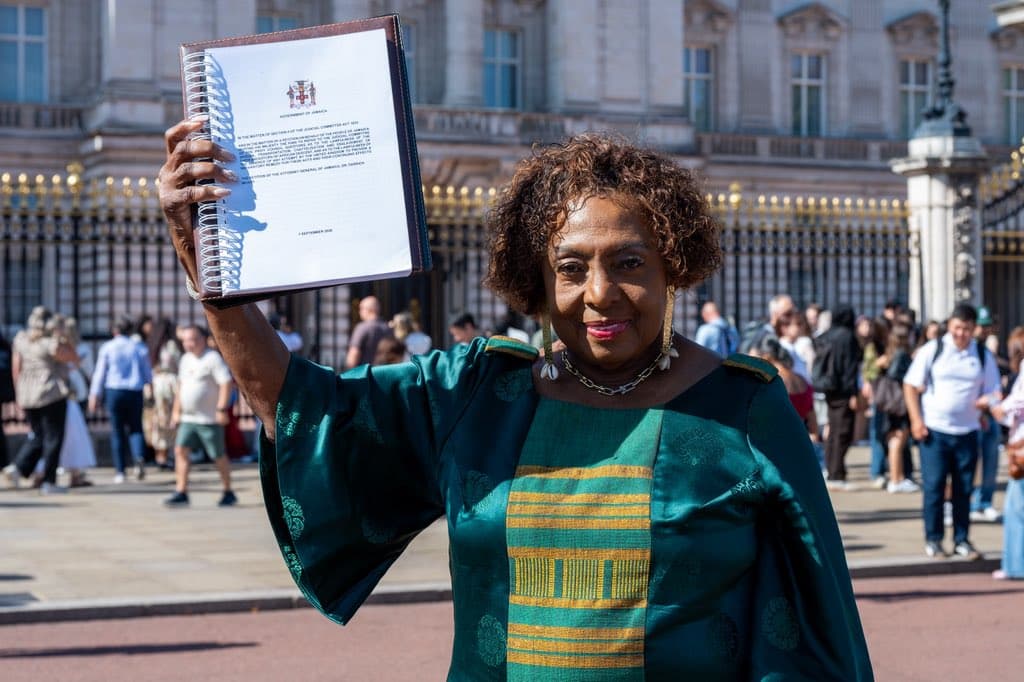
- Jamaica has formally filed a reparations petition to King Charles III, asking the monarch to refer key legal questions surrounding chattel slavery and Britain's obligations to the Judicial Committee of the Privy Council.
- Minister of Culture, Gender, Entertainment and Sport Olivia Grange confirmed that the petition was filed in London on Monday, Sept.
- 7, describing the move as historic in Jamaica's pursuit of reparatory justice.
- “We have filed a reparations petition to His Majesty.
- We anticipate that the petition will be referred to the Privy Council and we will await the decision,” Grange told a media briefing following the filing.
Jamaica has formally filed a reparations petition to King Charles III, asking the monarch to refer key legal questions surrounding chattel slavery and Britain's obligations to the Judicial Committee of the Privy Council.
Minister of Culture, Gender, Entertainment and Sport Olivia Grange confirmed that the petition was filed in London on Monday, Sept. 7, describing the move as historic in Jamaica's pursuit of reparatory justice.
“We have filed a reparations petition to His Majesty. We anticipate that the petition will be referred to the Privy Council and we will await the decision,” Grange told a media briefing following the filing.
The petition asks King Charles, in his capacity as Jamaica's head of state, to refer three questions concerning the legality of the enslavement of Africans to the Judicial Committee of the Privy Council, Jamaica's highest court.
Grange stressed that the petition does not seek monetary compensation, pushing back against reports suggesting that the Jamaican government had submitted a financial claim.
“I wish to make it clear, and will do so at every single opportunity, that this petition is a legal petition,” Grange said. “It contains three specific questions… [and] does not include a monetary claim.”
The three questions ask whether the seizure, transportation and enslavement as chattel of Africans was ever lawful under English law; whether the seizure, transportation and enslavement of Africans in Jamaica breached international law; and whether the United Kingdom has a legal obligation to provide a reparatory remedy to the people of Jamaica.
England-based barrister Edward Fitzgerald, who helped formulate the petition as part of a team of Jamaican and British lawyers, said it asks the King to refer issues of significant legal and constitutional importance to the Privy Council.
“There's a special jurisdiction under section four of the Judicial Committee Act for the King to refer an issue of legal or constitutional importance to the Privy Council, for their determination,” Fitzgerald said.
He argued that there is a strong legal case that the enslavement of Africans was never lawful under English common law.
“If you think of it, it'd be a pretty strange thing if a citizen could just go to Africa, see someone, against their will push them into a boat, and take them on a tortuous journey, and that that was lawful under English common law,” Fitzgerald said.
He added that there was no statute authorizing the practice and pointed to a statute from the reign of George II that the National Council for Reparations has cited as evidence that the seizure of people from Africa was unlawful.
“So to those who say, oh, well, it was lawful at the time, we asked the Privy Council to find that it was never lawful at the time,” Fitzgerald said.
The petition also argues that chattel enslavement constituted a crime against humanity.
On the question of reparatory remedies, Fitzgerald said the petition sets out legal principles supporting Jamaica's argument that a remedy is required, while leaving the precise form of any remedy to be determined through subsequent legal proceedings.
“The question of what the exact form the remedy would take would be a matter to be worked out in the litigation,” he said. “But there must be some remedy for wrongs of this magnitude, which continue to have damaging effects on the descendants of those who were enslaved.”
Jamaica's National Council for Reparations, chaired by attorney-at-law Laleta Davis Mattis, serves as a high-level advisory body to the government on reparatory justice and reports to Grange.
Grange said pursuing reparations was her duty “not only as a proud woman of African descent, but as a member of the human race” because of the centuries of chattel enslavement endured by Africans on plantations in Jamaica.
“How can we not be moved to action about what is declared to be the gravest crime against humanity that went on for so long and affected so many millions of people?” she said, as she called for support for Jamaica's petition.