Fifth defendant convicted in plot to assassinate Haitian President Jovenel Moïse
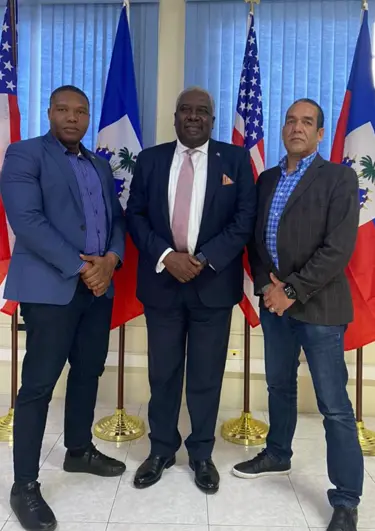
Sanon (center) and co-conspirators
Key Points(5)
- A federal jury in Miami has convicted Christian Emmanuel Sanon, a 67-year-old Haitian national, for his role in the 2021 assassination of Haitian President Jovenel Moïse, making him the fifth defendant found guilty at trial in the United States in connection with the killing.
- He faces a maximum sentence of life in federal prison, according to the U.S.
- Department of Justice, which announced the verdict on Thursday, Nov.
- Prosecutors said Sanon helped launch a conspiracy in early 2021 to overthrow Moïse and install himself as Haiti's next president.
- According to evidence presented at trial, Sanon falsely claimed to have the backing of the U.S.
A federal jury in Miami has convicted Christian Emmanuel Sanon, a 67-year-old Haitian national, for his role in the 2021 assassination of Haitian President Jovenel Moïse, making him the fifth defendant found guilty at trial in the United States in connection with the killing.
Sanon was convicted on multiple charges, including conspiracy to provide material support resulting in death, providing material support resulting in death, conspiracy to kill and kidnap a person outside the United States, smuggling goods from the United States and submitting false export information.
He faces a maximum sentence of life in federal prison, according to the U.S. Department of Justice, which announced the verdict on Thursday, Nov. 19.
Prosecutors said Sanon helped launch a conspiracy in early 2021 to overthrow Moïse and install himself as Haiti's next president.
Working with several co-conspirators in the United States and Haiti, including Arcangel Pretel Ortiz, Antonio Intriago, Walter Veintemilla and James Solages, Sanon allegedly promised lucrative government infrastructure contracts in exchange for financial and logistical support to kidnap or kill the Haitian leader.
According to evidence presented at trial, Sanon falsely claimed to have the backing of the U.S. Department of State to recruit supporters and gain credibility for the plot. He also used American flags and other U.S. government imagery to reinforce those claims.
When efforts to install him as president stalled, Sanon agreed to take a secondary role in the proposed new Haitian government but remained involved in the conspiracy.
Prosecutors said he helped arrange transportation, lodging, food, equipment and other supplies for the 22 Colombian mercenaries involved in the assassination.
In June 2021, Sanon assisted in smuggling ballistic vests from the United States into Haiti for the mercenaries. Later that month, he sent Solages, described as his right-hand man, back to the United States to obtain additional tactical advice and finalize plans for the attack.
On July 7, 2021, a group of former Colombian special forces soldiers, along with Haitian accomplices, stormed Moïse's private residence and fatally shot him in his bedroom. His wife, Martine Moïse, was seriously wounded in the attack.
Digital evidence presented during the trial revealed months of communications between Sanon and his co-conspirators detailing plans to kidnap or kill the president.
Investigators also found that Sanon deleted most of the incriminating communications from his three cellphones shortly before his arrest on July 9, 2021, including messages discussing what he expected to gain from the assassination.
“Sanon helped orchestrate one of the most brazen acts of political violence in the Western Hemisphere in recent history,” said Acting Principal Deputy Assistant Attorney General for National Security M. Scott Proctor.
“This conviction ensures that another participant in this conspiracy is held accountable and reaffirms that the United States will not tolerate its territory or financial systems being used to facilitate acts of terror abroad.”
Acting U.S. Attorney Yara Lorenzo Klukas for the Southern District of Florida said the verdict represented another step toward justice for Moïse's family and the Haitian people.
“The assassination of a sitting president is an attack not only on a life, but on the sovereignty of a nation and the very foundations of democracy,” Klukas said.
The conviction follows several other developments in the U.S. investigation into the assassination.
Eight co-conspirators, including two Colombian mercenaries and several Haitian and American associates, have pleaded guilty to their roles in the plot.
In May 2026, a federal jury convicted four other defendants — Pretel Ortiz, Intriago, Veintemilla and Solages — for their involvement in the assassination conspiracy.
In September, federal authorities indicted 29 additional defendants for their alleged roles in the plot. Those charges also involve an alleged fraud and money laundering scheme tied to funds obtained through the Paycheck Protection Program, a federal COVID-19 relief initiative, which prosecutors say helped finance the assassination.
The assassination of Moïse plunged Haiti into a prolonged political and security crisis, further destabilizing a country already struggling with gang violence and weak state institutions.
Sanon's sentencing date was not specified in the Justice Department's announcement. A federal judge will determine his sentence after considering federal sentencing guidelines and other statutory factors.