Caribbean agriculture ministers demand new financing model to drive food security
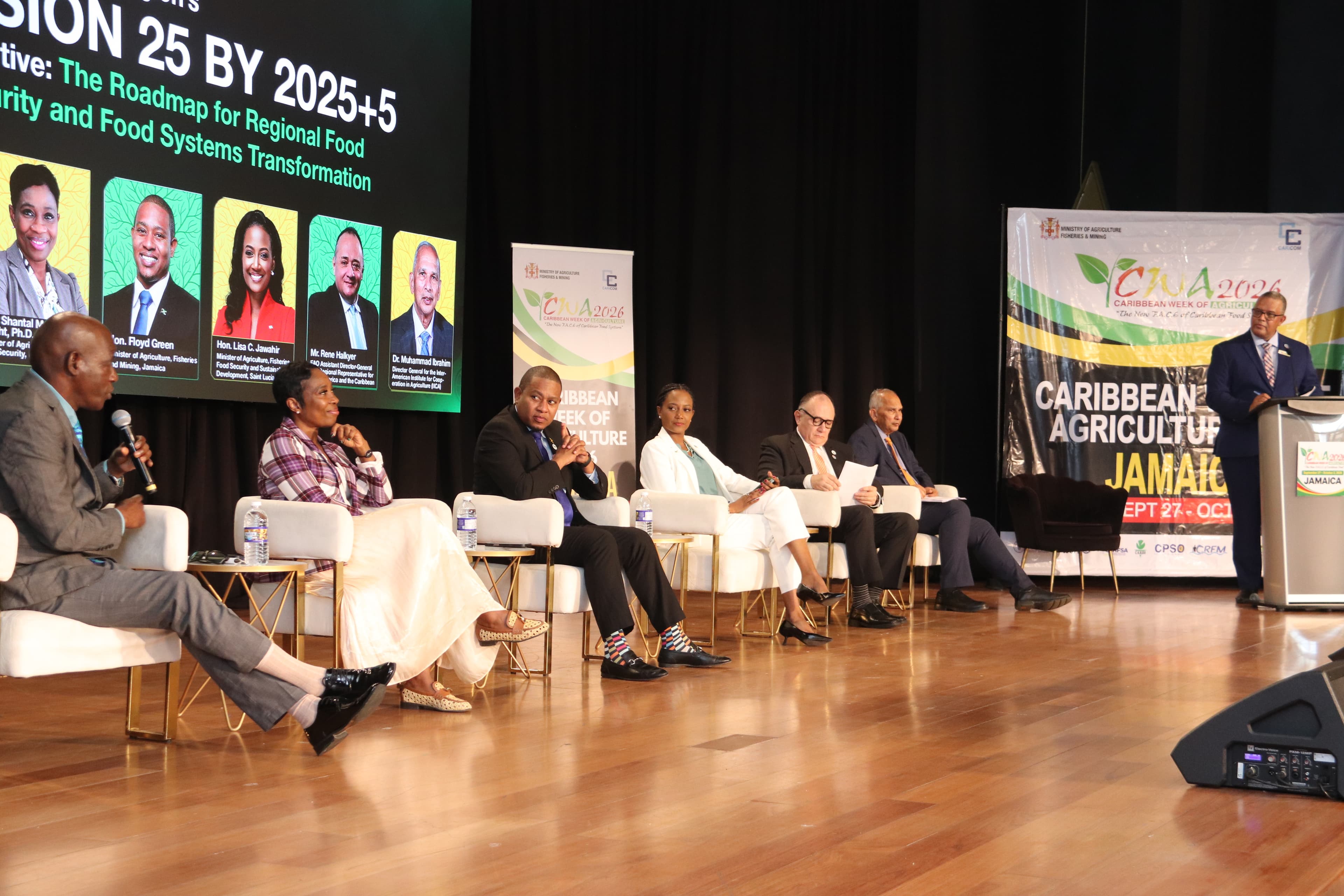
Panelists at the plenary session, “Achieving the Region’s Vision 25 by 2025+5: The Roadmap for Regional Food Security and Food Systems Transformation,” held during Caribbean Week of Agriculture
Key Points(5)
- The call came during a September 28 plenary at Caribbean Week of Agriculture in Jamaica, where ministers from Jamaica, Barbados, Belize and Saint Lucia assessed progress under the region’s Vision 25 by 2025+5 food security initiative and outlined priorities through 2030.
- At the heart of the discussion was the fact that the Caribbean is producing more, but the systems needed to move that production efficiently across the region have not kept pace.
- Belize’s Minister of Agriculture, Food Security and New Growth Industries, Rodwell Ferguson, said Caribbean countries must do more to trade with each other.
- “I do not believe that we are trading as much as possible with each other.
- We must help each other survive,” Ferguson said.
Caribbean agriculture ministers are calling for a fundamental overhaul of how the region trades and finances agriculture, warning that increased production alone will not deliver food security unless farmers can move their products across borders and access financing suited to the Caribbean’s unique vulnerabilities.
The call came during a September 28 plenary at Caribbean Week of Agriculture in Jamaica, where ministers from Jamaica, Barbados, Belize and Saint Lucia assessed progress under the region’s Vision 25 by 2025+5 food security initiative and outlined priorities through 2030.
At the heart of the discussion was the fact that the Caribbean is producing more, but the systems needed to move that production efficiently across the region have not kept pace.
Belize’s Minister of Agriculture, Food Security and New Growth Industries, Rodwell Ferguson, said Caribbean countries must do more to trade with each other.
“I do not believe that we are trading as much as possible with each other. We must help each other survive,” Ferguson said.
The ministers identified transportation, logistics and trade standards as among the most urgent barriers to achieving greater regional food security.
As production increases, they argued, the absence of reliable air and sea connections, cold-chain facilities and efficient border procedures risks creating a situation where food is available in one territory but unavailable in another.
The priority, therefore, is not simply to produce more cereals, fruits, vegetables, poultry, beef, dairy, roots, tubers and small ruminants, but to establish the infrastructure needed to move those commodities from areas of surplus to areas of deficit.
Regional food hubs and improved transportation networks emerged as key components of that effort, with ministers agreeing that stronger inter-island connections will be essential if the region is to translate agricultural production into actual food security.
Breaking down trade barriers
Saint Lucia’s Minister of Agriculture, Fisheries, Food Security and Sustainable Development, Lisa Jawahir, pointed to differing standards across markets.
She called for harmonised access to regional standards so that Saint Lucian value-added products can meet the same benchmarks across the Caribbean.
For producers, common standards could help reduce barriers to intra-regional trade and create a more level playing field for Caribbean-made products.
The discussion comes as the region continues to pursue greater food security while remaining vulnerable to external supply disruptions, high import costs and increasingly unpredictable weather.
Jamaica, meanwhile, has recorded significant gains in domestic production despite those pressures.
Agriculture Minister Floyd Green said the country historically averaged approximately 600,000 tonnes of domestic production before reaching a record 841,000 tonnes in 2022/23.
Even after Hurricane Melissa wiped out the final quarter of the subsequent production year, Jamaica still recorded its second-highest level of domestic production, according to Green.
But he said the lesson from the hurricane was the need to prepare before disasters strike rather than rebuild afterwards.
“In order to build a resilient food system, we must build forward,” Green said. “As Caribbean nations, we do not have the luxury of waiting until a disaster strikes to put measures in place. We must plan ahead.”
Jamaica has earmarked agricultural land for young people and women, while introducing a moratorium on lease payments and an agribusiness challenge intended to encourage innovation and attract a new generation to the sector.
Rethinking agricultural financing
While infrastructure and trade dominated much of the discussion, ministers also challenged international financial institutions to rethink how agricultural projects in the Caribbean are assessed and financed.
They argued that conventional financing models often fail to account for the region’s exposure to hurricanes and other climate shocks, relatively small markets and limited access to collateral.
Barbados’ Minister of Agriculture and Food Security, Shantal Munro-Knight, said the region needs investment partners that understand its particular circumstances.
“We must have investment partners who truly understand our nuances as a region,” she said.
Green was more direct in his appeal for a new approach.
“We need to redefine financing for the region and not try to fit the Caribbean into an archaic box for financing,” he said, challenging international partners to develop a model that takes the region’s specific risks into consideration.
He suggested that securing agreement from financing institutions on such a model during Caribbean Week of Agriculture would represent a significant achievement for the event.
The issue is particularly important for small farmers and agricultural businesses that may struggle to secure traditional financing because of limited collateral or the risks associated with climate-related losses.
The ministers’ discussion ultimately pointed to a broader shift in the region’s approach to food security.
Increasing production remains important, but the next stage will require Caribbean countries to operate more effectively as an interconnected food system, moving food where it is needed, establishing common standards, strengthening infrastructure and creating financing mechanisms that reflect regional realities.
The plenary identified several areas for immediate action, including capacity building, trade facilitation and the development of agritech ecosystems.
For Vision 25 by 2025+5 to translate into measurable gains through 2030, Caribbean countries will have to move beyond commitments and strengthen the practical systems that allow farmers, businesses and markets to work together.
In the words of Belize’s Ferguson, the objective is ultimately about countries helping each other “survive” and, increasingly, producing, trading and investing as a region capable of feeding itself.



.jpg&w=3840&q=75)