Home Blog Page 66

Performance metrics business should track when using digital signage Apple TV

Apple TV

Digital displays transform how companies communicate with staff and customers. Success depends on clear data rather than simple visual presence. Proper measurement ensures that every screen provides actual value to the organization. Managers must identify specific data points to evaluate hardware performance and content impact. This article explores the key metrics to monitor for optimal screen management and viewer engagement.

Screen Uptime and Hardware Reliability

Reliable hardware serves as the foundation for any successful visual communication strategy. Organizations must monitor how each digital signage Apple TV unit remains active and connected to the network. Frequent disconnections or system crashes interrupt the flow of information and decrease the total return on investment. Tech teams should track the duration of uninterrupted service to identify potential power or connectivity issues. High uptime percentages indicate a stable setup that delivers messages consistently to the target audience.

Content Engagement and Interaction Rates 

Visual displays must do more than just show images to justify their costs. Metrics related to how people interact with the screens provide deep insights into content quality. If a display includes interactive elements or QR codes, the system can track every scan or touch. This data reveals which messages capture attention and which ones fail to resonate. Managers use these numbers to refine their creative strategies for better results.

Audience Retention And Dwell Time

Dwell time measures how long a person stands in front of a screen to consume information. High dwell times suggest that the content is relevant and easy to read. Organizations use sensors to capture this data without invading personal privacy.

The following list highlights specific engagement data points to collect:

  • Total scan counts for displayed QR codes provide direct proof of audience interest.
  • Average dwell time shows if the content length matches the typical wait time in an area.
  • Interaction frequency reveals the most popular touchpoints on an interactive map or menu.
  • Peak viewing hours help staff schedule the most important announcements for maximum impact.

Proof of Play and Playback Logs 

Proof of play reports confirms that specific media files actually appeared on the screen at the scheduled time. These logs are vital for internal compliance and external advertising audits. Detailed records show the start time, end time, and total number of repetitions for every asset in the loop. Automated logs remove the need for manual checks and provide a clear audit trail for stakeholders. Accurate playback data ensures that every department receives its fair share of screen time throughout the day.

Employee Feedback and Internal Awareness 

Internal communication success relies on qualitative data gathered from the workforce. Surveys help determine if employees actually remember the safety tips or company news shown on the screens. High awareness levels indicate that the placement and design of the displays work effectively. If staff members cannot recall recent announcements, the content strategy might require a complete overhaul.

Effective internal measurement includes several key indicators:

  • Quiz scores after training sessions show if the displays effectively taught new concepts.
  • Employee participation rates in company events advertised on screens measure call-to-action success.
  • Survey responses provide direct feedback on the visual appeal of the current layouts.
  • Staff suggestions for new content themes demonstrate active interest in the communication channel.

Network Performance and Bandwidth Efficiency 

Network health impacts how quickly new media files reach each digital signage apple tv device. Administrators must track the speed of content downloads to prevent lag or empty screens. Efficient bandwidth use ensures that the display system does not slow down other critical business operations. Regular monitoring of data consumption helps in planning for future network upgrades or optimizations. Proper network management leads to a seamless experience for the viewer and the IT department alike.

Data collection turns a simple screen into a strategic asset for growth. By monitoring uptime, engagement, and network health, businesses transform their communication methods into measurable results. Consistent analysis of these figures allows for precise adjustments that maximize the impact of every visual message. Success requires a commitment to tracking these specific data points every month. Smart leaders use these insights to drive better internal alignment and customer satisfaction.

 

What strategies lower costs for beach getaways?

AnguillAir

Most dream about lounging under the sun, feeling the sand between their toes, and surfing the waves. But the vacation setting bill usually discourages passengers from booking an oceanside getaway. However, you can implement a few strategies that can significantly lower the cost of beach vacations. With the right practical approaches, travelers can lift their feet up by the surf without stretching their budget.

Choosing the Right Destination

Instead of heading to famous tourist hubs, travelers can go to less popular coastal spots for an affordable beach vacation. These beaches are generally less touristy and have cheaper accommodation. Venturing outside of the tourist hotspots will allow travelers to experience the local culture for a fraction of the price. Along with this, these destinations give breathtaking views without the steep cost of other popular locations.

Flexible Travel Dates

Flight and accommodation prices change across the seasons. Booking for the off-season can significantly lower the overall price of any trip. These beach towns are often surprisingly affordable during the off-season. Being flexible with travel dates means you can score considerable savings.

Booking in Advance

Booking housing and transport ahead of time typically will result in better prices. Hotels and airlines often have early bookings at a cheaper rate. Booking several months in advance of the departure can increase the odds of bargains.

Considering Alternative Accommodation

Prime locations charge extra. You will find that traveling is often more affordable when you are staying in vacation rentals, hostels, or guesthouses. Some may want to camp out close to the beach; it can be a cost-effective and adventurous way to experience summer family vacations. Comparison of accommodation types ensures the best value for any budget.

Packing Smart

To escape the exorbitant stores by the seaside, travelers can bring important items from home. Packing items like sunscreen, snacks, and reusable water bottles avoids unnecessary cost. You can also save on beach rentals by bringing your own towels and umbrellas. You obviously don’t want to spend extra money on towels.

Traveling with a Group

Sharing with friends and family can significantly reduce costs. When you split accommodation, transportation, and food bills, there are lower individual costs to pay. Tours and activities also tend to offer discounts if you are in a group. So, splitting expenses is likely a more accessible choice for experiences that don’t hurt. When travelers band together, they have more collective spending power and shared memories.

Public Transportation and Walking

By opting for public transit or walking rather than taking cabs, visitors can save money on a day-to-day basis. Most beach towns have a decent bus or train network linking the majority of the sights. It can be enjoyable to walk or bike in the nearby area to explore at a slower pace. For a more economical tour, make the most of the native transport approach.

Preparing Simple Meals

When you are on a vacation, every meal becomes pretty expensive. Travelers can manage their food expenses by preparing simple breakfasts or picnics. Local markets often supply fresh produce and snacks at relatively low rates. Eating a home-cooked meal on the sand can really be comparable to dining in a restaurant.

Free and Low-Cost Activities

Most beach activities require very little financial investment. Swimming, sunbathing, and seashell searching provide hours of free fun. Local festivals or outdoor concerts often provide visitors with free entertainment. Check for community events to help fill your itinerary without spending a lot.

Taking Advantage of Deals

Numerous attractions and vendors offer discounts for early bookings or group purchases. Look online for coupons or specials before arriving. It’s possible to save a lot of money by checking the prices charged by various providers. Hunting for bargains allows a modest budget to stretch much further.

Conclusion

With some planning and the right tactics, you can enjoy affordable beach getaways. A flexible approach, the selection of alternative destinations, and smart travel choices can enable an unforgettable shoreline experience. Cutting down costs does not risk losing comfort or enjoyment. So with some of these very practical tips, you can prepare a great trip by the sea without shelling out a fortune.


PortMiami hosts high-stakes pre-forum on Caribbean maritime growth

PortMiami

On the eve of the inaugural U.S.-Caribbean Maritime & Ports Forum, the bustling docks of PortMiami became more than a hub for global trade—they set the stage for a high-level meeting of minds.

At 1:00 p.m. today, port leaders, regional ministers, and international financiers gathered for an exclusive pre-event to lay the groundwork for a new era of Caribbean infrastructure, security, and economic development.

Hosted by the Atlantic Council’s Caribbean Initiative in partnership with PortMiami, the session offered an intimate venue for decision-makers to tackle the “Blue Economy’s” most pressing challenges ahead of the main forum at Fontainebleau Miami Beach tomorrow.

A focus on resilient infrastructure and creative finance

Discussions underscored a critical reality: the Caribbean’s geographic advantage can only be fully leveraged through modern, resilient infrastructure. With maritime trade serving as the lifeline for island nations, the dialogue explored strategies to attract institutional capital into port expansions.

Financial leaders and development experts emphasized the growing importance of Public-Private Partnerships (P3s) and green financing. These tools, they agreed, are essential for building facilities capable of withstanding climate volatility while accommodating increased TEU volumes.

Securing the trade lanes

Security remained a top priority. As ports increasingly embrace digital operations, attendees discussed the twin challenges of physical and cybersecurity. Standardized security protocols across the Caribbean basin were highlighted as vital to ensure smoother trade with U.S. hubs like Miami.

Regional operators and consultants stressed the importance of technologies that accelerate “last-mile” logistics without compromising safety.

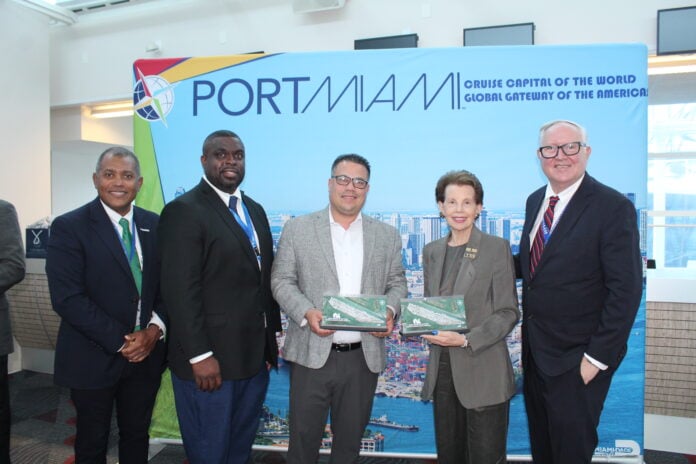
Celebrating leadership: Special awards presentation

A highlight of the afternoon was a special awards presentation led by Sonless Martin of PortMiami, recognizing leaders at the intersection of philanthropy, environmental policy, and maritime growth:

  • Ms. Adrienne Arsht, Executive Vice Chair of the Atlantic Council and Founder of the Adrienne Arsht Latin America Center, received an award for her commitment to regional resilience and strengthening U.S.-Caribbean partnerships.

  • The Hon. Matthew Samuda, Jamaica’s Minister of Water, Environment, and Climate Change, was honored for ensuring that port development in Jamaica and the wider Caribbean aligns with ecological sustainability.

“Today we honor those who have provided both the vision and policy framework to make a sustainable Blue Economy possible,” Martin said during the presentation.

Distinguished attendees

The pre-event drew an elite group of public- and private-sector stakeholders, including:

  • Adrienne Arsht, Executive Vice Chair, Atlantic Council

  • The Hon. Matthew Samuda, Minister of Water, Environment, and Climate Change, Jamaica

  • Patricia Francis, Nonresident Senior Fellow, Atlantic Council’s Caribbean Initiative

  • Jeffrey Hall, CEO and Vice Chairman, Pan Jamaica Group Limited; Chairman, Kingston Wharves Limited

  • Tim Martin, President and CEO, Tropical Shipping

  • Rick Crooks, President and CEO, EAC Consulting

  • Captain Gus Andersson, Associate Vice President, Royal Caribbean Group

  • Lilia Burunciuc, Country Director for Caribbean Countries, World Bank

  • Dion Bethell, President and CFO, Nassau Container Port, Bahamas

  • Erik Bethel, General Partner, Mare Liberum Capital

  • Felipe Ezquerra, Head of Transport, Infrastructure and Energy Division, IDB Invest

  • Adam Carter, Managing Director, CIBC FirstCaribbean International Bank

  • Andrew Clutz, Head of Economic Development, Tractus Asia

As the gathering concluded against the backdrop of the Miami skyline, one message stood out: the Caribbean is open for business, but success depends on collaborative investment, shared security, and a commitment to sustainable infrastructure.

Spice brings star power to WYFL riddim with ‘Clean and Fresh’

Dancehall royalty is back on a familiar beat. Grammy-nominated entertainer Spice has officially joined the WYFL riddim with the release of her new single, “Clean and Fresh.” Produced by DJ Mac and CRASH Dummy, the track rides the infectious pulse of the WYFL riddim, delivering the kind of bass-heavy bounce that commands attention.

While the rhythm is primed for movement, Spice’s message runs deeper, championing proper hygiene, self-love, and showing up unapologetically as your best self.


View this post on Instagram


A post shared by QUEEN OF DANCEHALL (@spiceofficial)

“‘Clean and Fresh’ is about owning your presence, honoring your body, and stepping into every moment with freshness, freedom, and fearless self-love. Real, authentic dancehall,” Spice shared in a statement.

For the Portmore native, the single represents a return to the raw, unfiltered dancehall sound that first propelled her into the spotlight over two decades ago. The track captures that unmistakable Spice charisma while reinforcing her place at the forefront of global dancehall culture.

Over the years, Spice has built an empire on lyricism and commanding visuals, carving out her lane as one of the most influential female voices in the genre. Her 2021 album 10 earned her a Grammy nomination for Best Reggae Album, propelled by the crossover hit “Go Down Deh,” featuring Shaggy and Sean Paul. The project marked a major mainstream breakthrough, pushing her onto even bigger international stages and platforms. She followed that compilation with Mirror 25, released in August 2024—a body of work celebrating 25 years in the industry while chronicling personal growth, resilience, and reinvention.

With “Clean and Fresh,” Spice transforms everyday lifestyle habits into bold lyrical declarations. The underlying message is simple but powerful: confidence begins with how you carry yourself.

“Clean and Fresh” is now available on all major streaming platforms, and if early reactions are any indication, the WYFL riddim just got a serious glow-up.

Haiti reports 553 earthquakes in 2025, most minor and shallow

Earthquake

The Haiti Ministry of the Environment, alongside the Bureau of Mines and Energy (BME) and the Technical Unit of Seismology (UTS), has released its annual report on seismic activity for 2025. Data for the report was gathered from local monitoring networks, including Ayiti-séismes and UTS, as well as regional networks in Cuba, Jamaica, and the Dominican Republic.

In total, 553 earthquakes were recorded across the country, marking a 12% decrease from 2024’s 628 events. On average, Haiti experienced 46 earthquakes per month, with May and August being the most active months at 60 earthquakes each.

Magnitudes ranged from 0.2 to 4.2, with the vast majority (503, or 90.9%) measuring 3 or below, classified as very minor. Minor to slight earthquakes (magnitude 3.1 to 4.2) accounted for 50 events. The strongest quake, a magnitude 4.2, occurred off the coast of Jean Rabel on August 23.

Approximately 206 earthquakes (37%) occurred offshore, particularly near the Northwest Peninsula. Nearly half of all quakes (263, or 47.5%) were shallow, with depths of 10 km or less, making them more noticeable at the surface.

Seismic activity was unevenly distributed across the country’s ten departments. The West recorded the highest number with 138 earthquakes, followed by Nippes (115) and Northwest (102), collectively accounting for 64% of annual activity. In contrast, the Center, North, and Northeast departments were the least affected, registering just 31 quakes combined, or 5.6% of the total.

The report highlights that while most seismic events in 2025 were minor, the concentration of shallow and offshore quakes underscores the importance of ongoing monitoring to safeguard communities and infrastructure.

Pembroke Pines and Lauderhill gear up for municipal elections on March 10

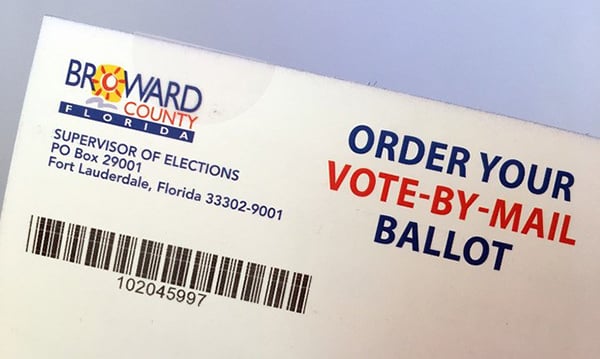
Vote-by-mail ballots

Voters in Pembroke Pines and Lauderhill are preparing to head to the polls on Tuesday, March 10, as both municipalities hold important local elections and referenda.

According to figures from the Broward County Supervisor of Elections, the city has 123,146 registered voters eligible to participate in the municipal election — the first local vote in two years. The latest voter rolls show an increase of about 1,266 voters since 2024, when roughly 121,880 residents were registered.

Democrats remain the largest group in the city, with about 52,400 voters, or roughly 44 percent of the electorate. Voters with no party affiliation account for approximately 39,520 registrations, or about 33 percent, while Republicans total about 28,560 voters, representing around 20 percent.

In District 1, incumbent Commissioner Thomas Good is seeking reelection. He faces former Pembroke Pines police sergeant James Henry and Dennis Hinds, a Jamaican-American professional with experience in banking, finance, real estate and insurance. In District 4, Vice Mayor Mike Hernández seeks a full four-year term against community advocate Elizabeth Burns, who previously ran for mayor in 2024.

The deadline to request that the ballot be mailed is February 26.

Meanwhile, in Lauderhill, voters will decide a $65 million bond initiative called RISE Lauderhill, aimed at funding public safety, parks, city facilities, and transportation projects. The ballot includes three questions: $9.5 million for public safety, $34 million for parks and infrastructure, and $21.5 million for transportation and roadway improvements. Lauderhill residents will also return to the polls in November to elect a mayor and determine who will hold Seat 4 on the city commission. Only one candidate — Ishmel Brown — has filed to run for the Mayor’s post now held by Denise Grant. For Seat 4, Vice Mayor Richard Campbell faces a challenge from Tiffany Jackson.

Polling places in both cities will be open from 7 a.m. to 7 p.m. Early voting is not available, and residents who requested vote-by-mail ballots must ensure they are received by the Supervisor of Elections by 7 p.m. on Election Day.


Broward relaunches free heart screening initiative with new partner

heart test

Residents in Broward County will once again have access to free preventive heart screenings following the relaunch of the county’s heart health initiative, now renamed the Broward County/Florida Panthers Preventive Heart Program.

The updated program was announced during a November 18, 2025, meeting of the Broward County Commission, where Mayor Mark D. Bogen outlined plans to bring back the initiative with a new provider and application process. The effort is a partnership between Broward County and the Florida Panthers Foundation, with medical screenings to be carried out by the Cleveland Clinic.

The program, now open to residents, is funded with more than $3 million remaining from the county’s original $10 million investment, along with an additional $1 million contribution from the Florida Panthers Foundation. Officials say the initiative is intended to help residents detect potential heart problems before they become life-threatening.

The screening, known as the “Take Heart Test,” involves a CT scan of the heart combined with an iodine-based contrast injection that allows doctors to identify blockages in coronary arteries that could lead to heart attacks. For participants allergic to iodine, an alternative CT calcium score test will be available, although officials note it may only detect certain types of plaque buildup.

County leaders say preventive care is especially important for adults aged 45 and older, who are encouraged to take advantage of the screening and discuss results with their primary care physicians to evaluate their risk of heart disease and consider treatment or lifestyle changes if necessary.

Eligibility for the free screening will be determined on a case-by-case basis. Under previous versions of the program, participants were typically between ages 45 and 70 and had at least one risk factor, such as high cholesterol, high blood pressure, diabetes, a history of smoking, or a family history of heart disease.

Residents interested in participating can apply through the program’s online form or contact the Broward County mayor’s office for additional information by calling 954-357-7002 or emailing mbogen@broward.​org.

Blizzard triggers flight cancellations at South Florida airports

Miami International Airport

A powerful winter storm battering the U.S. East Coast has caused widespread travel disruptions, with thousands of flights canceled nationwide and major impacts reported at airports in South Florida.

According to flight tracking data, more than 4,800 flights were canceled across the United States on Monday as the storm intensified. Airports in Miami and Fort Lauderdale also reported significant disruptions as airlines adjusted schedules due to the severe weather affecting northern routes.

At Miami International Airport, more than 135 flights were canceled and about 18 delayed as of Monday. Officials said they are continuing to monitor conditions and coordinate with airline partners to minimize disruption to travelers.

Meanwhile, Fort Lauderdale-Hollywood International Airport reported more than 185 cancellations and roughly 17 delays. Updated figures later in the day indicated around 191 canceled flights and 25 delays at the airport.

The disruptions come as blizzard warnings stretch along the East Coast from Maryland to Maine. Meteorologists with the National Weather Service warned that travel conditions in affected areas could be “nearly impossible.”

In New York City, officials implemented a ban on non-emergency travel through midday Monday as heavy snow and strong winds swept across the region. Forecasters say the storm could bring up to two feet of snow in some areas, with roughly 41 million people under blizzard warnings.

Flight disruptions began as early as Sunday, with thousands of cancellations and delays affecting flights traveling into, out of and within the United States. Airlines continue to adjust schedules as the storm moves through the northeastern corridor.

Professor Minerva Thame among honorees for Jamaican Women Pinnacle Awards Gala 2026

Minerva Thame

Renowned Jamaican physician and researcher Minerva Thame will be among 15 women recognized at the Jamaican Women Pinnacle Awards Gala 2026, an event highlighting influential leaders whose work has made a significant impact in Jamaica and across the diaspora.

The awards ceremony, held in observance of International Women’s History Month, is scheduled for March 14 at the Jamaica Pegasus Hotel in Kingston. The gala will celebrate women from a wide range of industries and leadership roles who have contributed to national and regional development.

A leading figure in academic medicine, Thame serves as Professor of Perinatal and Paediatric Medicine and Consultant Paediatrician in the Department of Child and Adolescent Health at The University of the West Indies and the University Hospital of the West Indies. Her career has combined clinical work, research, teaching and institutional leadership focused largely on improving the health of mothers and children.

From 2021 to 2025, she made history as the first woman to serve as Dean of the Faculty of Medical Sciences at the university’s Mona campus. Before that role, she held several senior posts, including head of the Department of Child and Adolescent Health, deputy dean, director of graduate studies and research, and consultant paediatrician at the University Hospital of the West Indies.

Throughout her career, Thame has worked extensively with newborn and high-risk infants, including serving as one of the consultants overseeing the Special Care Nursery and Neonatal Intensive Care Unit. She has also trained generations of medical students, nurses, midwives, and paediatric specialists who now practice throughout Jamaica and the wider Caribbean.

Her research has focused on maternal and fetal health, examining how factors such as maternal body composition and nutrition influence fetal growth and birth outcomes. Much of her work has explored issues affecting pregnant adolescents, older mothers and women living with sickle cell disease.

Thame’s contributions have earned numerous awards, including the Principal’s Award for Most Outstanding Researcher in the Faculty of Medical Sciences and the Vice Chancellor’s Award for Excellence in Research. She has also been honored with the Paul Harris Fellow Award from Rotary International and recognition from the Jamaica Medical Foundation for her work in child health.

Beyond the university and hospital setting, she continues to influence regional public health. She currently chairs the Research Advisory Committee at the Caribbean Public Health Agency and serves on the Regional Eminent Persons Panel of the ANSA McAL Foundation, which administers the Anthony N. Sabga Awards for Caribbean Excellence.

Recently appointed Emerita Professor by The University of the West Indies, Thame is being recognized at the upcoming awards gala for a career dedicated to advancing paediatric and adolescent health and mentoring the next generation of Caribbean medical professionals.

Cold weather shelters open in South Florida as temperatures drop

Officials in Palm Beach County and Broward County are activating emergency shelter plans as unusually cold temperatures are forecast across the region.

The National Weather Service office in Miami has issued a cold weather advisory for Palm Beach County from 3 a.m. to 9 a.m. Tuesday, February 24, 2026. Forecasters say overnight temperatures could fall into the upper 30s to low 40s, with wind chills dipping into the low to mid-30s.

In response, the Palm Beach County Division of Emergency Management has activated its Cold Weather Shelter Plan to provide refuge for residents needing a warm place to stay.

Two shelters will open at 7 p.m. Monday and remain available until 9 a.m. Tuesday:

  • Belle Glade Transitional Shelter and Lake Village at the Glades, 341 NW 11th Street, Belle Glade

  • Westgate Park and Recreation Center, 3691 Oswego Avenue, West Palm Beach

Transportation will also be available, with Palm Tran providing bus pickups along established routes at 6 p.m. and again at 7:30 p.m.

Meanwhile in neighboring Broward County, officials say emergency shelter will be provided for individuals and families experiencing homelessness as temperatures are expected to drop significantly Monday night.

The Broward County Housing Options Solutions and Supports Division is coordinating with community partners to provide space at the local The Salvation Army facility at 1445 W. Broward Blvd. in Fort Lauderdale. Individuals seeking shelter are advised to arrive beginning at 5:30 p.m., with dinner available starting at 4:30 p.m.

Shelter beds will be provided on a first-come, first-served basis and space may be limited. Officials say the number of shelter nights could change depending on updated weather forecasts.

Authorities are also encouraging residents to assist friends or family members who may need a warm place to stay as temperatures in some areas could fall below 40 degrees overnight. Anyone needing additional information or assistance can contact the Broward County Homeless Helpline at 954-563-4357.

Senior Miami homeowners to receive property tax rebates

seniors

Senior homeowners in Miami will begin receiving rebate checks in the coming days under the city’s Senior Citizen Tax Relief Program, which provides a full refund of the city’s portion of property taxes for qualifying residents.

City officials announced that the payments are part of a measure approved in September 2025 during the adoption of the fiscal year 2025–2026 budget. The initiative aims to ease financial pressure on older residents, particularly those living on fixed incomes.

To qualify for the rebate, residents must be at least 65 years old and must own and homestead their primary residence within Miami city limits.

The rebate applies only to the city’s share of ad valorem property taxes and does not affect taxes levied by other authorities such as county government or the school board. Officials say the program is intended to provide immediate relief while helping seniors remain in their homes despite rising costs.

Marco Rubio to visit St. Kitts and Nevis for CARICOM Heads of Government meeting

marco rubio

U.S. Secretary of State Marco Rubio will travel to Saint Kitts and Nevis on February 25 to participate in the 50th Regular Meeting of the Conference of Heads of Government of the Caribbean Community.

According to a statement attributed to Principal Deputy Spokesperson Thomas ‘Tommy’ Pigott, Rubio is expected to engage with Caribbean leaders on a range of shared priorities. These include strengthening regional security, expanding cooperation to combat illegal immigration and illicit trafficking, and promoting economic growth, health initiatives, and energy security across the Caribbean. The visit is also expected to reaffirm the United States’ commitment to working with CARICOM member states to support stability and prosperity across the hemisphere.

The CARICOM summit will be held February 24–27 in Basseterre under the chairmanship of Terrance Drew, prime minister of St. Kitts and Nevis, who is serving as CARICOM chair from January 1 to June 30, 2026.

Leaders scheduled to speak at the opening ceremony on February 24 include Jamaica’s prime Minister Andrew Holness, who is the outgoing CARICOM chair; Kamla Persad-Bissessar of Trinidad and Tobago; Jennifer Geerlings-Simons of Suriname; Godwin Friday; and Carla Barnett, secretary-general of CARICOM.

The meeting brings together regional leaders to address major issues affecting the Caribbean, including economic development, regional cooperation, and security.

6 steps for company formation in Singapore

Starting a business in Singapore is an exciting proposition, but the actual process can be complex.

Regulations, documentation, compliance rules, and roles can become confusing in a short span of time. As a result, a lot of entrepreneurs are concerned about delays, rejections, or missing legal obligations. At the same time, each delay raises operational costs and delays revenue plans.

Therefore, knowing what the process will be like in advance saves time and money. If you know what the specific requirements are clearly, the process of incorporation becomes organized, as opposed to stressful.

This article discusses the six important steps needed to successfully form a company in Singapore in a smooth and proper manner.

Step 1: Reserve and Approve Your Company Name

The first step to company formation is the selection and reservation of your business name. This step appears to be simple; however, approval is dependent on obedience to the guidelines of naming in Singapore.

That said, the name you propose should be original and should not violate other trademarks. Moreover, it should avoid prohibited or sensitive terms that may require special approval from authorities. Therefore, it is best to conduct a proper name search beforehand, which prevents rejection and delays.

Select a name that is in line with your brand identity and your long-term expansion strategies. Short, professional names are easier to remember and provide greater recognition by clients.

Once approved, the name is usually reserved for a limited amount of time so that you have time to complete the incorporation procedures. Consequently, you should prepare the necessary documents in advance to avoid losing the reservation window.

Step 2: Define Directors, Shareholders, and Company Officers

Once the name is approved, the next thing you need to do is outline the leadership and ownership of your company. Singapore regulations mandate at least one resident director who is either a citizen, a permanent resident, or a holder of an eligible visa.

Meanwhile, more directors may be local or foreign individuals. Having a clear responsibility assignment avoids confusion of operations later.

Next, determine shareholder structure. Shareholders can be individuals or corporate entities, and the ownership percentages should reflect the contribution to the investment and also the decision-making.

Furthermore, every company must appoint a company secretary within six months of incorporation. This officer plays an important role in ensuring regulatory filings and statutory compliance are up to date. Proper role allocation during this stage helps avoid disputes and governance problems in the future.

Step 3: Decide Your Company Structure and Capital

Once leadership roles are established, you must confirm the structural details of the company. Singapore companies are generally registered as private limited companies because this structure can provide liability protection and scalability.

You also have to define share capital. Luckily, Singapore permits the incorporation with minimal initial paid-up capital, allowing startups to enter the market easily. However, setting realistic capital is helpful in maintaining stability in operation during the initial stages.

In addition, make decisions on share distribution among shareholders carefully. Voting and profit distribution depend on the percentage of ownership. Therefore, discussing expectations early prevents conflicts in the future.

Selecting the right structure also has an effect on taxation, investor interest, and long-term expansion opportunities. Hence, careful planning at this stage is beneficial for future growth.

Step 4: Prepare Required Documents for Registration

Now follows the documentation phase. Accuracy here directly affects the speed of approval, and therefore, preparation should be thorough. You will need identification documents for the directors and shareholders, the residential address information, and consent forms to confirm appointments.

Additionally, a company constitution stating the rules of governance must be prepared. Furthermore, registered office details in Singapore are compulsory. The address should be operational and accessible during the official business hours. Having a consistent document, therefore, helps avoid rejection because of mismatched information.

Therefore, double-check spelling, addresses, and identification numbers before submission. A well-prepared documentation package helps incorporation authorities to process your application in an efficient manner.

Step 5: Submit Registration and Complete Incorporation

With documents prepared, incorporation can now be submitted through the business registration authority of Singapore. Generally, the approval process is rapid, provided that all information is in compliance with requirements.

Nonetheless, it can be delayed when some activities involve regulatory approvals or industry-specific licensing. As a result, verifying your business activities in advance minimizes waiting times. Additional incorporation is issued once it is approved. This includes registration details needed for operational activities such as signing contracts and opening bank accounts.

At this stage, your company is legally in existence. Nevertheless, operational readiness still has a few steps to go through, so planning should proceed immediately.

Step 6: Fulfill Post-Incorporation Compliance Requirements

After registration, compliance obligations commence. Many new business owners believe that incorporation completes the process, but continuing responsibilities are also very important.

First, open a corporate bank account to separate the corporate and personal bank accounts. Proper financial segregation helps to enhance transparency and also simplifies accounting.

Second, register for relevant taxes, such as Goods and Services Tax, in case revenue is more than the stipulated levels.

Additionally, keep proper accounting records from the beginning to avoid any future audit complications. You must also have annual filings, maintain statutory registers, and have mandated meetings in order to stay compliant with the regulations in Singapore.

Finally, consider obtaining necessary business licenses, insurance policies, and employment contracts before operations expand. Proactive compliance ensures the continuity of business operations.

Final Thoughts

Company incorporation in Singapore becomes manageable once each step is understood clearly. Rather than rushing through procedures, following a structured approach reduces costly errors and approval delays.

From name reservation and leadership setup to compliance maintenance, every phase plays a critical role in establishing a stable business foundation. Moreover, thoughtful planning ensures smoother operations and investor confidence in the long term.

By following these six steps carefully, you position your business for faster market entry and sustainable growth in Singapore’s competitive environment.


Reggae world honors Stephen ‘Cat’ Coore at star-studded tribute concert

Legendary reggae musician Stephen ‘Cat’ Coore was celebrated in style last Friday, February 20, at a tribute concert organized by the Ministry of Culture, Entertainment and Sports, following his sudden passing on January 18 at age 69.

Coore, co-founder of the iconic band Third World, was widely regarded as one of the architects of reggae’s global rise.

During the event, Minister of Culture, Entertainment and Sports Olivia Grange presented Kanna Coore with a framed citation for Third World’s Jamaica Music Icon Award, originally conferred in 2024 by Prime Minister Dr. Andrew Holness at the Jamaica 62 Independence Grand Gala. Minister Grange announced that each member of Third World will also receive a framed citation in recognition of their enduring contribution to Jamaican music.

The concert opened with a powerful drumming performance by Tony ‘Ruption’ Williams, Congo Billy, and Bongo Herman, paying homage to Jamaica’s musical ancestors. Young performers from the Voice Box Performing Arts Group energized the crowd with renditions of Dancing on the Floor and Now That We Found Love, reminiscent of Cathy Levy’s Little People and Teen Players.

The Alpha School of Music followed with Picture on the Wall, Don’t Stay Away, and Perfidia, while singer Charmaine Lemonius captivated audiences with People Get Ready, I Know, and A Song. Wayne Marshall delivered Lord I Pray, setting the stage for the Ruption Band, joined by Banky Banks from Anguilla, who noted Coore’s honorary citizenship on the island. Dean Fraser and Friends performed Always Around, before Maxi Priest thrilled the audience with Say a Prayer for the World and a high-energy rendition of Wild World.

Gramps Morgan offered heartfelt tributes through Down by the River and Wash the Tears, inviting Coore’s son, Shiah, onstage. He shared a personal reflection, recalling the loss of his own brother Peetah, and assured Shiah that the world will continue and that he will be all right. Morgan concluded with People Like You. Tarrus Riley followed with Lion Paw and Simple Blessings, turning the concert into a full reggae celebration.

An eight-member string ensemble featuring acoustic guitars, cello, and violins performed Dreamland to the delight of the crowd, followed by The Skatalites. The atmosphere grew electric as Minister Grange presented the Jamaica Music Icon Award to Coore, accepted by his widow, Lisa Coore.

The night culminated with New Third World, performing fan favorites including Reggae Ambassador and Now That We Found Love. Shiah Coore joined the band, performing 96 Degrees in the Shade and Try Jah Love, representing the next generation of reggae talent. The grand finale saw Damian ‘Junior Gong’ Marley take the stage, performing You’re Not the Only One, Shoot-Out, and Get Up Stand Up, bringing the crowd to a euphoric peak well past midnight.

The tribute highlighted not only Coore’s musical legacy but also the multigenerational impact of Third World, celebrating a life that shaped reggae music at home and abroad.

US tax refunds can help diaspora support Hurricane Melissa recovery in Jamaica

tax refunds

The 2026 tax filing season in the United States presents a timely and practical opportunity for diasporans and other individuals to support ongoing Hurricane Melissa recovery efforts in Jamaica, while also reinforcing their own financial resilience, according to Harry Bhoorasingh, senior country manager for JN Money Services USA.

The Internal Revenue Service (IRS) began accepting and processing federal tax returns in late January, with the annual filing deadline for most individual taxpayers set for April 15. Several states have different deadlines, and certain taxpayers also have the option to file for an extension up to October.

Bhoorasingh, a seasoned remittance official, said that while several new tax law provisions in the ‘One, Big, Beautiful Bill’ could affect federal taxes, credits, and deductions this year, contributions from these refunds can provide a financial boost and hope for many families and communities in western Jamaica dealing with hurricane-related damage and disruption.

Harry Bhoorasingh
Harry Bhoorasingh

“Every year, households rely on tax refunds to meet important financial needs, and after the devastation of Hurricane Melissa in Jamaica last October, these funds could also play a role in recovery—helping with home repairs, temporary relocation, replacing damaged appliances, or supporting small businesses and entrepreneurs rebuilding their operations,” said Bhoorasingh. He emphasized that secure and structured remittance channels, such as those offered through JN Money, can ensure that funds reach intended recipients safely and efficiently.

“There are several flexible options for sending funds, including transfers to a bank account in Jamaica or for pick-up at an agent. At JN Money, we also offer a JN Money card, which recipients can use conveniently at ATMs and POS machines, or you can send funds directly to cover bills and top up mobile phones. These are all practical ways to make an immediate difference for families and individuals still affected by Hurricane Melissa,” he said.

Bhoorasingh stressed that refunds, whether used for home repairs, construction, or even as a gift, also help support local economic activity, especially as Jamaica faces significant fiscal and economic pressures following the category 5 storm. Highlighting international financial support and recent revenue measures announced by the government to aid recovery, he noted that remittances contributed through these diaspora tax refunds can complement these efforts by providing flexible, timely resources to those who need them most.

Outside of recovery activities, he suggested that refunds could also support broader household stability, such as replenishing emergency savings, paying down high-interest debt, or investing in home improvements that increase resilience against disasters.

The senior country manager noted that careful preparation can help maximize refunds and make them work harder over time.

“Tax refunds don’t have to be just a one-time windfall. They can be a smart way to make your money work harder, helping you reinforce your financial stability today and build a stronger foundation for the future,” he said. “Through JN Money, you can also send your tax refunds to a savings or investment account in Jamaica, allowing your funds to grow over time and helping you prepare for retirement or build resources for future emergencies and opportunities with minimal effort.”

Traditional vs. modern putting grip styles: What’s the difference?

putting grip styles

Players looking to perfect their game still have golf on their minds. In putting, grip style is one of the most important factors. While new styles claim to offer more consistency, stability, and control, older, tested grips have been a dependable choice for years. One different thing is where the hands go. It can influence your stroke consistency, wrist action, and confidence on short putts. 

Understanding how these grip types contrast helps you, as the player, determine which method best suits your natural rhythm while putting.

What Defines a Traditional Putting Grip?

Traditional grips commonly feature a lower placement of the dominant hand. Most people refer to this as the “traditional” or “reverse overlap” grip. It promotes a natural wrist swing and is a comfortable feel for new golfers. Since this grip has been around for quite a long time in terms of golfers’ instruction, it feels comfortable for most players. It has a more traditional style that promotes the feel of the hands on the club. When learning different putting grip styles, many golfers start with the traditional reverse overlap, since it offers a familiar feel and encourages a natural wrist motion.

This style is a favorite among many golfers because of its simplicity. That structure is one you will be used to, which will help beginners develop a stroke that is the same every time. This positioning can help some players better control their distance. Also, it has been used throughout history in golf, so it breeds confidence too. This method makes for an easier progression from full swings to putting motions for many golfers.

Potential Drawbacks of Traditional Grips

Classic grips often cause unwanted wrist action in some players. Too much wrist action results in a putt that misses its target line. If you have trouble with consistency, your hands might find it hard to stay quiet in the stroke. This grip can make it difficult for many people to keep the clubface square at impact. There are golfers who eventually seek other grip options due to these factors.

Modern Putting Grip Styles Explained

In recent times, other styles of grips have become mainstream. The most notable contemporary grips are the so-called “cross-handed” (also called “cross-gripped”), “claw,” and “arm-lock” grips. These techniques are intended to minimize activity in the wrist and to steady the hands. Every variation is slightly different, but they all emphasize a more consistent stroke. However, a modern grip promotes holding the putter face still throughout the stroke.

Benefits of Using More Recent Gripping Strategies

Some golfers prefer the control provided by these methods. Decreasing wrist action is one way to achieve a smoother, more consistent stroke. A few players find that their accuracy has improved, their short putts have gone down, and their number of missed short putts has been decreased. Today styles are a boon for “yips,” or inconsistent results. New grip options provide players with tools to overcome persistent putting challenges.

Possible Disadvantages of Modern Grips

Adjustment to a different grip might feel unfamiliar at first. Others lose their touch, so to speak, when switching to the new ball. Players accustomed to conventional ball rolling techniques might struggle to adjust their distance control. An associated learning curve with these grips can dissuade some from full commitment. Experimenting is usually required since not every style of grip is the right fit for the individual.

Comparing Comfort and Personal Preference

What grip style works best is often a matter of comfort. Golfers should be aware of their hand style and stroke-forcing designs. For some, traditional grips suit their natural movement, while others enjoy the added stability that modern approaches can offer. Experimenting with different ways to hold it in practice helps pick the right one. The more confident and comfortable you are, the better you perform on the green.

Performance Considerations

There are areas to grow in both styles of grip. But of course, putters still strive for consistency, control, and confidence. What golfers need to consider is which method gives the most consistent results for their stroke. Golfers should concentrate on how each grip alters the line and distance, and then use this information to guide their decision-making process. In the end, individual outcomes take precedence over the popularity of any one method.

Conclusion

Knowing your strengths and weaknesses is the key to finding the right putting grip. The modern grip style partially dissolves the pros and cons of the traditional grip style. Trying out different methods and paying attention to comfort and performance will improve putting results. The golfers who find a grip that works for their game tend to gain confidence and achieve more success on the greens.


British national convicted in South Florida for sexually abusing child

Four Jamaicans arrested in Alabama for alleged involvement in lottery scam

A British man has been convicted in a U.S. federal court for traveling to the United States to sexually abuse a child he had previously victimized overseas.

U.S. District Judge Jose E. Martinez found 59-year-old Justin Matthew Ward guilty of traveling with the intent to engage in illicit sexual conduct with a minor. Ward faces up to 30 years in federal prison, with sentencing scheduled for April 7.

“Crimes against children are the most vile offenses imaginable,” said U.S. Attorney Jason A. Reding Quiñones for the Southern District of Florida. “This defendant crossed international borders to continue abusing a child he had already victimized overseas. After years of legal challenges, he was extradited to the United States to face justice. Let this be clear: distance, time, and geography will not shield child predators. The Southern District of Florida will relentlessly pursue those who exploit children, no matter where they hide and no matter how long it takes.”

Court records show that Ward befriended a family living in Germany while the parents worked for the U.S. Department of State. While in Germany, he sexually assaulted one of the family’s children, who was under 12. After the family relocated to South Florida, Ward traveled to the U.S. in February 2004 and resumed sexually abusing the same victim.

Ward was arrested in the United Kingdom in December 2012 on unrelated child molestation and child sexual abuse material charges, and was sentenced to 11 years in prison. After completing that sentence, he was extradited to the Southern District of Florida on July 14, 2025, following years of legal challenges.

The case was announced by U.S. Attorney Reding Quiñones and FBI Miami Special Agent in Charge Brett D. Skiles. The FBI continues to investigate the matter, and Assistant U.S. Attorney Catherine Koontz is prosecuting the case.

This conviction underscores authorities’ commitment to pursuing child predators across international borders, officials said.

’11 million civilians facing punishment,’ PJ Patterson says of Cuba crisis

P.J. Patterson

Former Jamaican Prime Minister P. J. Patterson says he has been experiencing “indescribable” personal torment over the deepening political and humanitarian crisis in Cuba, warning that the Caribbean must not remain silent as conditions worsen.

Patterson was among 10 former Caribbean prime ministers who issued a joint statement as the situation on the island deteriorates amid reported fuel shortages. Speaking on Beyond the Headlines on Radio Jamaica, he said the present moment stands in sharp contrast to the bold leadership shown by the region decades ago.

“I have been undergoing a level of personal torment which is indescribable because what I see is a total reverse of the courage, the boldness, the foresight, a willingness to fight formidable odds, which were all evident in the meeting of December 8, 1972, and the present time,” he said.

On that date, leaders of four independent Caribbean states met in Chaguaramas, Trinidad, and agreed to establish diplomatic relations with Cuba despite the United States’ embargo — a move strongly associated with the leadership of Michael Manley.

Patterson said he felt compelled to break his long-standing rule about avoiding public comment.

“I’m often quoted for saying silence cannot be misquoted, but I’m also aware of that passage in Ecclesiastes, which says there’s a time to be silent and a time to refrain from silence. And in my mind, in my torment, in my agony, the time had come to refrain from silence.

“And so, I reached out to a number of former colleagues who have served at various times as heads of state and government in the Caribbean. We are not a formal organisation, and as we have all retired from active service, we are not in the kind of regular contact which previously obtained,” he said.

The initial signatories included Jamaica’s Bruce Golding and Patterson, St. Lucia’s Kenny Anthony, Barbados’ Freundel Stuart, Guyana’s Donald Ramotar, Trinidad and Tobago’s Keith Rowley, Grenada’s Tillman Thomas and Dominica’s Edison James. Antigua and Barbuda’s Baldwin Spencer and Belize’s Said Musa later added their names.

Patterson stressed that the former leaders are mindful that they no longer hold political power.

“We are aware that we no longer exercise political control, and we are acutely conscious of the challenges and responsibilities of those in whose hands that power presently resides. And our statement was intended and is designed to set out the very clear principles on which our relationships with Cuba has been based over many years of association,” he said.

He warned that cutting off energy supplies to Cuba could trigger severe humanitarian consequences.

“If you cut off the energy supplies, you’re cutting off food supplies, medical supplies, [and] we’ve just heard sanitation problems arise which could result in an epidemic, a pandemic,” Patterson said, describing the situation as one that “offends our common humanity.”

“This one is of an unprecedented dimension because whatever one might think about the people in the government of Cuba, it is the 11 million civilians that are facing punishment,” he added.

Patterson also urged regional leaders meeting this week in Saint Kitts and Nevis to make clear where the Caribbean stands.

“Our appeal is for the Caribbean heads… to make very clear where the Caribbean region stands in solidarity with the people of Cuba in their repudiation of action which will result in an unprecedented humanitarian crisis,” he said.

Former Guyana Education Minister Rupert Roopnarine dies at 83

Rupert Roopnarine

Former Education Minister in Guyana Rupert Roopnarine died early Monday morning at the age of 83, according to reports from political colleagues.

Roopnarine was a professor, parliamentarian and government minister who served in the Ministries of Public Service and Education. He also led the Working People’s Alliance, where he played a prominent role in the country’s political life for decades.

His passing was confirmed during a broadcast by WPA Co-Leader David Hinds, who described Roopnarine as “one of the leading voices of our post-colonial experience” and a figure whose contributions spanned political activism, academia and public service.

Hinds reflected on Roopnarine’s decades-long involvement in Guyana’s political development, noting his role in the WPA since returning to Guyana in 1977. He highlighted Roopnarine’s advocacy for multi-ethnic politics and national unity, recalling his belief that the country’s progress depended on all communities advancing together. Hinds described him as a proponent of coalition politics and national government arrangements, referencing his involvement in discussions that later influenced the formation of A Partnership for National Unity.

Beyond politics, Roopnarine was also regarded as an intellectual and cultural figure. A trained scholar in English and literature, he taught at the University of Guyana and was known for his work on the poetry of Martin Carter. He was also involved in filmmaking and public scholarship and, according to Hinds, remained committed to Caribbean radical thought and working-class advocacy.

Hinds noted that Roopnarine endured periods of detention during the political struggles of earlier decades and at one point left academia to become a full-time activist.

In his tribute, Hinds said Guyana was “better in many regards because of Rupert Roopnarine,” describing him as a man who combined intellectual rigor with political conviction. While Roopnarine had been ailing in recent years, Hinds said his name and legacy continued to carry weight in national discourse.

Tributes are expected from across the political spectrum as the country reflects on the life of a figure who played a significant role in its modern political history.

Belize issues travel advisory for citizens in Mexico amid cartel violence

travel advisory Bahamas

The government of Belize is urging its nationals in Mexico to exercise a high degree of caution following a surge of violence linked to a major anti-narcotics operation.

In a travel advisory issued Sunday from Belmopan, officials advised Belizeans living in or transiting Mexico to remain aware of their surroundings and avoid non-essential travel to the states of Jalisco, Tamaulipas, Michoacán, Guerrero and Nuevo León. Citizens in Mérida and northern areas of Quintana Roo were also urged to remain cautious and monitor official warnings.

Authorities said the advisory comes after a large-scale crackdown by the Mexican government targeting narcotics operations, which has triggered retaliatory actions from criminal groups.

“The Government of Belize continues to monitor the situation, which currently has no direct impact on Belize, and will update the public accordingly,” the statement said.

The warning follows widespread unrest across parts of Mexico after cartel leader Nemesio Rubén Oseguera Cervantes, widely known as “El Mencho,” was killed during a shoot-out in the state of Jalisco as Mexican military forces attempted to capture him.

In response, cartel members reportedly blocked roads and set fire to vehicles in several areas. Tourists in some regions have also been advised to remain inside hotels or residences as security operations continue.

Disruptions have also affected air travel. All international flights to Puerto Vallarta International Airport were cancelled on Sunday.

“The airport is under the protection of personnel from the National Guard (GN) and the Ministry of National Defense (SEDENA), as part of ongoing coordination efforts with federal authorities,” the airport said in a statement posted on its official X account, @VallartaAirport.

“However, by decision of the airlines, today, Sunday February 22, 2026, all international operations and most of the domestic flights have been cancelled.”

Several airlines have also adjusted travel plans. American Airlines, United Airlines and Delta Air Lines have waived change fees for passengers traveling to, through or from Guadalajara and Puerto Vallarta in the coming days, while Air Canada cancelled all flights to and from Puerto Vallarta scheduled for February 23.

Airports elsewhere in the country, including Mexico City International Airport, remain open and operating normally.

“AICM is operating normally,” airport officials said in a statement, advising travelers with upcoming trips to stay in contact with their airlines to confirm the status of their flights.

How to successfully implement human services case management software

Future-proofing your business

The contract is signed.

Confetti doesn’t fall—but it feels like it should.
Finally. A new system. No more spreadsheets. No more patchwork reporting. No more “Which version is the latest?”

Then someone says, “When do we go live?”

And suddenly the mood shifts.

Because implementing human services case management software isn’t just flipping a switch. It’s more like renovating a house… while everyone is still living in it.

Here’s how to do it without knocking down a load-bearing wall.

Start With Why (Or Prepare for Chaos)

If your implementation goal is simply “launch by Q3,” you’re already in trouble.

What problem are you solving?

Is reporting a quarterly panic attack?
Are staff drowning in duplicate data entry?
Are compliance reviews stressful because documentation lives everywhere?

Be honest. Be specific.

Clear goals shape configuration decisions, training priorities, and success metrics. Without them, implementation becomes a scavenger hunt through features.

Human services case management software should align with mission objectives—not just replace paper with pixels.

Build the Right Team (Hint: Not Just Leadership)

This is not a one-department project.

Include:

  • Program managers
  • Frontline caseworkers
  • Compliance or data leads
  • Administrative staff
  • IT support

Why? Because each group experiences the system differently.

Frontline staff know where workflows actually break down. Compliance teams know where audits get uncomfortable. Leadership cares about reporting and oversight.

If you configure the system without those voices, you’ll hear from them later. Loudly.

Map the Mess Before You Digitize It

Here’s a tough question: are your current workflows efficient?

Probably not all of them.

Before migrating into new human services case management software, map your intake process. Document eligibility steps. Track approval chains. Identify bottlenecks.

Then refine.

Implementation is the perfect time to eliminate unnecessary duplication. Don’t digitize outdated habits. Improve them.

Platforms like Casebook offer configurable workflows designed specifically for human services environments. That flexibility is powerful—but only if you use it intentionally.

Data Migration: The Unsexy but Critical Phase

No one gets excited about data clean-up.

They should.

Before importing legacy records, review for duplicates. Outdated cases. Inconsistent formatting. Missing fields.

Bad data transferred into a new system becomes… well, new bad data.

Take the time to clean it. Map fields carefully. Verify historical notes and documents migrate correctly.

It’s tedious. It’s essential.

Security Isn’t a “Later” Conversation

Human services organizations manage deeply sensitive information—health records, trauma histories, housing instability documentation.

Security must be built into the implementation process from day one.

Configure:

  • Role-based permissions
  • Unique user credentials
  • Two-factor authentication
  • Audit trails

Ensure the system aligns with compliance requirements such as HIPAA where applicable and cybersecurity best practices like those outlined by the National Institute of Standards and Technology (nist.gov).

Protection isn’t optional. It’s part of the mission.

Train for Real Life, Not Just for Go-Live

Generic demos don’t stick.

Train staff using real scenarios: open a case, document a home visit, generate a funding report, approve a service plan.

Let them click. Let them ask questions. Let them struggle a little while support is present.

And here’s the key—offer follow-up training.

Adoption improves when people feel supported beyond the first week.

Change is uncomfortable. Acknowledge that. Explain why the new human services case management software was chosen and how it reduces friction long-term.

Transparency builds buy-in.

Consider a Phased Rollout (Your Sanity Will Thank You)

If you operate multiple programs, resist the urge to launch everything at once.

Start with one department. Gather feedback. Refine workflows. Adjust training materials.

Early adopters become internal champions. They help others navigate the transition.

Phased rollouts reduce risk—and stress.

Go-Live Is Not the Finish Line

This part surprises people.

Implementation doesn’t end when the system goes live. It evolves.

Set checkpoints at 30, 60, and 90 days. Ask:

Is reporting easier?
Are documentation errors decreasing?
Are workflows smoother?

Collect feedback. Adjust configurations. Refine processes.

Human services case management software should grow with your organization—not freeze it in place.

Final Thought: It’s About More Than Technology

Implementation is a cultural shift.

When done thoughtfully, the right system reduces administrative burden, strengthens compliance, clarifies reporting, and gives staff back something precious:

Time.

And in human services, time isn’t just efficiency.

It’s impact.

Cayman Islands proposes immigration fee increases

cayman islands

The government of the Cayman Islands has circulated a proposed schedule of immigration fee increases, including charges tied to work permits, residency and status, saying the measures are needed to help balance this year’s budget.

Officials had initially planned for the new fees to take effect on March 1, but that start date has since been cancelled and a new implementation date has not yet been announced.

In a statement, the government said the proposed changes come amid significant population growth and increased demand for public services and infrastructure since immigration application fees were last reviewed.

“The updated fee structure is designed to ensure that permit processes are used appropriately and to support effective administration, regulation and long-term national resilience,” the statement said.

Employment and Immigration Minister Michael Myles stressed that the main permit fees will remain unchanged.

“We are, however, increasing various immigration application fees for the first time in over 15 years. This is a necessary step to ensure our fee structure reflects current economic realities and supports the critical infrastructure, administration and services our growing population depends on. These changes will help strengthen immigration administration and contribute to sustainable national development,” he said.

Myles added that most of the adjustments related to work permits involve application fees rather than the cost of the permits themselves.

Bahamas Deputy Prime Minister dismisses online Epstein claims as fake

The Bahamas Deputy Prime Minister Chester Cooper has dismissed as “fake” a document circulating on social media alleging that he met with the late convicted United States sex offender Jeffrey Epstein and received a campaign contribution from him.

“Let me state unequivocally: I have never met Jeffrey Epstein or anyone who claimed to be associated with him.

“I have never communicated with him or anyone who claimed to be associated with him. I have never received any campaign contribution — directly or indirectly — from him or anyone acting on his behalf,” Cooper said in a statement.

Epstein died in a New York prison cell on August 10, 2019 while awaiting trial without the chance of bail on sex trafficking charges.

It came more than a decade after his conviction for soliciting prostitution from a minor, for which he was registered as a sex offender.

Epstein was known to have maintained relationships with several high-profile figures, including Prince Andrew, the British royal, who was arrested on Thursday on a charge of misbehaviour in public office, which is not related to crimes connected to Epstein.

In his statement, Cooper said he had received a press inquiry regarding claims circulating online referencing what is purported to be an email exchange connected to the so-called Epstein files alleging that he met with Epstein and received a campaign contribution from him.

But he insisted that the document being circulated contains basic factual errors that call its authenticity into question.

“The fake email is dated, ‘Tuesday, March 14, 2016,’ when March 14, 2016 was in fact a Monday. The other is dated ‘Monday, March 20, 2016,’ when March 20, 2016 was a Sunday.

“When a document cannot correctly identify something as simple and independently verifiable as calendar dates, it raises serious concerns about its reliability,” he said.

Cooper, who is contesting the upcoming general election for the ruling Progressive Liberal Party, urged voters to be cautious about information circulating online as the campaign season intensifies.

“We are living in a time when AI-generated documents, manipulated screenshots, and fabricated images can be created and circulated within minutes. Not everything that appears formatted or official is authentic.

“My public record and campaign disclosures are transparent and available for review. I categorically reject any attempt to associate my name with Mr. Epstein or his activities and remain focused on serving the people of The Exumas and Ragged Island and The Bahamas,” Cooper added.

Last month, two other candidates from the Progressive Liberal Party also denied any association with Epstein after their names surfaced in an FBI document summarizing interviews conducted on May 20, 2021. The file was included in the Epstein files.

Cooper, who also serves as Minister of Tourism, Investments and Aviation, warned that knowingly spreading false information that harms reputations could have legal consequences.

“Knowingly spreading false information that damages reputations is not harmless – it may constitute criminal libel and is an offense under the law.

“I encourage everyone to think carefully before sharing or amplifying unverified material,” he said.

“My public record and campaign disclosures are transparent and available for review.

“I categorically reject any attempt to associate my name with Mr Epstein or his activities and remain focused on serving the people of the Exumas and Ragged Island and The Bahamas.”

St. Vincent government awaiting US response on third-country deportees

Godwin Friday

Prime Minister Godwin Friday says his new administration is awaiting a response from the United States after Saint Vincent and the Grenadines was asked to facilitate third-country refugees being sent to the island when Washington cannot return them to their state of birth or origin.

Speaking on state-owned NBC Radio, Friday said Kingstown had already sent a response to Washington and is now waiting for further information regarding the migration policy.

“Yes, we have been approached with respect to that and a number of other countries in the OECS, I think all of them have. We have been presented with a memorandum of understanding for us to review. We have engaged in that process with the US authorities and have responded with a draft that we seek to negotiate.

“And this is something that other countries in the region have done, and that process is continuing,” said Friday, who also serves as chairman of the eight-member Organisation of Eastern Caribbean States.

He noted that both the OECS and the wider Caribbean Community grouping were created to promote regional integration and cooperation, although he acknowledged that the bloc has faced challenges coordinating foreign policy over the years.

“… but we never stopped trying, and certainly with this issue, with respect to this initiative for the third country deportees, this is something we have discussed with our OECS colleagues, and we essentially seek to coordinate a response with respect to that.”

Friday said that while each OECS country has been approached, the initiatives are being pursued bilaterally between the United States and individual countries.

“But, as I said, CARICOM and OECS were put together for a particular purpose, and we use that in a way for us to seek to have common approaches to them,” he said, noting that the OECS has free movement of people and that any arrangement allowing individuals to enter one country could affect the others.

Friday said it therefore “makes sense for us to … take advice from one another, and to discuss these matters and to seek to coordinate our responses.

“So that is part of what we are doing. And we know that the US, in terms of their requests and so forth, they understand that that’s part of the process, and that we have to look as well for the security and ask questions about how we are going to, how would that programme would be operationalised, and some of those matters we are discussing at the moment,” Friday said, adding that the issue of third-country deportees “raises a number of concerns for us.

“We want to be helpful and be cooperative and to have good relations with all of the countries that we’ve had historically good relations with, including the United States, and where we can be of assistance, we always say that we would, and we expect reciprocity in that regard,” Friday said.

President urges national pride as Guyana marks 56th Republic Anniversary

Guyana’s President Dr. Mohamed Irfaan Ali

As Guyana celebrates its 56th Republic Anniversary today, President Irfaan Ali is urging citizens to showcase and demonstrate their national pride.

In an address to the nation at the Republic Flag Raising Ceremony last evening at the Parliament building, the president reminded that national pride is non-negotiable for every Guyanese.

“That weight of national pride is for all of us to carry equally, a pride grounded in shared prosperity, where growth is for all communities, where growth and development is for every segment of the Guyanese population, where every home, every village and every community can feel the impact of development, can have access to the services that the State offers in a way and manner that adds value to their life, to their families, and to their communities. A pride that blossoms in community harmony, where neighbourly love and national unity are the cornerstone of what makes us Guyanese, where our common heritage binds us, not blinds us, and where our shared protection of this land becomes a collective covenant”, the president noted.

He said at the heart of the society and the future being built stands a belief in something greater and deeper, which would be a republic grounded in faith or belief in God and the values that flow from it.

The president said on the foundation of faith and in the bosom of national pride, momentum must be built.

He said “let the farmer plant more, and the teacher inspire more. Let the nurse tend to the sick with renewed purpose. Let the police officer keep our streets safer, and the soldier defend our borders with strength. Let the housewife build her home with love and industry. Let the entrepreneur risk more, and the citizen care more. Together, we are the architects of this Republic, and together, we will build it higher than ever before with the grace of God.”

As the republic continues to be built, President Ali noted that it will be a portrait of its people, and that portrait remains unfinished until every face is painted with dignity.

“We are therefore empowering our Indigenous peoples so that they can claim their place in our nation. We are empowering our youth, the energy of this nation, to channel their creativity and passion into enterprises that will outlive us all. And we are empowering our women, the backbone of this nation, to break every ceiling, seize every opportunity, and lead us into a more secure future. This is our covenant: that no Guyanese—whether from the rivers of the interior, the classrooms of the coast, or the markets of our towns—will be left behind”, he said.

The president also noted that within the country’s borders, the republic is becoming safer. Noting a decline in serious crimes, he thanked the men and women in uniform who continue to ensure that communities across the republic are safer.

He said the government is building a security sector to secure, protect and prevent. President Ali also said the republic is putting its people to work to generate wealth, highlighting the creation of more than 100,000 jobs over the past few years.

The president said 56 years after Guyana severed the remaining vestiges of colonial monarchy, he is proud to report that the republic is thriving.