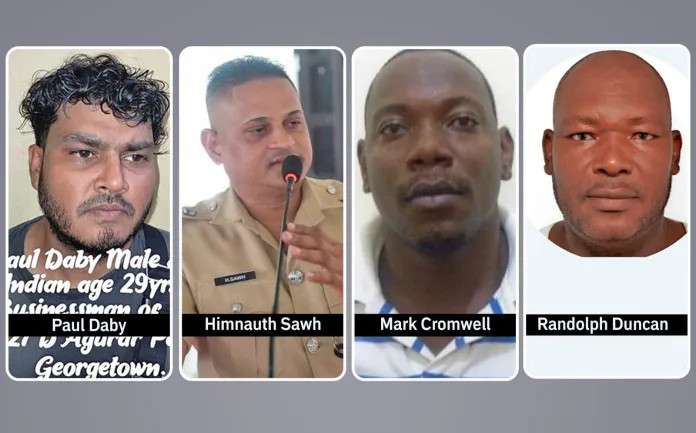
The U.S. Department of the Treasury has sanctioned four Guyanese and two Colombian nationals accused of trafficking tons of cocaine from South America to the United States, Europe, and the Caribbean.

The sanctions, announced Thursday, also target a corrupt Guyanese police officer and individuals allegedly operating secret airstrips and using narco-submarines and maritime vessels to transport drugs across international waters.
According to the Treasury’s Office of Foreign Assets Control (OFAC), Guyanese nationals Paul Daby Jr. and Randolph Duncan run two of the largest drug trafficking organizations in Guyana. Daby Jr. is accused of coordinating massive cocaine shipments from Colombia and Venezuela using aircraft and illegal airstrips, and of hiding drugs in shipping containers leaving ports in Guyana and Suriname. He’s also allegedly involved in smuggling illegal gold. Duncan is said to operate similar routes with cocaine destined for Africa, the Caribbean, Europe, and the United States.

The sanctions also name former police officer Mark Cromwell, wanted by the Guyana Police Force in connection with a 2024 kidnapping. Authorities describe Cromwell as a violent trafficker and close associate of Daby Jr. Another sanctioned figure, law enforcement officer Himnauth Sawh, was removed from his post as Divisional Commander of Region One in 2024 after 4.4 tons of cocaine were found in underground bunkers near the Venezuela border. OFAC says Sawh had been providing safe passage to Colombian and Venezuelan traffickers.
Colombian nationals Yeison Andres Sanchez Vallejo and Manuel Salazar Gutierrez were designated for managing clandestine airstrips used to move cocaine via aircraft from Colombia into Guyana.
“Today’s action is a strong signal that this administration will continue to take the fight to the cartels, regardless of where they are located,” said Treasury Deputy Secretary Michael Faulkender. He emphasized ongoing cooperation with Guyanese authorities and pledged to keep exposing criminal networks fueling drug trafficking into the United States.
The designations were issued under Executive Order 14059, which targets individuals contributing to the global spread of illicit drugs and drug production. The sanctions block all property and interests belonging to the six individuals within U.S. jurisdiction and bar American persons and businesses from transacting with them.
Guyana, with its strategic location and long-standing issues with corruption, remains a key transit point for South American cocaine. OFAC noted that traffickers routinely exploit the country’s rivers, ports, and jungles, and that Mexican cartels, including the Sinaloa Cartel, maintain a known presence in the region.
U.S. and Guyanese law enforcement have made several major drug busts in recent years, including the 2024 seizure of a narco-submarine carrying 2,370 kilograms of cocaine and the discovery of a cargo ship in 2025 off Trinidad and Tobago with more than 180 kilograms of cocaine. Packages on board were stamped with the Toyota logo — a Sinaloa Cartel trademark.

Thursday’s sanctions aim to freeze assets, block support networks, and increase pressure on individuals contributing to the international drug trade. The U.S. Treasury reiterated that the purpose of sanctions is not simply punitive, but to drive behavioral change and dismantle the systems enabling transnational crime.