IMF team visits Barbados for consultations and post-program discussions
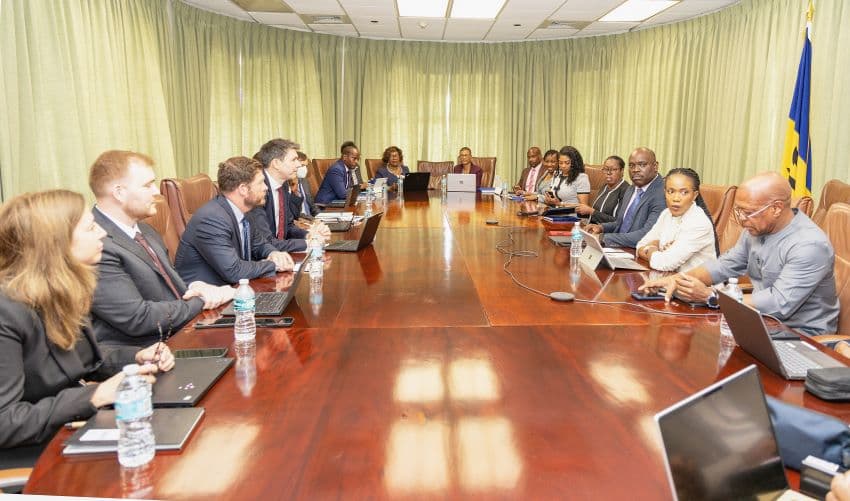
A mission from the International Monetary Fund (IMF) is in Barbados this week for regular Article IV consultations with the Government, as well as discussions on a new post-programme relationship following the country’s exit from its IMF-supported programme last year.
The team, led by IMF Mission Chief Michael Perks, is scheduled to meet with Prime Minister Mia Amor Mottley; Minister of Finance Ryan Straughn; and Minister of Economic Affairs and Planning Marsha Caddle, along with officials from the Ministry of Finance, Economic Affairs and Investment, and the Central Bank of Barbados.
Minister Caddle was part of the delegation that attended a kick-off meeting on Monday morning to outline expectations for continued engagement with the Fund.
Barbados completed its Extended Fund Facility (EFF) and Resilience and Sustainability Facility (RSF) arrangements with the IMF in June 2025, after authorities said implementation of the home-grown Barbados Economic Recovery and Transformation (BERT) plan had remained strong and key objectives had been achieved.
At the time, the IMF noted that “macroeconomic stability has been reinforced, reforms have been implemented to boost fiscal sustainability, enhance growth and build resilience, and Barbados’ economy has continued to perform well.” The Fund also highlighted that growth had been robust, inflation had moderated, fiscal and external positions had improved, and the public debt-to-GDP ratio had continued to decline.
Following Monday’s meeting, Minister Caddle said Barbados’ economic approach continues to emphasise resilience and risk management.
“In Barbados’ journey since 2018, from stabilisation to growth to transformation, the management of risk in a small economy like ours has to be a part of the country’s economic management programme,” she said.
She noted that maintaining access to liquidity in times of crisis remains a priority, pointing to instruments such as the Contingent Credit Facility with the Inter-American Development Bank and natural disaster clauses.
“We have a few tools for that… But climate and environmental disasters are not the only shocks we can experience. We saw that with COVID, and we see that with the multiple and ongoing conflicts that impact our access to commodities. So, our arrangements with international financial institutions matter,” she added.
Caddle also said ongoing reforms under the BERT 3.0 framework remain focused on long-term growth and productivity, including infrastructure investment, reform of state-owned enterprises, closing skills gaps, and strengthening social sectors.
“Continuing to invest in infrastructure at a scale that matches the growth of our economy and the ambitions of our people, right-sizing state-owned enterprises… and making sustainable our investments in health, education and water are some of the BERT 3.0 targets,” she said. “While we continue with this transformation, we have to ensure that no future crisis will jeopardise our gains.”
During the week-long visit, the IMF delegation is also expected to meet with stakeholders from the public, private, and third sectors as part of its assessment of Barbados’ post-program economic framework.