


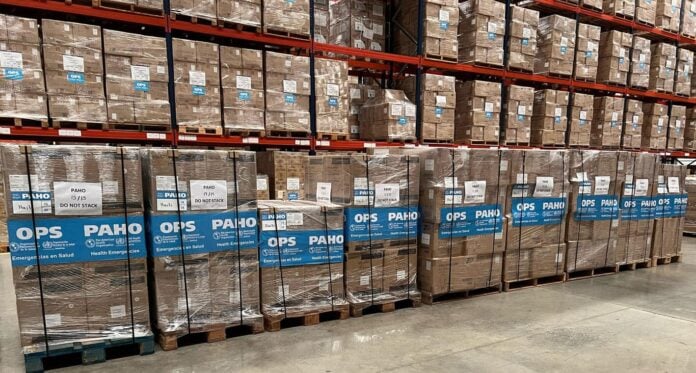
The Pan American Health Organization (PAHO) has delivered a new shipment of nearly three tons of essential medicines and health supplies to Haiti, as part of its ongoing efforts to address the country’s worsening humanitarian crisis.

The shipment, which arrived on Friday, was dispatched from PAHO’s Strategic Reserve in Panama.
Included in the delivery are surgical care kits for trauma patients, syringes, personal protective equipment for healthcare workers, emergency medical backpacks, and other critical supplies intended to meet the urgent medical needs of the Haitian population. The Strategic Reserve also provided support to the Haitian Ministry of Public Health and Population for the cold chain storage of laboratory supplies and disease surveillance kits for COVID-19, Influenza A/B, Dengue, and HIV.

This latest delivery builds on ongoing collaboration between PAHO, Haitian health authorities, and humanitarian partners, which has enabled the Organization to maintain aid operations despite limited access to international ports. Since the beginning of 2024, PAHO has mobilized a total of 254 tons of medical supplies for Haiti.
“Increasing violence, including blockades at ports and airports, has hampered the health sector’s capacity to deliver humanitarian aid to the communities in Haiti that need it the most,” said Dr. Oscar Barreneche, PAHO/WHO Representative in Haiti. “These humanitarian shipments coordinated by PAHO have been a lifeline in supporting the continued delivery of both emergency treatment and routine healthcare services for Haitians,” he added.
The delivery was made possible through coordination with the Haiti Logistics Cluster, the United Nations Humanitarian Response Depot in Panama, and the World Food Programme (WFP).
Haiti has been grappling with escalating armed violence since September 2022, particularly in the Port-au-Prince metropolitan area, where just 42% of health facilities remain fully operational. Another 16% are only partially functioning, while 42% have been forced to shut down completely, significantly limiting access to healthcare for millions.
The deteriorating security situation has also triggered a sharp rise in internal displacement. According to the International Organization for Migration (IOM), more than one million people have fled their homes, primarily in Port-au-Prince. That figure represents a threefold increase from 315,000 in December 2023.
In overcrowded and underserved sites for internally displaced persons (IDPs), the lack of medical resources has compounded the crisis. Poor sanitation and limited access to healthcare in these areas have heightened the risk of disease outbreaks.

PAHO says it will continue to work with Haitian authorities and international partners to ensure medical aid reaches the country’s most vulnerable, and that health workers on the ground are supported in their mission to save lives and improve public health.









 has delivered nearly three tons of essential medicines and health supplies to Haiti.)