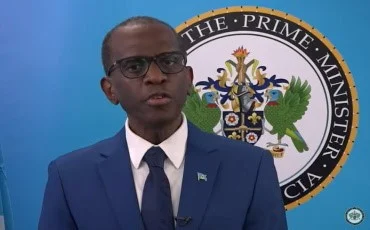
Chairman of the Organisation of Eastern Caribbean States (OECS), St. Lucia Prime Minister Phillip J. Pierre, has called for the urgent implementation of a long-delayed regime to ensure the free circulation of goods across the sub-region, warning that the bloc cannot afford to move forward in “fits and starts.”
Addressing the Seventh Sitting of the OECS Assembly—the first since March 2022—Pierre said regional integration efforts must remain focused and consistent. “We cannot progress in fits and starts. We cannot step off the desired path of the revised treaty to chase after shiny objects that appear along the way,” he told delegates.
“We must steer the course. We must be brutal in our self-assessment, rigorous and prompt when adjustments are needed, and uncompromising in striving to attain the objectives of our treaty,” Pierre added.

The OECS, which includes nine member states, has long promoted the free movement of people, but the corresponding system for goods remains incomplete. “We knew then how critical it was for the OECS to move beyond the existing free movement of goods and people framework to cement the single space,” Pierre said, urging swift progress on establishing a regime to enable goods to move “without fetter” after satisfying regional border formalities.
Without naming specific delays, he acknowledged the slow progress in implementation. “Suffice it to say, the free circulation of goods is a natural calling to the free movement of people and the establishment operation of businesses in a single financial and economic space,” he said. “We must get it done.”
Pierre warned that failure to act now could hurt citizens. “The introduction of tariffs in the OECS economic space will further put more pressure on the quality of life of our people if we do not do something now.”
He emphasized that the OECS Assembly must shoulder this responsibility collectively: “It is significant that we are constituted as national delegations designated by our parliaments to represent national perspectives.”
Five draft bills are under consideration to support the free circulation regime: the OECS Animal Health Bill, Plant Protection Bill, Food Safety Bill, Standards Bill, and Customs Control and Management Bill. Pierre said these bills had already received approval at the cabinet level in member states and would be submitted for national enactment following deliberation.
The OECS leader also outlined upcoming legislative work, including the harmonization of border tax and management structures and the development of laws concerning rights linked to the free movement of people.

He called for the bloc to act with urgency: “We will attach the warranted urgency to this exercise, ensuring that presently, the free circulation of goods regime is able to function and we bridge the existing divide between the full and unhindered movement of people and of goods in the single space.”
The prime minister grounded his remarks in the broader geopolitical climate, urging the region not to let global events dictate its integration efforts. “We are ultimately responsible, as representatives of the people, to chart the destiny of our region,” Pierre said.
He also stressed that the 2011 Revised Treaty of Basseterre, which established the OECS Economic Union, should have already resulted in more tangible outcomes. “No, today we should be fine-tuning our systems that were already in place, becoming even more resilient because our economic union pillars have been standing,” he said.
Pierre closed with a reminder that the goal of integration must be centered on improving lives. “The extent to which all the regional policies, laws, institutions and actions enhance the lives and welfare of our people” is, he said, “the real litmus test of progress in the economic union and the OECS.”
The OECS includes Antigua and Barbuda, Dominica, Grenada, St. Lucia, St. Vincent and the Grenadines, St. Kitts and Nevis, Montserrat, Anguilla, and the British Virgin Islands.