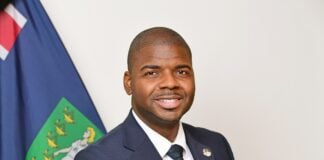
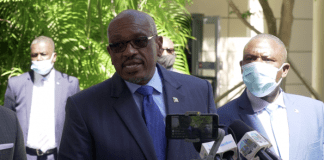
Prime Minister Ariel Henry has confirmed the appointment of the inspector general, Frantz Elbé as the Director-General of the National Police of Haiti (PNH), following the resignation of Léon Charles.

“The Director-General of the National Police of Haiti, Léon Charles has presented me his resignation. He has been replaced by Frantz Elbé,” said Henry, adding “for the moment, there are no other changes in government”.
Elbé said he is committed to dealing with the crime situation in the French-speaking Caribbean Community (CARICOM) country.

” We would like public peace to be restored, that we return to normal life and that we find the way to democracy. Finally, we would like to organize elections. We wish the new acting DG good work and success,” Prime Minister Henry said.
The new PNH director-general takes up office at a time when armed gangs are involved in several criminal activities including kidnapping, with the latest high-profile case being the abduction of 17 American and Canadian missionaries over the last weekend. Their abductors are demanding a ransom of US$17 million.
Elbé is promising to “strengthen security devices throughout the country, especially in the metropolitan area in order to prevent cases of kidnapping, prevent thugs from committing their crimes”.
The Bank of the Republic of Haiti (BRH) in a statement said that it wanted to inform the public that it is not involved in any operation or financial mechanism aimed at paying ransom for hostages.
Meanwhile, the Center for Analysis and Research in Human Rights (CARDH) here said that more than 100 people have been kidnapped in Haiti during the first half of this month.
CARDH, a non-profit organization whose mission is to contribute to the promotion of the values of the Universal Declaration of Human Rights, said most, if not all of the abductions have been carried out by the criminal gang “400 mawozo” which has been terrorizing the Croix-des-Bouquets and Ganthier areas.

The human rights group said that in September there had been 117 kidnappings.
“Citizens do not trust the Haitian national police and this poses a problem because we cannot have an efficient police force if the population does not collaborate,” Gedeon Jean, the CARDH director, told the AFP news agency.
“According to our statistics, there are at least two policemen in every large armed group: some policemen are active in gangs and others provide cover, allowing gangs to operate, or they share information with them.”
CMC