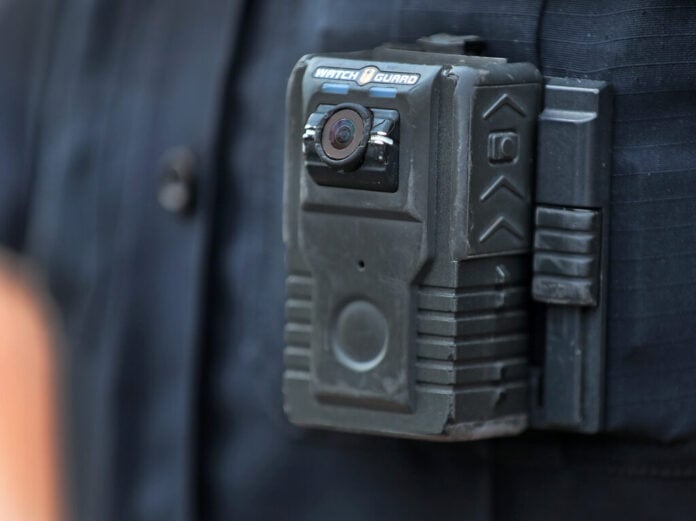
Jamaica’s National Security Minister Horace Chang has pushed back firmly against growing calls for police to wear body cameras during armed operations, arguing that such a move would endanger officers rather than improve accountability.
The issue has become a flashpoint between the Government and civil society groups, particularly Jamaicans For Justice, which has been advocating for increased use of body cameras following a rise in fatal police shootings. But Chang made it clear this week that cameras will not be used in high-risk tactical engagements.
Speaking at Wednesday’s post-Cabinet media briefing at Jamaica House, the minister dismissed the proposal outright.

“This thing that you must wear a camera when you going to look for a man who has a M16 that’s firing 60 rounds per second is a crazy idea,” he said.
“When gunshot start blaze across your head or over your head, you’re going to dive, you’re going to find cover even if you’re a policeman, and look a place where you can find a space to in fact return fire,” Chang added.
He stressed that during planned early morning operations targeting armed suspects, officers will not be equipped with cameras, arguing that doing so would compromise their safety.
“The hunted moves much faster than the hunter,” he said, explaining that suspects are often mobile and difficult to track.
“You can’t send an officer in there with a marked car with lights blaring; they’re gone. So you send a special squad in there, they’re at risk; they will be killed if they’re not careful and they can’t go with cameras. Cameras make them a target,” Chang stated.
While rejecting their use in tactical settings, Chang emphasized that body cameras remain part of the Jamaica Constabulary Force toolkit, with additional units on the way. However, he underscored that decisions about their deployment rest solely with Police Commissioner Kevin Blake.

“It is part of police equipment like anything else, so we buy the cameras and the police issue them,” he said, noting that the commissioner determines “who wears a camera, where and when.”
Chang also rebuked attempts by civil society groups to influence operational decisions, maintaining that while all police activities are planned—including coordinated road checks—external groups cannot dictate how law enforcement deploys its resources.
He noted that cameras are sometimes used during road policing operations and at public events, where they have proven effective in reducing confrontations.
“When last have you seen a video — because they used to go viral — of a policeman and a taximan fighting, or a policeman has to beat up a taximan? They don’t, because when the taximan or any driver sees a policeman with a camera and he stops a car, they behave themselves,” Chang said.
“You don’t get the string of colourful words anymore,” he added.
Cameras not effective during raids, says Chang
Chang argued that there is little evidence to support the effectiveness of body cameras in high-risk operations, pointing to their use in the United States, including departments like the Los Angeles Police Department, where they were introduced largely to document routine public interactions in response to concerns about racial profiling.
He further suggested that mistrust of law enforcement in Jamaica is rooted in a broader historical perception.
“There is a legacy issue in Jamaica… where elements of the public assume that those of us who are elected are corrupt. It assumes that those who have authority are corrupt, so the idea that the police is a corrupt body out there to extort people is a wrong legacy. It’s incorrect and I cannot support anything that seeks to reinforce that and that’s what the call for cameras to be used all the time does,” he said.
Maintaining that criticism is part of democratic engagement, Chang nevertheless called for greater trust in local institutions.
“We’re not objecting to criticism, but it’s time we trust our own people; it’s time we respect our own professionals,” he said.
He acknowledged that the JCF, with a force of roughly 14,000, is not without wrongdoing, but insisted such cases are limited.
As he did during the sectoral debate, Chang urged civil society groups to allow oversight bodies like Indecom to complete their investigations before drawing conclusions or issuing public criticism.