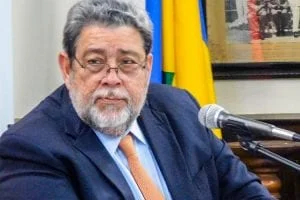
Prime Minister Dr. Ralph Gonsalves has expressed concern that escalating U.S. tariffs could create ripple effects across the Caribbean, potentially turning St. Vincent and the Grenadines into a haven for criminals fleeing economic hardship in neighboring nations.

Speaking in Parliament this week, Gonsalves cautioned that the knock-on effects of Washington’s tariff regime — particularly on Trinidad and Tobago and Guyana — could lead to an uptick in regional crime spilling over into St. Vincent.
“If there’s a real challenge there, we can find the knock-on effect of more people leaving Trinidad, more criminals, that Trinidad and Tobago can become a security problem for St. Vincent and the Grenadines, more than it is at the moment,” said Gonsalves, who also holds the national security portfolio.

His remarks follow U.S. President Donald Trump’s decision to temporarily suspend, for 90 days, most of the tariffs his administration had imposed globally. However, most Caribbean countries still face a 10 percent base tariff, while imports from Guyana face a steep 38 percent duty. Gonsalves argued that these economic shocks could have national security consequences.
Referring to the energy-dependent economy of Trinidad and Tobago, Gonsalves highlighted that the country exported nearly US$2.7 billion in goods to the United States in 2024. He pointed out that any sustained disruption — such as the recent revocation of Trinidad’s OFAC license to work on Venezuela’s Dragon Gas Field — could further destabilize the country’s economy and, by extension, its security.
Gonsalves said these concerns likely weighed on voters in Trinidad and Tobago’s recent general election, where the Kamla Persad Bissessar-led United National Congress (UNC) defeated the incumbent People’s National Movement (PNM).
Drawing from a just-received report by the Caribbean Community’s Implementation Agency for Crime and Security (Caricom IMPACS) titled “Potential Implications of U.S. Protectionist Tariffs,” Gonsalves stressed that the region must prepare not only economically but also from a security standpoint.
“We know that we talk about shooters come up on hire and all the rest of it, and we know the problems with guns and bullets from the U.S. That’s a major problem,” he said.
On Guyana, Gonsalves disputed the headline 38 percent tariff, saying the actual burden may be closer to 11 to 12 percent based on how it’s calculated. Still, he warned that any strain on Guyana’s economy could also have cross-border consequences.

“The problem is not so much for the economy as a whole, the 10 per cent tariff on the exports, but it’s on the imports and the currency and the security questions which would follow,” he said.
In the meantime, Gonsalves urged his country to strengthen food production and maintain vigilance on the national security front: “Now, what we have to do is to do what we’re trying with our fundamentals… and, certainly, on the security front, for us to be even more vigilant.”