Former Trinidad Prime Ministers slam Kamla’s threat to Venezuelan vessels
Key Points(5)
- Persad-Bissessar made the comment during Thursday’s post-Cabinet media briefing, where she also declared her administration’s support for the United States on matters concerning Venezuela.
- Her statements came in response to claims by Venezuelan Justice Minister Diosdado Cabello, who alleged that a Trinidadian national—identified as “Guis Kendell Jerome”—was captured while travelling from Trinidad and Tobago with a group of so-called “terrorists” attempting to destabilise Venezuela.
- Cabello also accused Trinidad and Tobago of becoming a “launchpad” for mercenaries and warned, “There must be justice.
- As has happened on many occasions in the past, our radar system may fail to pick up marine vessels entering and leaving our waters.
- This is nothing new,” he wrote.
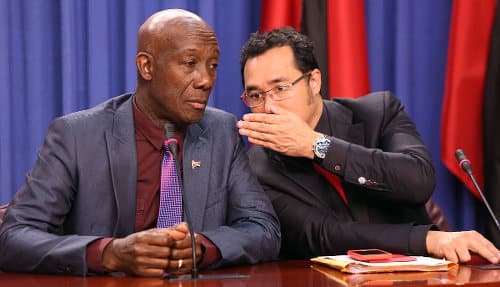
Former Prime Minister Stuart Young is urging current Prime Minister Kamla Persad-Bissessar to reconsider her recent warning that Trinidad and Tobago is "off-limits" to Venezuela and that the Coast Guard has been placed on alert to use deadly force if any Venezuelan vessel enters the country’s waters illegally.
Persad-Bissessar made the comment during Thursday’s post-Cabinet media briefing, where she also declared her administration’s support for the United States on matters concerning Venezuela.
Her statements came in response to claims by Venezuelan Justice Minister Diosdado Cabello, who alleged that a Trinidadian national—identified as “Guis Kendell Jerome”—was captured while travelling from Trinidad and Tobago with a group of so-called “terrorists” attempting to destabilise Venezuela. Cabello also accused Trinidad and Tobago of becoming a “launchpad” for mercenaries and warned, “There must be justice. We are going after the gangs, wherever they are … Together, we will guarantee peace in this country.”
Responding to Persad-Bissessar’s remarks in a Facebook post, Young described the Prime Minister’s position as “the height of irresponsibility and arguably, borderline insanity.”
“Venezuela is seven miles off of the coast of Trinidad and Tobago and is our closest geographical neighbour. As has happened on many occasions in the past, our radar system may fail to pick up marine vessels entering and leaving our waters. This is nothing new,” he wrote.
Young said the Government cannot definitively determine the origin or intent of every vessel, and described the administration’s posture as reckless.
“In fact, it is the same UNC that used to scream in opposition about our porous borders. So to now pretend that you can conclusively determine whether a vessel left Trinidad and Tobago destined for Venezuela with persons onboard is simply not true,” he stated.
He called on the Government to take a more diplomatic approach in dealing with Venezuela.
“I call upon the Government to engage in proper diplomatic communications with Venezuela and to appreciate that as the Government, you have to act responsibly and judiciously. Carrying on with false bravado associated with soap box politics is not only unbecoming but frankly dangerous in the circumstances.”
Young also warned that escalating tensions could have economic consequences, particularly regarding Trinidad and Tobago’s future energy security, which he said relies on stable relations with Venezuela.
“This Government needs to wake up and stop jeopardising our future and our country’s reputation,” he added.
Former prime minister Dr Keith Rowley also weighed in on Facebook, criticizing Persad-Bissessar’s approach and urging a more measured diplomatic strategy.
Former national security minister Gary Griffith echoed the sentiment, cautioning that T&T lacks the military capability to follow through on threats.
“It is commendable that the Prime Minister has taken a firm stance in refusing to let Trinidad and Tobago be bullied. But strength is not just about words. It’s about foresight, capability, and leadership,” Griffith said in a social media post.
He emphasized the importance of diplomacy over “muscle-flexing,” pointing to previous incidents where negotiations successfully resolved disputes with Venezuela’s Guardia Nacional.
“We didn’t respond with threats—we responded with diplomacy, and through sustained dialogue, we established a bilateral agreement which led to those incursions stopping. A win for both countries involved,” he said.
Griffith warned that T&T’s defence systems are currently inadequate for any serious confrontation.
“We have no aircraft, no helicopters, no drones, and even the vessels that we were supposed to have acquired, that being the OPVs—would have been acquired without effective firing systems, making them little more than floating stones in a modern confrontation,” he said.
He concluded that a military approach is not only unrealistic but dangerous. “The idea that we could stand toe-to-toe in the Gulf is not just unrealistic—it is dangerous,” Griffith said, adding that diplomacy must take precedence—not because the country is weak, but because it is the only rational choice.