Former Suriname Minister Albert Ramdin sworn in as OAS Secretary General
Key Points(5)
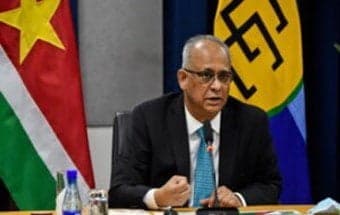
- Suriname’s former Foreign Affairs Minister, Albert Ramdin, was officially sworn in on Friday as the new Secretary General of the Organization of American States (OAS), ushering in what he called the beginning of a “new era” for the hemispheric body.
- In a special session of the OAS Permanent Council, Ramdin—who previously served as Assistant Secretary General—laid out an ambitious vision focused on revitalizing the world’s oldest multilateral organization amid growing global uncertainty, democratic erosion, and deepening social inequality.
- “Let this moment not be remembered as the beginning of a new administration,” Ramdin declared, “but as the beginning of a new era.” Ramdin takes the helm from Uruguay’s Luis Almagro, who served two terms and was known for his vocal advocacy on democracy and human rights.
- Ramdin praised his predecessor’s legacy and also welcomed Colombian diplomat Laura Gil, set to become the OAS’s first female Under-Secretary-General.
- In his inaugural address, Ramdin pledged to pursue four key priorities during his first year: internal institutional strengthening, greater public visibility of the OAS, financial sustainability, and an expanded role in tackling regional crises—chief among them, the worsening situation in Haiti.
Suriname’s former Foreign Affairs Minister, Albert Ramdin, was officially sworn in on Friday as the new Secretary General of the Organization of American States (OAS), ushering in what he called the beginning of a “new era” for the hemispheric body.
In a special session of the OAS Permanent Council, Ramdin—who previously served as Assistant Secretary General—laid out an ambitious vision focused on revitalizing the world’s oldest multilateral organization amid growing global uncertainty, democratic erosion, and deepening social inequality.
“Let this moment not be remembered as the beginning of a new administration,” Ramdin declared, “but as the beginning of a new era.”
Ramdin takes the helm from Uruguay’s Luis Almagro, who served two terms and was known for his vocal advocacy on democracy and human rights. Ramdin praised his predecessor’s legacy and also welcomed Colombian diplomat Laura Gil, set to become the OAS’s first female Under-Secretary-General.
In his inaugural address, Ramdin pledged to pursue four key priorities during his first year: internal institutional strengthening, greater public visibility of the OAS, financial sustainability, and an expanded role in tackling regional crises—chief among them, the worsening situation in Haiti.
Ramdin’s reform plan includes overhauling the OAS’s internal operations, introducing monthly cabinet meetings, improved staff communication, and a renewed focus on employee well-being and professional development. A change management unit will be established within his office to support these efforts.
“The OAS must become more effective, agile and cost-conscious,” he said, adding that revitalizing the institution is key to maintaining its relevance and impact in a fast-changing world.
Another major pillar of Ramdin’s strategy is to bring the OAS closer to the citizens of the Americas. He vowed to modernize the organization’s communications through storytelling, public campaigns, and partnerships with civil society, media, and academic institutions.
“From the modern cities of North America to the cultural richness of the Caribbean, it is our diversity that forms the foundation of mutual understanding,” Ramdin said. “The OAS is not just a bureaucracy, it is the beating heart of cooperation, peace and regional unity.”
Financial sustainability was also high on Ramdin’s agenda. He plans to build stronger alliances with development banks, private sector entities, NGOs, and observer nations. “More impactful programs require broader partnerships,” he said.
Ramdin identified Haiti as the hemisphere’s most urgent challenge, saying the OAS will support efforts to restore security, reform political institutions, and prepare for 2026 elections. He announced the relaunch of the “Group of Friends of Haiti” to help coordinate international assistance and emphasized the need for a referendum on a new constitution.
He also reiterated the OAS’s continued commitment to its core mission of promoting democracy, human rights, security, and development.
Highlighting his extensive experience in election observation, Ramdin stressed that digital resilience is essential in safeguarding democratic processes from disinformation and cyber threats. He sees the OAS playing a central role in supporting countries as they navigate artificial intelligence and digital modernization.
Ramdin also addressed regional concerns, including migration, organized crime, drug violence, and climate change—urging for evidence-based solutions and stronger regional cooperation. He backed ongoing efforts like the Bridgetown Initiative and called for serious engagement on the Multi Vulnerability Index to ensure small and climate-vulnerable states receive adequate support.
Finally, he emphasized the need for greater intra-regional trade, logistics connectivity, and economic self-reliance in the face of global disruptions.
“The strength of the Americas lies in its people, its history, and its potential,” Ramdin said. “Only through cooperation and shared responsibility can we build resilience for the future.”
Ramdin’s five-year term officially begins with broad expectations for transformative leadership and renewed purpose within the OAS.