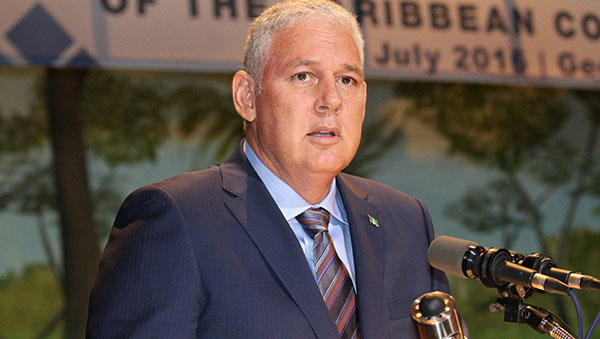
St. Lucia’s Opposition Leader Allen Chastanet has raised serious concerns about the effectiveness of the relationship between the Organisation of Eastern Caribbean States (OECS) and the wider Caribbean Community (CARICOM), suggesting that OECS leaders consider whether they would be better off negotiating bilateral deals outside of the CARICOM framework.

Speaking Tuesday during the Seventh Meeting of the OECS Assembly in St. Vincent, Chastanet argued that the OECS Assembly has become “too ceremonial” and urged the sub-regional bloc to take bolder steps in defining its own path—especially in the face of external pressures, such as recent scrutiny of Citizenship by Investment (CBI) programmes.
“We are members of CARICOM in which [trade integration] is not working, and all the leaders sitting around this table all know that our relationship with CARICOM is not working,” Chastanet said.

“So imagine if we had the tenacity to pull out of CARICOM and renegotiate bilateral agreements with Jamaica, bilaterals with Trinidad, bilaterals with Guyana and bilaterals with Barbados. Would we be better off?” he posed to fellow legislators.
Chastanet, who served as St. Lucia’s prime minister from 2016 to 2021, clarified that he was not advocating for a withdrawal from CARICOM. However, he emphasized that OECS countries must seriously evaluate whether remaining in the regional grouping serves their best interests.
“Certainly when I was prime minister, I felt that we were being ignored. I felt we were being disrespected,” he said. “So many times we went to a meeting at CARICOM and listened to the larger countries debate among themselves as if we were not even there, and reached no conclusion.”
The OECS comprises ten members: Antigua and Barbuda, Dominica, Grenada, St. Lucia, St. Vincent and the Grenadines, St. Kitts-Nevis, Montserrat, Anguilla, and the British Virgin Islands. The bloc maintains an economic and currency union, with provisions for the free movement of its citizens. It is nested within CARICOM, which also includes larger economies like Jamaica, Trinidad and Tobago, Guyana, and Barbados.
Chastanet pointed out that discussions at the Assembly about regional trade bills, including harmonized tariff structures and internal tax regimes, may be unrealistic given the varying stages of economic development among member states.
“I look at the bill, I ask myself, ‘Is it reasonable?’ Are we all going to sit here and try to suggest that we are going to have a common policy on the value of tariffs? Really? We all are [at] different stages of development,” he said.

He also questioned the readiness of the region to adopt unified policies on sensitive economic measures. “And worse yet, when we hear, in my mind, we were talking about common internal tariffs, common VAT rate? Are we ready for that?”
Chastanet concluded by highlighting the importance of balancing deeper integration with national sovereignty. “The Revised Treaty of Basseterre speaks about deeper integration,” he said, “but it also maintains our own independence, and that recognises that we are [at] different stages of development.”