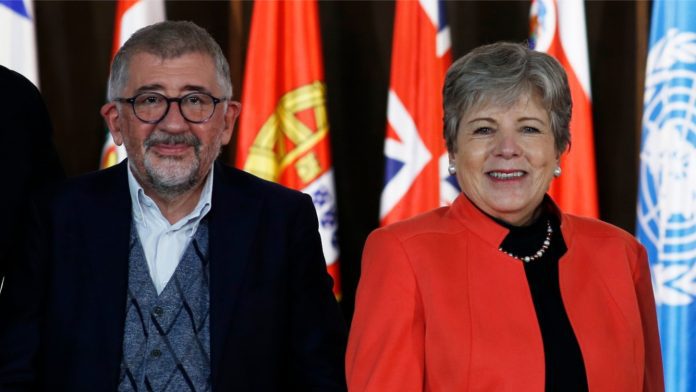
United Nations Secretary-General António Guterres has appointed Argentine economist Mario Cimoli, the Deputy Executive Secretary of the Economic Commission for Latin America and the Caribbean (ECLAC), to serve as the institution’s acting executive secretary.

According to ECLAC, Cimoli replaces Mexican diplomat Alicia Bárcena, who concluded her mandate on Thursday after nearly 14 years at the helm of the UN regional commission.
ECLAC said Cimoli, who earned his PhD from the University of Sussex in the United Kingdom and is a full professor of political economy at the Ca’ Foscari University of Venice in Italy – has more than 20 years of work experience in the United Nations and ECLAC.

Within the regional commission, he has served as economic affairs officer of the Division of Production, Productivity and Management (1999-2009); head of that same division’s Innovation and Information Communications Technology (ICT) Unit (2009-2010); director of the Division of Production, Productivity and Management (2010-2018); and officer-in-charge of the Division of International Trade and Integration (2015-2020).
ECLAC said Cimoli has “a long trajectory” as visiting professor and researcher at various institutions, including the University of Udine, the Metropolitan Autonomous University of Mexico (UAM), the University of Pisa, the University of Pavía and the National University of General Sarmiento.
“His extensive publication record reflects a substantial contribution to the fields of micro- and macroeconomic policies, with a focus on development paths, economic growth and the interconnections between industrial policy, technological development and innovation,” ECLAC said.
It said Cimoli’s most recent publications include Industrial Policies, Patterns of Learning and Development: An Evolutionary Perspective (2020); Choosing sides in the trilemma: international financial cycles and structural change in developing economies (2020); and A technology gap interpretation of growth paths in Asia and Latin America (2019).
He was also co-director of the Industrial Policy Task Force of Intellectual Property Rights Regimes for Development Task Force, along with Giovanni Dosi and Joseph E. Stiglitz, of Columbia University (2004-present).
ECLAC said Bárcena’s nearly 14 years of stewardship was characterized by “the hallmark of equality and its key impact on countries’ development processes and human progress.”

“Today, I conclude this fruitful cycle as the highest authority of ECLAC,” said Bárcena during a ceremony held in her honor, which took place as a hybrid event from the regional commission’s central headquarters in Santiago, Chile. “This has been the brightest phase of my professional career.
Bárcena was appointed ECLAC chief on July 1, 2008, by then United Nations Secretary-General Ban Ki-moon, becoming the first woman to hold the post.
Among the many initiatives that make up Bárcena’s legacy, ECLAC said a few in particular stand out – the Comprehensive Development Plan for El Salvador, Guatemala, Honduras and south-southeast Mexico, “as a bid to address the structural causes of migration”; the Plan for Self-Sufficiency in Health Matters in Latin America and the Caribbean, “which seeks to strengthen the capacities for research, development, production, and access to vaccines and medicines throughout the region, with emphasis on actions to promote regional integration”; and the Caribbean First initiative, “a strategy that aims to reappraise and strengthen the Caribbean’s place as a fundamental part of our region and to expand opportunities for integration and cooperation.”
CMC/