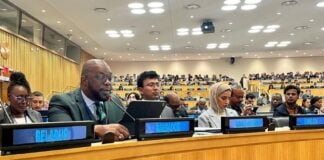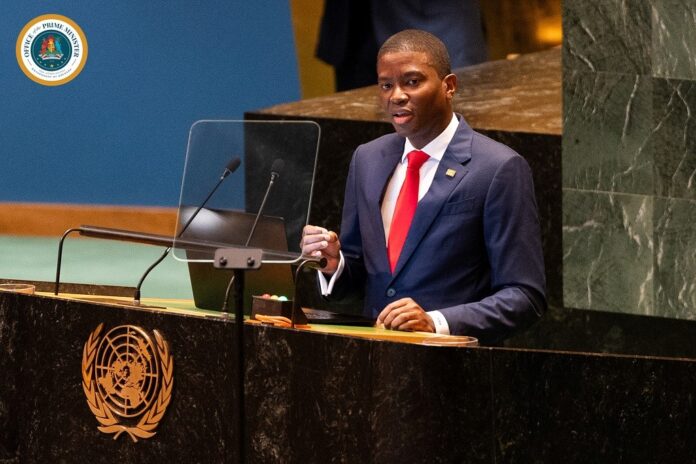
Grenada’s Prime Minister Dickon Mitchell, positioned small island nations as leaders in climate resilience and calling for stronger international partnerships to combat global challenges during his address to the 79th Session of the United Nations General Assembly.

As both the leader of Grenada and Chair of the Caribbean Community (CARICOM), Mitchell stressed the urgent need for action on climate change, a crisis that nations like Grenada are facing directly.
“We in the Caribbean have a simple message for those looking to adapt to climate change: Learn from us,” Mitchell urged, inviting the international community to collaborate with Caribbean nations and draw from their experiences on the front lines of climate change.

The Prime Minister also highlighted innovative disaster preparedness and recovery strategies developed by Grenada and other Caribbean countries, including financial tools such as the Caribbean Catastrophe Risk Insurance Facility. These initiatives, born from necessity, provide valuable insights for global climate adaptation efforts.
Mitchell’s speech emphasized the importance of resilience, which he described as “not merely a buzzword – it is the definition of daily life” for the 16 million people in the Caribbean Community. Drawing from his personal journey from a small village in Grenada to the UN podium, he illustrated how resilience has shaped both his own path and that of the entire region.
A central theme in Mitchell’s vision for building resilience was education. He highlighted Grenada’s commitment to providing free education up to age 18 and underscored the importance of digital education in preparing youth for the global economy. “Digital education — and digitization more broadly — is a priority for our government because we know that if we want to build future resilience in the next generation, we need to equip them with the relevant training now,” he explained.
The Prime Minister also tackled pressing regional issues, calling for Cuba’s removal from the U.S. list of State Sponsors of Terrorism and an end to the long-standing economic blockade. Regarding Haiti, Mitchell stressed the necessity of international support to address the country’s acute food insecurity and security challenges.
In a compelling call to action, Prime Minister Mitchell urged developed nations to fulfill their pledge of $100 billion for climate adaptation and mitigation support. He emphasized that this partnership requires tangible financial commitment to help rebuild with greater resilience. “We are seeking more than just financial aid; we want partnerships that enable us to work together on climate adaptation,” Mitchell asserted.
He wrapped up his address with a vision of resilience that transcends mere survival. “Resilience is not only about weathering a storm—it’s about emerging from it stronger, more united, and with a deeper understanding of one another than ever before,” he said.