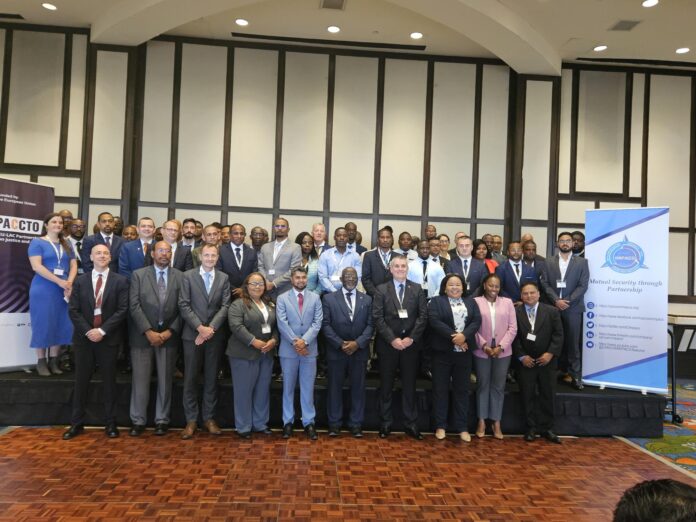
Illicit firearms trafficking remains one of the most urgent transnational threats facing the Caribbean, contributing directly to surging violence and undermining public safety. That’s the message coming out of the opening ceremony of a five-day regional training workshop on firearms trafficking, hosted in Port-of-Spain, Trinidad and Tobago.

The initiative is a joint effort by the Caribbean Community (CARICOM) Implementation Agency for Crime and Security (IMPACS), the European Union’s EL PACCTO 2.0 programme, and France’s ALCORCA (Technical Cooperation Support Program for the Fight against Organized Crime in the Caribbean Region).
“These instruments of violence fuel gang warfare, drive up homicide rates and undermine the peace and stability essential for our sustainable development,” said Lt. Col. Michael Jones, Executive Director of CARICOM IMPACS. He noted that the training reflects growing regional cooperation to combat illegal weapons and is a direct outcome of collaboration among CARICOM IMPACS, EL PACCTO 2.0, and ALCORCA.

Jones highlighted the role of the CARICOM Crime Gun Intelligence Unit (CGIU) as the intelligence hub for crime gun data and urged CARICOM Member States to observe intelligence-sharing protocols to ensure the effectiveness of the region’s security response.
For Michel Segura, Deputy Director of EL PACCTO 2.0, the workshop marks a milestone as the first tripartite collaboration between the three agencies to tackle transnational organized crime. “This training represents more than a technical event. It is a common vision for a safer, more prepared, more connected regional space to fight against firearms trafficking,” he said. He emphasized the importance of coordinated responses, best practice sharing, and international cooperation.
Fabrice Coussot, International Technical Expert on Organised Crime and Narco Trafficking with ALCORCA, noted that this was the 50th training session since the programme’s inception nine years ago. “More than ever, we are convinced that training, sharing intelligence and expertise are the only way to tackle the threats we face. This is particularly true in the case of arms trafficking,” he stressed.
Delivering the feature address, Videsh Maharaj, Permanent Secretary at Trinidad and Tobago’s Ministry of National Security, said the Caribbean experiences violent death rates nearly three times the global average, with over 50% of homicides involving firearms. He cited data showing that between 2009 and 2018, more than 22,000 illegal firearms and 300,000 rounds of ammunition were seized across CARICOM. He also pointed to U.S. ATF data showing that from 2018 to 2022, 73% of the 7,399 firearms traced in the Caribbean were sourced from the United States.
“Understanding these dynamics, Trinidad and Tobago remains committed to forming stronger alliances,” Maharaj said, referencing partnerships through CARICOM IMPACS, the Caribbean Firearms Roadmap, and technical assistance from UNLIREC, backed by Canada, the UK, Germany, and the EU.
He encouraged workshop participants to share their experiences and build lasting relationships. “Coordination built on relationships is what turns policy into action,” Maharaj said.