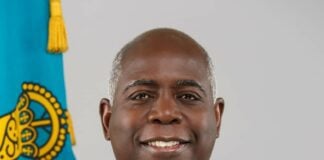
Prime Minister Philip Davis has issued a stark warning against “digital colonization,” urging Caribbean nations to take bold, collective action to secure their digital future and prevent becoming “tenants in a house we do not own.”

Speaking at the opening ceremony of the 40th Annual CANTO Conference in Nassau on Saturday, Davis called on regional leaders to confront the growing imbalance in the global digital landscape and invest seriously in digital infrastructure, cybersecurity, education, and homegrown innovation.
“We use foreign platforms to communicate with our citizens. We store national data on servers located outside our legal jurisdiction. We adopt financial technologies we cannot regulate, and rely on infrastructure we do not control,” Davis said.
“We call it progress. But in truth, it comes at a cost: the slow erosion of our authority, our self-determination, our agency.”

The Prime Minister described the current moment as one of urgent reckoning, where artificial intelligence, blockchain, and quantum computing are already reshaping the world, while many Caribbean nations still struggle to ensure basic internet access and digital literacy.
“If we do not secure our digital future, someone else will define it for us,” he said.
Highlighting The Bahamas’ own strides, Davis pointed to the launch of the Sand Dollar—the world’s first central bank digital currency—and the Digital Assets and Registered Exchanges (DARE) Act, which positioned the country as a global regulatory leader in the space.
“We proved that we can lead on our own terms, for our own people,” he said, emphasizing that digital sovereignty “is not a matter of pride. It is a matter of protection.”
Davis called on Caribbean countries to build interoperable, secure digital systems; invest in teachers and coders; and create opportunities for youth to not only use technology but to lead in creating it.
“Talent without opportunity is a tragedy,” he said. “Our young people are not simply users of technology. They are inventors, designers, and problem-solvers.”

In a symbolic gesture of regional leadership, Davis also endorsed Bahamian technocrat Stephen Bereaux as the Caribbean’s candidate for Deputy Secretary-General of the International Telecommunication Union (ITU).
“Backing Stephen is not merely about representation. It is about responsibility,” he said. “Because when we place Caribbean leadership in global institutions, we are not just elevating an individual — we are advancing the values, needs, and ambitions of 44 million people across our region.”
Celebrating CANTO’s 40th anniversary, Davis praised the organization’s role in building regional telecommunications capacity and urged its members to take on an even greater leadership role in shaping the Caribbean’s digital future.
“Let this be the moment we say: the Caribbean will not drift into the digital world. We will drive it,” he said.