Antigua and Barbuda to ratify San Jose Treaty as CARICOM pushes maritime security
Key Points(5)
- Antigua and Barbuda is taking formal steps to join the San Jose Treaty, a major regional agreement aimed at enhancing cooperation in maritime and air drug interdiction.
- The move was announced during the opening of a two-day workshop hosted at the American University of Antigua, in partnership with CARICOM IMPACS.
- Until 2021, only Belize had both signed and implemented the treaty.
- While Haiti and Jamaica have signed, they are yet to ratify it.
- Trinidad and Tobago has recently approved the agreement, and St.
Antigua and Barbuda is taking formal steps to join the San Jose Treaty, a major regional agreement aimed at enhancing cooperation in maritime and air drug interdiction.
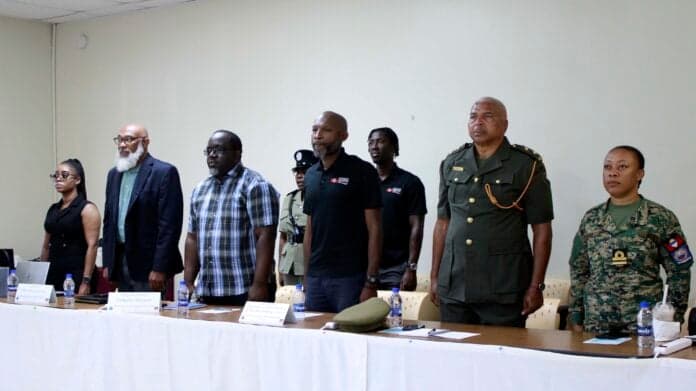
The move was announced during the opening of a two-day workshop hosted at the American University of Antigua, in partnership with CARICOM IMPACS.
Attorney General Sir Steadroy Benjamin declared, “At the next sitting of Parliament, the Treaty of San Jose will be ratified, and you can tell your colleagues in CARICOM IMPACS that at the sitting thereafter, the law will be drafted to make it applicable to Antigua and Barbuda.”
The San Jose Treaty — officially titled The Agreement Concerning Co-Operation in Suppressing Illicit Maritime and Air Trafficking in Narcotic Drugs and Psychotropic Substances in the Caribbean Area — was concluded in 2003 but has seen slow uptake among Caribbean nations. Until 2021, only Belize had both signed and implemented the treaty. While Haiti and Jamaica have signed, they are yet to ratify it. Trinidad and Tobago has recently approved the agreement, and St. Kitts and Nevis is reportedly in the final stages of accession.
Callixtus Joseph, Assistant Director of Policy, Strategy and Innovation at CARICOM IMPACS, emphasized the treaty’s relevance during the workshop. “This framework will help law enforcement better understand how to conduct maritime drug interdiction operations across jurisdictions,” he said, noting Antigua and Barbuda’s commitment to ratification within two months.
The treaty allows participating states to conduct cross-border law enforcement activities at sea, including the right to pursue vessels into territorial waters, automatically board stateless vessels, and request expedited nationality verification. It also establishes a legal basis for intelligence sharing, joint operations, and streamlined prosecution processes — while preserving flag state jurisdiction.
Joseph addressed longstanding sovereignty concerns that have hindered broader adoption. “One of the key issues countries have with anything is about issues of sovereignty. What we are doing at CARICOM IMPACS is clarifying that issue of sovereignty, showing that it is not taking away your sovereignty from you,” he told Observer media.
Brigadier General Telbert Benjamin, Chief of Defence Staff of the Antigua and Barbuda Defence Force, underscored the treaty’s value for smaller nations. “In an environment that is resource-weak, treaties such as this play a tremendous role in ensuring that we can maximize on our limited resources,” he said. “It plays a tremendous role to ensure that we can engage, not only with our sub-regional partners but our wider regional and international partners.”
The workshop also highlighted the evolving security challenges facing the region, including the increasing use of containerized shipping to traffic narcotics. Joseph noted that several major European drug seizures have been linked back to the Caribbean, where items produced locally have been used to conceal illicit cargo.


.png&w=3840&q=75)