The Birth of Reggae Legend Bob Marley
Key Points(5)
- Bob Marley’s lifetime of creativity originated in Jamaica and became the foundation of inspiration that spread messages of hope, justice, and understanding around the world.
- The rebel with a spliff.
- That guy who told us every little thing is gonna be alright.
- The fella who prompted people around the world over to grow dreads, including Dutch football legend Ruud Gullit, and who was handy with the ball himself.
- An icon for the so-called third world.
Bob Marley’s lifetime of creativity originated in Jamaica and became the foundation of inspiration that spread messages of hope, justice, and understanding around the world.
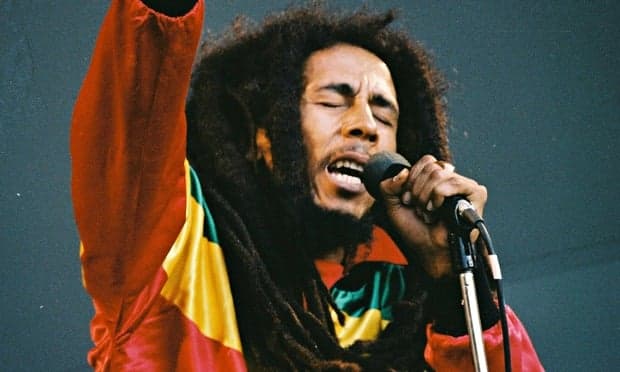
The rebel with a spliff. That guy who told us every little thing is gonna be alright. The fella who prompted people around the world over to grow dreads, including Dutch football legend Ruud Gullit, and who was handy with the ball himself. An icon for the so-called third world. The first Caribbean rock star. A legend. Which one was Bob Marley? All of them. And more.
Born Robert Nesta Marley February 6, 1945, to Cedella Marley when she was 18, Bob’s early life was spent in the rural community of Nine Miles, nestled in the mountainous terrain of the parish of St. Ann.
While barely into his teens, Bob left St. Ann and went to Jamaica’s capital, Kingston. He eventually settled in the western Kingston vicinity of Trench Town, a low-income community of squatter-settlements and government yards, tenements that housed a minimum of four families. He quickly learned to defend himself against Trench Town’s rude boys and bad men. Bob’s formidable street-fighting skills earned him the respectful nickname Tuff Gong.
Bob Marley lived the fast-paced life in Kingston. He was heavily influenced by the music of Fats Domino and Ray Charles which were popular in Jamaica at the time. With an emerging Jamaican music scene and a string of collaborations, Bob started his music career at the impressionable age of sixteen. Like many Jamaican kids, he saw music as an escape from the harsh reality of the ghetto he lived in. He recorded his first single Judge Not in 1961.
Despite the poverty, despair and various unsavory activities that sustained some ghetto dwellers, Trench Town was also a culturally rich community where Bob's abundant musical talents were nurtured. A lifelong source of inspiration, Bob immortalized Trench Town in his songs No Woman No Cry (1974) Trench Town Rock (1975) and Trench Town, the latter released posthumously in 1983.
In 1963, Bob and his childhood friend Neville Livingston a.k.a. Bunny Wailer began attending vocal classes held by Trench Town resident Joe Higgs, a successful singer who mentored many young singers in the principles of rhythm, harmony, and melody. In his Trench Town yard, Higgs introduced Bob and Bunny to Peter (Macintosh) Tosh, and the Bob Marley & The Wailers legend was born.
The Wailers’ first single Simmer Down, with Bob cautioning the ghetto youths to control their tempers or “the battle would be hotter,” reportedly sold over 80,000 copies. The Wailers went on to record several hits including Rude Boy, I’m Still Waiting and an early version of One Love, the song the BBC would designate as the “Song of the Century” 45 years later.
Marley married Rita Marley in February 1966, and it was she who introduced him to Rastafarianism. By 1969 Bob, Tosh and Livingston had fully embraced Rastafarianism, which greatly influence Marley's music in particular and reggae music in general. The Wailers collaborated with Lee “Scratch” Perry, resulting in some of the Wailers' finest tracks like Soul Rebel, Duppy Conqueror, 400 Years and Small Axe. This collaboration ended bitterly when the Wailers found that Perry, thinking the records were his, sold them in England without their consent. However, this brought the Wailers' music to the attention of Chris Blackwell, the owner of Island Records.
Blackwell immediately signed the Wailers and produced their first album, Catch a Fire. This was followed by Burnin, featuring tracks such as Get Up Stand Up and I Shot the Sheriff. In 1974 Tosh and Livingston left the Wailers to start solo careers. Marley later formed the band "Bob Marley and the Wailers", with his wife Rita as one of three backup singers called the I-Trees. This period saw the release of some groundbreaking albums, such as Natty Dread and Rastaman Vibration.
In 1976, during a period of spiraling political violence in Jamaica, an attempt was made on Marley's life. Marley left for England, where he lived in self-exile for two years. In England Exodus was produced, and it remained on the British charts for 56 straight weeks. This was followed by another successful album, Kaya. These successes introduced reggae music to the western world for the first time and established the beginning of Marley's international status.
In 1977 Marley consulted with a doctor when a wound on his big toe would not heal. More tests revealed malignant melanoma. He refused to have his toe amputated as his doctors recommended, claiming it contradicted his Rastafarian beliefs. Others, however, claim that the main reason behind his refusal was the possible negative impact on his dancing skills. The cancer was kept secret from the general public while Bob continued working.
Returning to Jamaica in 1978, he continued work and released Survival in 1979 which was followed by a successful European tour. In 1980 he was the only foreign artiste to participate in the independence ceremony of Zimbabwe. It was a time of great success for Marley, and he started an American tour to reach blacks in the US. He played two shows at Madison Square Garden but collapsed while jogging in NYC's Central Park on September 21, 1980. The cancer diagnosed earlier had spread to his brain, lungs, and stomach. Bob Marley died on May 11, 1981. He was 36 years old.
Marley’s music continues to be extremely beloved all over the world. In his lifetime, he has been awarded Rolling Stone’s Band of the Year and posthumously he was awarded the Grammy Lifetime Achievement in music and was placed at No.11 on the Rolling Stone’s 100 Greatest Artistes of All Time.
Even after his passing, Bob Marley’s name still remains synonymous with reggae which is a testament to the brilliance of his music and impact on the music world. Other singers have covered his songs, but they can’t reach the heights he did as one of the best reggae singers in history. He had it all.