

A Hit Mek: New book traces the full journey of Jamaica’s musical DNA
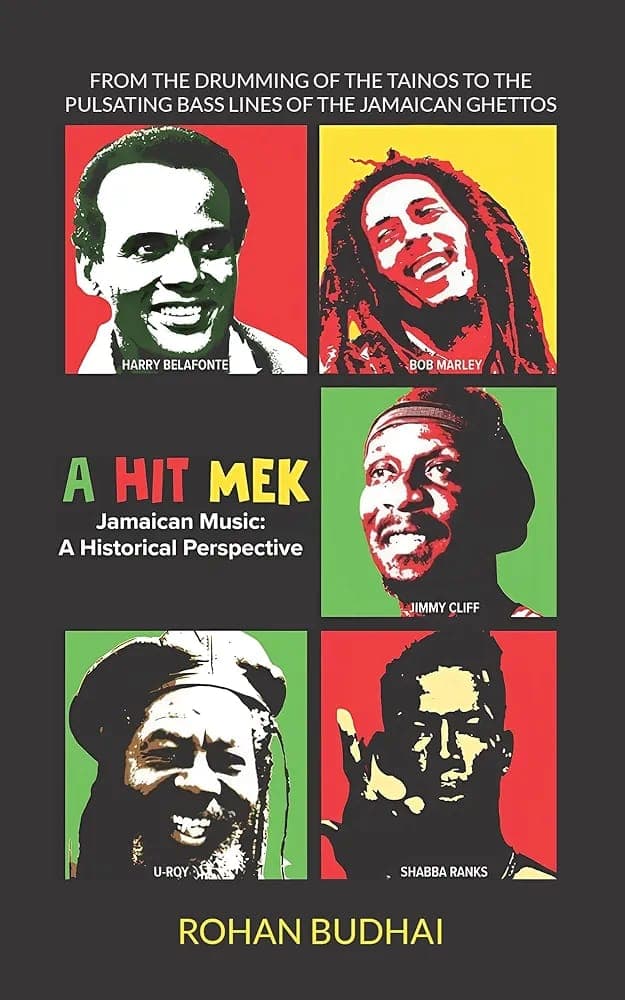
Key Points(5)
- Readers are taken along a sweeping timeline that begins in the late 1490s, with seafaring explorer Christopher Columbus in 1492 encountering — rather than discovering — indigenous Taino tribespeople intermixed with Africans in the region.
- It examines the tragedy of the slave trade and its effect on Africans in the New World.
- The book probes the music of the Tainos, Maroons, enslaved Africans, and indentured peoples, while tracing defining artforms including Kumina, Folk, Mento, Calypso, Festival music, Ska, Rocksteady, Reggae, and Dancehall.
- However, its origin remains disputed by cultural icons and intellectuals such as the late Rex Nettleford and Rosario Budhai, a former member of the Cuban National Choir, who argued that Mento is a Cuban genre.
- <em data-start="3679" data-end="3690">A Hit Mek</em> highlights how music has played the very notes of Jamaican life and lifestyle.</p> <p data-start="3771" data-end="4106">Reggae, arguably, has done so like no other artform — a rhythm of resistance, resilience, and identity.
The doors to everything culturally embedded in how music defines Jamaica’s identity have been flung wide open by author Rohan Budhai in his 560-page journal on Jamaican music, A Hit Mek.
If you thought the chapters on Jamaica’s epic and engaging musical history had already been closed, this book invites you to think again. It offers a sweeping narrative that reopens conversations and fills gaps in the country’s musical story.
A pun and play on the popular local phrase “A It Mek” — also the title of a hit song by Jamaican singer Desmond Dekker — the publication presents a provocative account of what the term in Jamaica’s vernacular truly represents, offering rationale for key developments and cultural shifts. As it unfolds, A Hit Mek is arguably the story of what has long remained untold.
In his stirring foreword, Clyde McKenzie, music consultant and author who has written extensively on Jamaican music, notes that Budhai “provides functional interpretations of critical historical events, showing the connections between the various Jamaican music genres and how history shaped them and played an essential role in their course.”
More than historical documentation, the book is a vivid dramatization of the evolving ways of life of a people whose music reflects trials, triumphs, rhythm, and rhapsody. Readers are taken along a sweeping timeline that begins in the late 1490s, with seafaring explorer Christopher Columbus in 1492 encountering — rather than discovering — indigenous Taino tribespeople intermixed with Africans in the region. Importantly, they already possessed their own musical styles, including drumming, call-and-response singing, and various instruments, many influenced by African traditions.
A Hit Mek explores the Anglo-Spanish influence of Jamaica’s enslavers and its impact on the island’s musical journey. It examines the tragedy of the slave trade and its effect on Africans in the New World. The book probes the music of the Tainos, Maroons, enslaved Africans, and indentured peoples, while tracing defining artforms including Kumina, Folk, Mento, Calypso, Festival music, Ska, Rocksteady, Reggae, and Dancehall. It also examines the global impact of Jamaican sound systems.
The publication further salutes the thousands of contributors to Jamaica’s many musical styles, highlighting the roles of Afro-Jamaicans, Lebanese/Syrian-Jamaicans, Chinese-Jamaicans, and Indian-Jamaicans, as well as Jamaican bands, radio stations, and entertainment organizations that helped advance the music.
The book notes that Mento was the first recognizable local music form and the first to be electronically recorded in Jamaica. However, its origin remains disputed by cultural icons and intellectuals such as the late Rex Nettleford and Rosario Budhai, a former member of the Cuban National Choir, who argued that Mento is a Cuban genre. The word “mento” itself is Latin-derived, from mentar, meaning “to call out” or “to mention.”
Jamaica’s music, at every critical stage, has been about calling out — telling stories that must be mentioned throughout the passage of time. A Hit Mek highlights how music has played the very notes of Jamaican life and lifestyle.
Reggae, arguably, has done so like no other artform — a rhythm of resistance, resilience, and identity. The book notes that Reggae has been influenced by Jamaica’s West African legacy, R&B, Jazz, Soul, indentured peoples, and European music, linking Jamaican music to Afro-Anglo, Afro-American, Afro-Cuban, and Afro-Caribbean heritage.
Reggae went on to influence local subgenres such as Lovers Rock, Dub, Dub Poetry, Reggae Jazz, Reggae Gospel, and Reggae Fusion. Its offbeat rhythms also made it easy to blend with and influence global genres including Pop, Rock, Punk, Disco, Hip-Hop, Electronic, House, Techno, Trap, Reggaeton, Ambient, Dubstep, Trip-Hop, Jungle, Garage, Ragga Soca, India’s Bhangra Muffin, and Africa’s Afrobeats — with reggae uniquely defining Jamaica to the world.

Budhai, who became involved in music production as a teenager before establishing his own record label, Howlers International Music, said his research revealed that much of the historical perspective of Jamaican music had been omitted from previous books.
He raised questions about the music of the Roman Catholic Church introduced by Columbus, Anglo-English music traditions, indigenous Taino music, and pre-Columbian African influences. He also explored the music of the Moors who later transitioned into Maroons, West African enslaved peoples, and indentured Africans who came to Jamaica after Emancipation.
As a result, Budhai said he realized that many aspects of Jamaica’s musical heritage had not been fully examined, expanding the scope of his research.
Author of A Feisty Bull and the upcoming The Art of Life in Jamaica, a collection of 25 short stories, Budhai revealed that he began writing A Hit Mek during the early years of the COVID-19 pandemic in 2021 and completed it in mid-2025.
The publication, available on Amazon, also offers Spanish, French, and Portuguese editions. Budhai considers the book the most comprehensive historical perspective on Jamaican music to date, though he believes there is still much more to explore.
Music, as he sees it, creates the “notes” that become the keys to Jamaican life.
“A-it-mek,” he suggests — and the story continues.



.jpg&w=1920&q=75)
