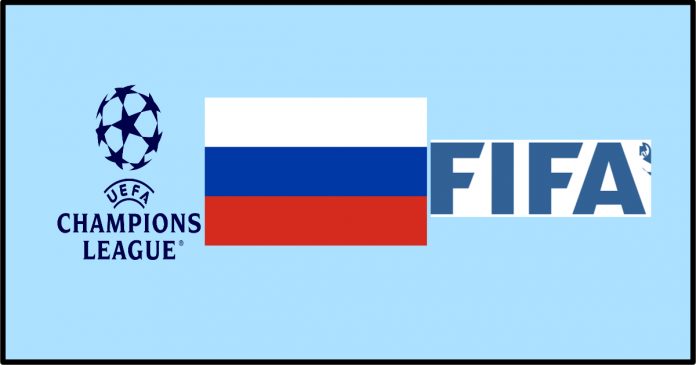
On February 28, 2022, FIFA and UEFA announced that they had suspended Russian clubs and national teams from all competitions until further notice.
The joint statement also noted that the associations would make a further decision later regarding the impact on the women’s Euro 2022 tournament in England in July, for which Russia has already qualified.
This sanction follows the Russian Government’s decision to invade Ukraine during the last week of February.

But FIFA has traditionally been silent and inactive on ethical failings and political matters. Indeed, it has long established a policy of keeping football apolitical, as absurd as that seems.
And the world governing body doesn’t usually punish member associations or their national teams for their government’s actions.
So, is it fair to these athletes who have been banned from participating in international competitions, including the World Cup Finals? Why are they being discriminated against when they played no part and had no real clout in this matter?
According to the FIFA statement, these decisions were adopted by the Bureau of the FIFA Council and the Executive Committee of UEFA, respectively, the highest decision-making bodies of both institutions on such urgent matters.
“Football is fully united here and in full solidarity with all the people affected in Ukraine. Both presidents hope that the situation in Ukraine will improve significantly and rapidly so that football can again be a vector for unity and peace amongst people.”
The Russian Football Union (RFU) has appealed to the Court of Arbitration for Sport (CAS) against the decisions by FIFA and UEFA to bar Russian teams from international competitions over Moscow’s invasion of Ukraine.

The RFU said it would file one lawsuit against the two governing bodies to demand Russian men’s and women’s national teams be allowed to compete, including in qualifying for this year’s World Cup in Qatar.
And to ensure the possibility of participation of Russian teams in the next scheduled matches, the RFU has asked for an expedited procedure for considering the case, the RFU said.
The Russians were to host Poland in a men’s World Cup qualifying play-off on March 24, with the winners down to play Sweden or the Czech Republic five days later. But all three teams had refused to play against Russia.
So why sanction RFU and its athletes now for something it had no control over? History is replete with similar circumstances which never necessitated such knee-jerk reactions amid public pressure.
Except for South Africa and Rhodesia during the apartheid era, no action was taken against other nations that pursued similar injustices.
I can understand the decision taken by UEFA to remove the Champions League finals from Russia because it does not affect Russian players who have nothing to do with their government’s action.
The International Olympic Committee (IOC) was the first global governing body to ban Russia, saying it had breached the Olympic Truce.
The Olympic Truce is a Greek concept in which states must halt hostilities to allow athletes the safe passage to compete during the games. The U.K. is reported to have persuaded all United Nations members to sign an Olympic Truce for the 2012 Olympic Games.
The U.N. endorsed a similar truce for the recent Winter Olympics and Paralympic Games in Beijing.
As football’s global governing body, FIFA is expected to remain neutral at all times, but by its haste to sanction the RFU, it would appear FIFA has landed squarely on one side of a dispute.
The two bodies arrived at the decision because it was the easiest thing to do, but was it the right thing to do under the circumstances? Have these world bodies established long-term, legal policies to treat moral and ethical standards?
And by extension, should Russians residing outside their geographical borders be shunned and terminated from their professions?
It will be interesting to hear how the CAS handles this case.