Health authorities in Haiti are turning a series of tragic rabies-related deaths into a public health initiative, with support from the Pan American Health Organization (PAHO), the regional office of the World Health Organization (WHO).

Last July, nine-year-old Jonas* from the remote southern locality of Butête became the latest victim of the disease. Bitten on the leg by a stray dog, the wound appeared minor, and his mother, living far from health facilities, was unaware that immediate medical attention was critical. Within a week, Jonas grew weak, stopped eating, and by the time he reached the nearest hospital, he was exhibiting classic rabies symptoms, including excruciating muscle spasms and hydrophobia. The boy later died surrounded by his family.
Jonas’s death marks the fourth human fatality from rabies in Haiti this year, a country grappling with political instability, economic hardship, and limited healthcare access. Data collected between 2022 and 2024 highlights the ongoing threat: over 8,000 suspected cases in dogs were investigated, more than 1,100 considered probable, and 46 confirmed. During the same period, 24 human cases were suspected to have been caused by dog bites, resulting in eight confirmed deaths.

Swift Surveillance and Response
Following Jonas’s hospital admission, Haiti’s Ministry of Public Health’s National Surveillance Network was immediately activated. Supported by PAHO, this network deploys epidemiology assistants and ‘labo-moto’ health workers—who reach remote communities via motorbikes—to investigate potential exposures.
A response team was sent to Butête to ensure no one else had been exposed. Jonas’s family received post-exposure care, and the area where the dog and her puppies had died was inspected. Authorities recommended dog vaccination campaigns, strengthened surveillance, and improved access to human rabies vaccines.
Preventable but Lethal
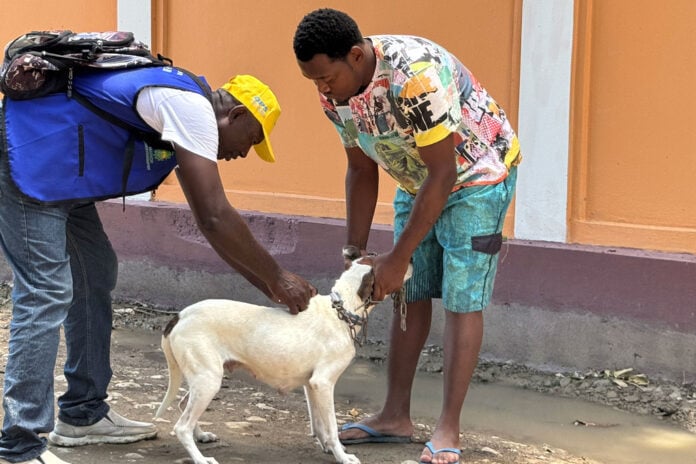
In August, Haiti launched a canine vaccination campaign targeting 140,000 dogs, both stray and community animals, alongside public awareness efforts. More than 480 veterinary agents were deployed in 240 teams across the departments of Artibonite, Centre, Nord-Est, and Nord-Ouest. A mobile app was introduced to register vaccinated dogs, enabling real-time monitoring and better data collection.
“By vaccinating dogs on a large scale, we directly protect human communities—especially children,” said Dr. Oscar Barreneche, PAHO/WHO representative in Haiti. “Rabies is lethal, but 100 per cent preventable.” The campaign aims to achieve an estimated 80 per cent vaccination coverage among the target dog population, reduce rabies circulation, and teach communities appropriate responses to bites from suspected rabid animals.
Global Context
Rabies is one of the world’s deadliest zoonotic diseases, causing an estimated 59,000 deaths annually, 40 per cent of which are children. Across the Americas, human rabies transmitted by dogs has dropped 98 per cent since 1983, with just 10 cases reported last year, according to PAHO.
Despite the challenges posed by Haiti’s instability, authorities say the vaccination campaign represents a major step toward long-term rabies control.

*Name changed to protect identity.