



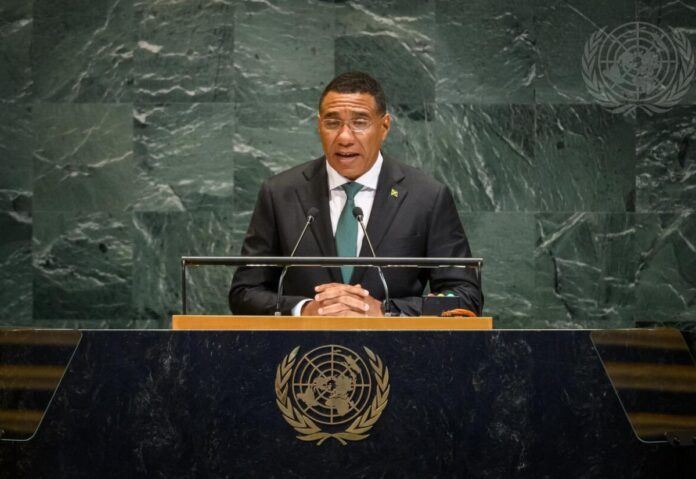
Jamaican Prime Minister Andrew Holness used his address to the United Nations General Assembly (UNGA) on Friday to demand a coordinated international response to Haiti’s spiraling security crisis and the flow of illegal guns and drugs destabilizing the Caribbean.

Speaking during the 80th Session of the UNGA in New York, Holness warned that “transnational criminal networks involved in cybercrime, arms and narcotics trafficking, and people organizing violence and destabilising institutions, are an existential threat to sovereign states.” He said the situation in Haiti underscores how these networks fuel gang violence, undermine governance, and threaten regional stability.
“Jamaica has made significant progress in tackling gangs and reducing our homicide rate by more than 50 per cent in recent years,” Holness said. “But we know that, unless these networks are totally dismantled, our gains remain fragile. This is why we call for nothing less than a global war on gangs, a coordinated international campaign to cut off the flow of weapons, money, and the influence that sustains them.”

Holness urged full implementation of the UN Programme of Action to Prevent, Combat and Eradicate the Illicit Trade in Small Arms and Light Weapons, and called on major arms-exporting countries to tighten export controls, strengthen end-use monitoring, and enforce rigorous post-delivery verification. He said Jamaica welcomes cooperation to interdict drug-trafficking vessels “provided that such operations are carried out with full respect for international law, human rights, and with the coordination and collaboration of the countries of the region.”
The prime minister also pressed for greater support for the Multinational Security Support Mission in Haiti, praising Kenya’s leadership but cautioning that “the situation remains dire.” As current chair of the Caribbean Community (CARICOM), Jamaica has helped lead regional efforts to restore peace and constitutional order in Haiti, Holness said, adding that the UN Security Council must move quickly on the Secretary-General’s recommendation for a more robust hybrid mechanism.
“Once stability is restored, the international community must help rebuild democratic institutions, ensure free and fair elections, expand humanitarian relief, and invest in infrastructure to support long-term stability,” he said. “Haiti’s recovery requires sustained global support.”
While security dominated his remarks, Holness also linked Haiti’s instability to broader structural challenges, including climate change and inadequate global financing. He noted that Jamaica remains committed to achieving net-zero emissions by 2050 and called for developed nations to honor climate funding pledges, warning that small island states face “disproportionate impacts” from hurricanes, droughts and rising seas.
Holness closed by urging the international community to treat the Caribbean’s security threats with the same urgency and resources devoted to the global fight against terrorism. “Only then,” he said, “can we turn the Caribbean and, indeed, the wider region into a true zone of peace.”



 to demand more help for Haiti.)