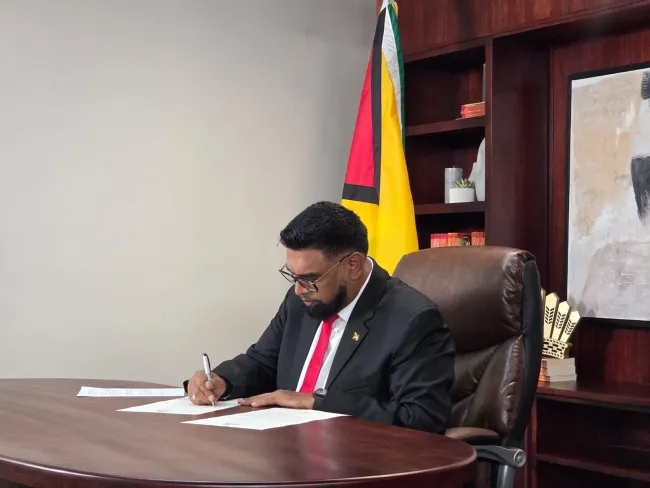
From passports to patient care, Guyana is taking bold steps to modernise government services through a comprehensive national digitisation programme. President Dr. Irfaan Ali announced on Monday that most government services are expected to be fully digitised by the end of the second quarter of 2026.

Addressing his first press conference since his re-election, the Head of State outlined a strategic plan focused on digital infrastructure, artificial intelligence (AI), cross-agency collaboration, and integrated ICT systems. A newly appointed Chief Technology Officer, supported by the National Data Management Authority (NDMA), will oversee the programme and implement a platform to monitor key performance indicators across government agencies, enhancing transparency, accountability, and efficiency.
“This initiative will create an integrated system across all agencies, including security services, to improve efficiency, transparency, and the ease of doing business,” President Ali said. “Whether it is obtaining a birth certificate, a death certificate, or a security clearance, all these systems are actively being migrated onto a digital platform.”

The President highlighted specific progress in key sectors. The online passport portal is in its final development stage and is expected to go live by year-end, decentralising services and eliminating long lines at offices. Meanwhile, the e-gate border control system launched in January, and the e-passport issuance system began in February, boosting accuracy, reliability, and compliance with International Civil Aviation Organization (ICAO) standards.
Digitising Healthcare
Healthcare will also see transformative changes. The Ministry of Health has begun digitising patient records at the Georgetown Public Hospital Corporation (GPHC), with records expected to go live by the end of the first quarter of 2026. Additionally, a pilot online appointment system at the Festival City Polyclinic is being tested to reduce wait times, with full implementation expected at GPHC early next year and later expanded to regional hospitals and clinics.
The One Health Project, a US$15 million initiative, is being implemented alongside these efforts to enhance disease surveillance, laboratory systems, and pandemic preparedness through workforce recruitment and training.
A Unified Digital Platform
President Ali described the broader vision of Digital Guyana as a unified, AI-driven platform to improve everyday life for citizens. Services will be accessible through a website and mobile applications, covering passports, birth certificates, driver’s licences, national ID cards, education records, tax filings, business registration, housing applications, and bill payments.
The government will also introduce ‘AskGov’, a generative AI-powered platform providing 24/7 assistance to citizens, while AI tools in education and healthcare will support personalised learning and disease diagnosis. An integrated Geographic Information System (GIS) will map infrastructure in real time, improving planning, emergency response, and utility management.
President Ali said the aim is to create efficient, reliable, and user-friendly government services, with AI-driven surveillance improving crime detection, traffic management enhancing road safety, and environmental monitoring supporting cleaner communities.

These initiatives complement ongoing projects such as One Guyana Digital School, telemedicine sites in hinterland and riverine areas, and the Guyana Online Academy of Learning (GOAL) scholarship programme, which has awarded over 30,000 scholarships nationwide.
“Digital Guyana represents our commitment to building a modern state where technology enhances public service, makes life easier, and ensures every citizen can access fast and reliable government services,” President Ali concluded.