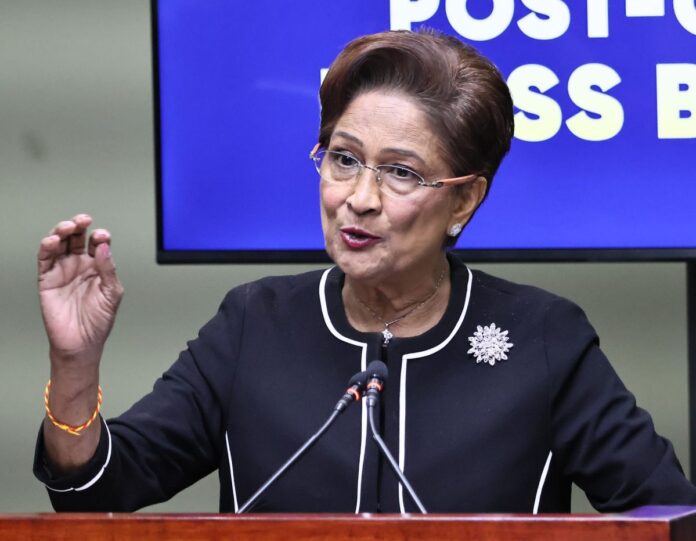
Trinidad and Tobago Prime Minister Kamla Persad-Bissessar is facing mounting criticism at home and abroad after her strong endorsement of Tuesday’s US military strike on an alleged Venezuelan drug vessel that killed 11 suspected members of the Tren de Aragua cartel.

Critics are warning that her hardline position risks undermining Trinidad and Tobago’s tradition of neutrality in regional affairs.
Persad-Bissessar doubled down on her stance yesterday, insisting that her call for the US to “kill them all violently” was rooted in her duty to protect law-abiding citizens from the impact of transnational cartels. “For more than 25 years, narco-traffickers have unleashed hell upon Trinidad and Tobago, fuelling our murder rate, flooding our streets with guns and drugs, and brutalising our people through torture, intimidation, extortion, kidnapping and violence,” she said. “My duty is to protect the law-abiding citizens of Trinidad and Tobago, not the criminals and cartels who prey upon them.”

Her remarks came after US President Donald Trump and Secretary of State Marco Rubio confirmed the strike, sharing video footage of the incident, though experts noted that no evidence has yet been provided to support claims that the vessel was a drug boat. Opposition Leader Pennelope Beckles sharply condemned the Prime Minister’s statements, calling them “reckless, disgraceful, and inconsistent with the oath she has taken to uphold the Constitution and the law.” Beckles warned that Persad-Bissessar’s words could endanger fisherfolk, offshore workers and others in the maritime space.
International relations experts have also weighed in. Professor Emeritus Anthony Bryan warned that Persad-Bissessar’s language “overstepped diplomatic boundaries,” adding: “We’ve always been a neutral country … have we abandoned that?” Professor Andy Knight went further, calling the US action an “intentional killing in international waters without due process” and warning that Persad-Bissessar’s endorsement placed the region at risk. “To claim it is OK because generally drug cartels kill innocent people is to bring the USA down to the same level of criminality that we accuse drug cartel criminals of doing,” he said.
The US Coast Guard’s rules of engagement emphasise proportionality, de-escalation and deadly force as a last resort, raising further questions about whether the strike aligned with official use-of-force policy.
The controversy has spilled beyond Trinidad and Tobago. According to Barbados Today, Barbadian Foreign Minister Kerrie Symmonds confirmed that Caricom foreign ministers have written to Secretary of State Rubio urging that future US operations in Caribbean waters not take place without prior notice. Colombian President Gustavo Petro also questioned the strike, noting that maritime interdictions can be conducted without attacking a vessel’s occupants.
Persad-Bissessar, however, has shown no signs of retreating. “Everyone else may choose their side; I have already chosen mine,” she said. “I stand with law-abiding citizens. And I stand with those who are willing to fight against these criminal cartels to help us have a safer country.”