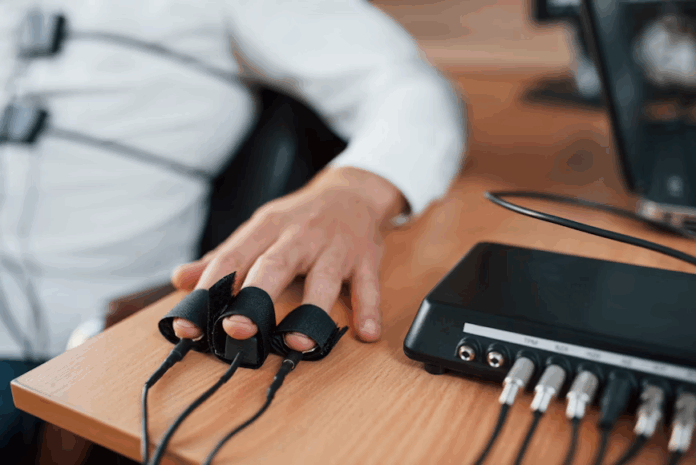
For most people, a mention of the term “lie detector test” conjures images of a polygraph examiner fervently grilling a criminal suspect in a tiny room. The subject could be a suspected serial killer, child molester, or even a petty offender.

Lie detector exams also comprise several court proceedings. The test findings may be used in criminal defense to exonerate suspects or corroborate witness statements.
Now, the polygraph’s association with law enforcement isn’t accidental.

For decades after its invention, the lie detector machine has been predominantly deployed by detectives to narrow down their suspects’ lists. In fact, the first documented use of the polygraph was in a 1921 criminal investigation of murder suspect William Hightower.
But while law enforcement still accounts for most lie detector tests, numerous other sectors have since embraced the technique. This article reveals the five other common use cases of polygraphs.
1. National Security Screening
The United States faces active security threats. From cybersecurity incidents targeted at critical IT infrastructures to outright terror attacks like 9/11, robust measures are necessary to avert these risks.
Some national security threats emanate from external players. Others originate right within U.S. soil, sometimes orchestrated by persons with high-level security clearance.
The polygraph test can be invaluable in assessing whether an individual poses significant national security risks. A classic use case is the Federal Bureau of Investigation (FBI), which deploys lie detector tests to investigate potential espionage activities within its ecosystem.
Prospective FBI employees and contractors undergo mandatory polygraph evaluations as part of the selection process. Besides, current staffers take periodic lie detector tests to facilitate the agency’s ongoing security risk assessment.

The Department of Defense (DoD) and the U.S. Citizenship and Immigration Services (USCIS) are other noteworthy federal departments that have embraced polygraph evaluations.
2. Investigating Relationship Disputes
The proverbial “happily ever after” is but a distant reality for many couples. In fact, every relationship experiences bumpy rides occasionally.
Various factors can cause disputes in relationships. Whether it’s infidelity allegations, financial difficulties, or family pressure, these issues are better resolved before they spiral out of control.
Relationship therapies use polygraph exams to investigate infidelity claims. Where one partner’s credibility has been severely attacked, conducting a lie detector test may help to separate fact from mere allegations.
Polygraph testing can play a crucial role in bringing emotional closure. It enables couples to embark on the arduous task of rebuilding fractured relationships.
3. Employment Screening
Selecting ideal job candidates is a grueling process that calls for in-depth background research. And since many people lie on their résumés, it’s best to have a second layer of validation.
Polygraphs have become a reliable tool for vetting job seekers’ credentials. With a lie detector test, you can corroborate an individual’s academic and professional claims.
Employment polygraph evaluations may also help to investigate a job applicant’s criminal history. For all you know, the person may be a corporate spy out to compromise your business secrets. Or, worse yet, a money laundering fugitive seeking the next victim to pounce on.
Besides screening job seekers, many organizations rely on polygraphs to investigate workplace incidents like theft or sexual harassment. However, the Employee Polygraph Protection Act (EPPA) cushions employees (both current and prospective) from undertaking mandatory lie detector tests.
Examinees must provide their written, informed consent for any polygraph exam to be legally defensible.
4. Sexual Offenses Investigations
Sexual offense allegations can be irreparably damning. Even if you eventually prove your innocence, the accusations may leave a massive dent in your reputation.
Polygraphs can help to get to the bottom of sexual assault allegations. Certain jurisdictions also permit conducting lie detector tests on released sexual offense parolees, ensuring the convicts adhere to their parole conditions.
If administering polygraphs on a paroled offender, you must follow the American Polygraph Association (APA) and the American Society for Testing and Materials (ASTM)’s standards for Post-Conviction Sex Offender Testing (PCSOT).
These requirements mandate that all PCSOT lie detector evaluations be conducted by examiners who possess special certifications. There are also precise PCSOT exams to use, including the PPG, which measures blood flow at the fingers and establishes if the subject used countermeasures.
5. Sports Testing
Polygraph testing has found its way into the sporting industry, too.
By having athletes submit to mandatory lie detector tests, sporting federations are able to level the playing field. It helps restore credibility in a sector marred by rampant match-fixing allegations.
The World Natural Bodybuilding Federation (WNBF) is a key pioneer of lie detector usage in the sports industry. According to the organization, athletes who have previously failed polygraphs with other bodybuilding federations must disclose that information prior to getting registered.
Polygraphs may also be used in fishing tournaments to establish if anglers followed tournament rules. Key requirements include using approved baits, as well as catching fish personally and within tournament boundaries.
Other sports that may benefit from polygraph tests include;
- Golf, to establish if the winners played by the rules
- Track & Field, to screen for banned substances
Cracking Everyday Investigations With Polygraph Tests
Law enforcement may have played the biggest role in popularizing polygraph testing. However, the technique has since pervaded numerous other sectors.
If professionally conducted, polygraph exams can help to solve pretty much any investigation. The trick is to have all lie detector tests undertaken by an accredited examiner.
Inquire if a polygrapher understands fundamental industry principles, such as ethical considerations and question design rules. More importantly, note that lie detector tests are only admissible if both parties willfully consent in writing.