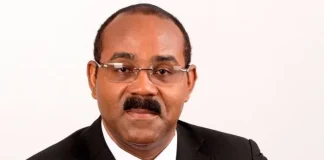
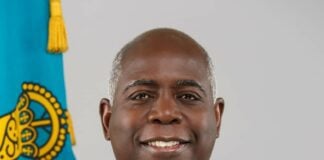
Dominica’s Prime Minister Roosevelt Skerrit has firmly rejected suggestions that the Organisation of Eastern Caribbean States (OECS) should consider leaving the Caribbean Community (CARICOM), instead calling for a “sincere conversation” about the present and future of regional integration.

“Certainly Dominica does not support the exit from the CSME (CARICOM Single Market and Economy), neither do we support the suggestion of exiting from CARICOM,” Skerrit said at a press conference on Monday. He added that he hopes the upcoming CARICOM Summit, set for July 6–8 in Jamaica, will provide an opportunity for open dialogue on the matter.
“In a family, you will have disagreements, but you have to look at it…and I think CARICOM has to have a very sincere conversation about the present state of CARICOM and the future of CARICOM where all members are concerned,” he stated. “I am hoping that at the CARICOM meeting in Jamaica next month that those matters can be discussed and fleshed out. But certainly we do not support the notion of exiting.”

Skerrit argued that the idea of individual countries withdrawing from CARICOM to pursue bilateral agreements is not realistic. “I don’t think it makes any sense for individual countries to exit CARICOM and go and have bilateral engagements. We don’t have the mass…that each of us in this CARICOM, we are prime ministers and presidents of this big continent and this huge populations and huge economies and…it is important in this very difficult, challenging and uncertain world that CARICOM rises to the occasion and get even closer together for the greater good of our citizens,” he said.
“There is no one country in the world that you can go out there with a fishing rod and say you are going to be fishing in this deep ocean by yourself,” Skerrit told reporters. “And so we are strong on integration, we are strong on regional solidarity. You know me, I am very strong on this and that’s intrinsic within me and I think we have to find a way of allowing that and enabling that solidarity to be more entrenched and more present.”
He warned that the region’s vulnerability to external shocks, natural disasters, and global instability makes solidarity even more critical. “We have to come to the realisation that if something affects country A, it is certainly going to affect every other country and this is what we have to recognise. We have seen it in less than 30 minutes countries can be wiped out, and we are islands, we do not have this land mass where you could run from one state to the other…and our economies are very vulnerable to external shocks,” Skerrit emphasized.
Skerrit’s remarks follow renewed debate over CARICOM’s relevance to OECS members. Last week at the OECS Assembly in Kingstown, St. Vincent and the Grenadines, Prime Minister Ralph Gonsalves and St. Lucia’s Opposition Leader Allen Chastanet raised concerns about the functioning of CARICOM. Chastanet even floated the idea of the OECS exiting the bloc to strike bilateral deals with other CARICOM nations.
Gonsalves took a more cautious stance. “The OECS countries may well, most reluctantly by force of circumstances, have to put on the table the continued relevance of our participation in the CSM, while, of course, remaining in CARICOM until the inequities refer to hearing are satisfied,” he said.
The CARICOM Single Market and Economy (CSME) aims to create a unified economic space by facilitating the free movement of goods, services, people, capital, and technology. However, Gonsalves, now the longest-serving head of government in the 15-member grouping, pointed out that the OECS already operates with a deeper level of integration and has yet to receive special carve-outs within CARICOM’s treaty framework.

“Multiple contradictions and challenges arise, and in this regard, it is to be seriously regretted that CARICOM has yet to find it possible to provide a specific carve out for the OECS within its treaty arrangements for a special attention beyond the general regime in CARICOM’s Treaty, chapter seven of it, covering special treatment for disadvantaged countries, regions and economic sectors,” Gonsalves said.
He noted that both CARICOM and the OECS are intended to function as “organic” integration mechanisms. “This means, in effect, that the strengths and weaknesses, limitations and possibilities of each member state are dissolved into an integrated whole, which is greater than the sum of the individual parts, from which each becomes a beneficiary and receives value greater than it otherwise would have realised, had it not been a member,” he explained.
The July summit in Jamaica is expected to bring these issues to the fore as leaders from across the Caribbean gather to reflect on the future of regional integration and solidarity.