With a solid framework, deep technical expertise and forward-thinking vision, Jamaica has established itself as the regional leader in radiation safety and security.

The country is leading the way for Caribbean nations and earning international acclaim for its efforts in the peaceful application and regulation of ionising radiation.
Central to this progress is the Hazardous Substances Regulatory Authority (HSRA), an agency under the Ministry of Industry, Investment and Commerce that is responsible for enforcing the Nuclear Safety and Radiation Protection Act (2015) and its supporting regulations.

Since its establishment, the HSRA has not only transformed Jamaica’s domestic radiation safety infrastructure but is now playing a pivotal role in helping to build regulatory capacity across the region.
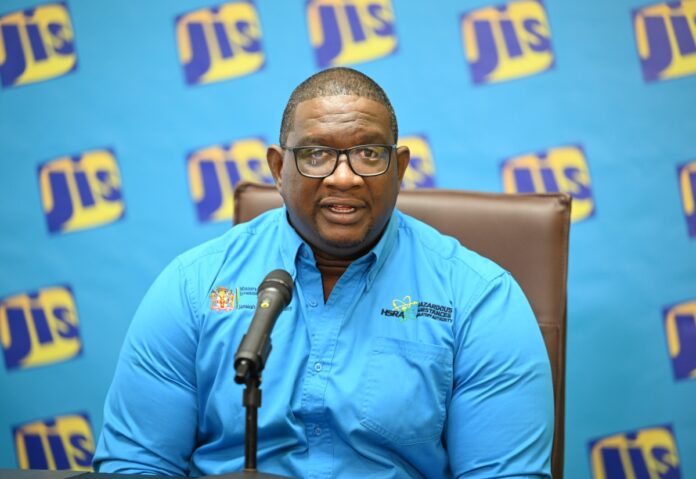
“We are proud to say that Jamaica has the most advanced independent regulatory body for radiation safety in the Caribbean. We have set the pace for other nations that are now following our lead, and we’ve been instrumental in helping them get started,” said Director General, Dr. Cliff Riley, during a recent Jamaica Information Service (JIS) ‘Think Tank’.
In December 2024, St. Lucia achieved a significant milestone by launching its independent regulatory body for radiation safety, with substantial support from HSRA’s team of inspectors and trainers.

“The Jamaican authorities provided hands-on support, training St. Lucia’s new regulators in inspection protocols, authorisation processes and international safety standards,” Dr. Riley informed.
He added that this is just one of many collaborations establishing Jamaica as the cornerstone of radiation regulation and technical support in the Caribbean.
According to the Director General, the HSRA’s leadership is not only grounded in experience but also in cultural relevance.

“The regulatory models from developed countries don’t always translate well in Caribbean contexts, hence our cultural norms and dynamics must be factored into how safety protocols are communicated and applied. That’s why it’s important that regional expertise, like what we’ve developed here at the HSRA, is leveraged to build sustainable systems,” he added.
With oversight spanning critical sectors such as healthcare, manufacturing, construction, mining, national security and border control, the HSRA ensures that any facility using radiation-emitting devices, whether a CT scanner, dental X-ray or industrial source, is compliant with rigorous safety and security protocols.
“While individual sectors may have highly trained professionals operating these technologies, you still need a neutral, expert regulatory body to ensure public safety,” Dr. Riley explained.
Consequently, he added, “our (HSRA) responsibility is to make sure all systems in use across the country are safe for operators, patients, the general public and future generations”.
Dr. Riley further emphasised that ionising radiation poses invisible risks, noting that, unlike other hazards, “it cannot be seen, tasted, felt or heard”.
“The effects may not manifest immediately, but can lead to long-term health issues, such as cancer or genetic mutations, underscoring the need for strict regulatory oversight,” he maintained.
Dr. Riley pointed out that the Authority’s work “is about the protection of people, the environment and of future generations”.
“That’s why we build deep technical capacity within our team and ensure Jamaica is not only compliant with international standards but contributing to shaping how those standards are applied regionally,” he stated.
Within just a few years, the HSRA has achieved significant milestones, with more than 50 per cent of Jamaican facilities utilising ionising radiation now authorized and sectors such as public health, medical diagnostics, and industrial applications demonstrating strong compliance.
As Jamaica strives to achieve at least 87 per cent authorisation by 2027, the Authority remains steadfast in ensuring that all facilities operate within the boundaries of the law.
“Jamaica’s leadership in this field is not just about policy; it’s about people. So, the HSRA is here to help to ensure that radiation technologies, which play a critical role in diagnosing disease, advancing infrastructure, and strengthening national security, are used safely and responsibly,” Dr. Riley informed.
He added that, “with Jamaica sharing its expertise across borders, lifting standards, building regional confidence, and helping to ensure that all Caribbean people benefit from the safe, secure, and peaceful use of radiation, there is hope for a bright future”.