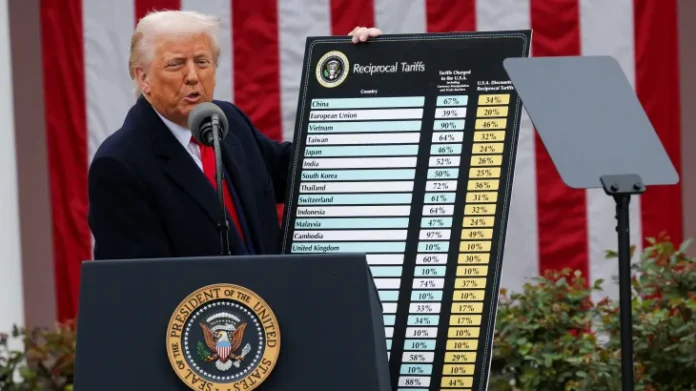
Caribbean-Americans, Caribbean nationals, and Caribbean exporters were caught off guard last week when President Donald Trump announced reciprocal tariffs that included a 10% tariff on imports from most Caribbean nations.

While the Trump administration had signaled plans to impose tariffs on imports to the U.S., there was no clear indication that Caribbean exports would be affected. Notably, no mention was made during U.S. Secretary of State Marco Rubio’s visit to the region just two weeks earlier.
For decades, the U.S. has been a major export market for Caribbean nations, providing essential economic, strategic, and social benefits. In 2023, the region earned approximately $258 billion in export revenues from the U.S. alone. Jamaica exported $1.1 billion worth of goods—mainly mineral fuels, ores, beverages, and agricultural products—while Trinidad and Tobago earned $4.86 billion, primarily from mineral fuels, inorganic chemicals, and steel. Barbados, exporting mostly beverages, precious stones, and mineral fuels, earned over $88 million.

These numbers highlight the depth of economic ties between the Caribbean and the U.S., across sectors such as energy, manufacturing, and agriculture. U.S. dollars earned through exports help stabilize Caribbean currencies, pay for imports, and build much-needed foreign exchange reserves.
Exports also play a key role in regional employment. The stronger the U.S. demand for Caribbean goods—whether agricultural, manufactured, or marine—the greater the impact on job creation. While tourism remains a dominant service export, many Caribbean nations have sought to diversify into areas like tech, services, and specialty manufacturing.
Since 1984, Caribbean countries have benefited from near duty-free access to the U.S. under the Caribbean Basin Initiative (CBI), created by the Caribbean Basin Economic Recovery Act (CBERA) and signed into law by President Ronald Reagan. The CBI was designed to promote economic development and political stability in the Caribbean and Central America. By eliminating tariffs, it made Caribbean exports more competitive and helped attract foreign investors to manufacturing and assembly sectors.
It remains unclear whether the Trump administration considered the CBI in its tariff decision.
Still, even with the advantages the CBI offered, the Caribbean’s heavy reliance on the U.S. market always came with risks. The region has long been vulnerable to shifts in U.S. economic conditions and policy changes. Now, with tariffs becoming reality, those risks are no longer theoretical. For many Caribbean countries, exports to the U.S. are a lifeline—and that lifeline is now under threat.
It is critical for CARICOM and individual Caribbean governments to begin immediate negotiations with the U.S. to clarify the scope and intent of the new tariffs. Reports indicate that more than 70 countries are seeking talks with the U.S. Caribbean nations must join that effort—urgently.

At the same time, the region’s private sector must treat this as a call to action. While governments negotiate trade terms, exporters must rethink their market strategies and reduce over-dependence on the U.S.
Some Caribbean exporters, lulled by the stability offered through the CBI, have shown little urgency to diversify. That complacency must end. The new U.S. tariffs demand a broader strategy—one that targets new and expanded markets such as Canada, the UK, and the European Union. Notably, the Economic Partnership Agreement (EPA) between CARIFORUM and the EU offers significant export opportunities.
Caribbean governments should provide incentives that encourage exporters to innovate, develop new products, and explore new markets. The region’s continued dependence on the U.S. is no longer sustainable. The time to pivot is now.