



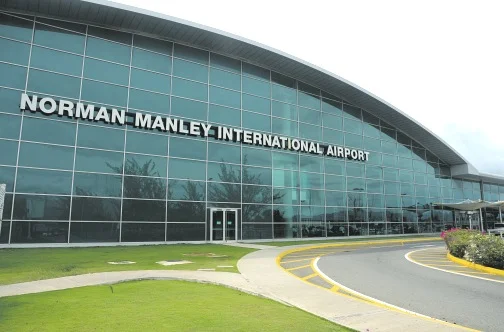
In a significant development amidst the ongoing renovation and expansion of Jamaica’s Norman Manley International Airport (NMIA) in Kingston, the iconic Air Jamaica aircraft tail that has long been a symbol of the gateway to the island nation has been removed from the roundabout leading to the airport.

This prominent piece of aviation history is set to find a new home in a museum, marking the end of an era and the dawn of a new welcome sign for travelers.
PAC Kingston Airport Limited initiates removal
The decision to remove the iconic plane tail was made by PAC Kingston Airport Limited, the entity responsible for operating NMIA.

According to the Jamaica Gleaner, Audley Deidrick, President and CEO of the Airports Authority of Jamaica (AAJ), confirmed this change, explaining that it was done to facilitate the redesign and construction of the roundabout facilities.
Reports are that as the airplane tail takes its place in storage at NMIA, it will not be featured in the new roundabout design. Instead, a welcoming sign will greet travelers, ushering them into Kingston and the airport.
Minister of Culture recognizes cultural significance
The Jamaica Gleaner further mentioned that Minister of Culture, Gender, Entertainment and Sports, Olivia ‘Babsy’ Grange, has voiced her recognition of the airplane tail’s cultural importance.

She acknowledges it as an integral part of Jamaica’s material culture and a significant object for its people.
In response, she has instructed the Jamaica National Heritage Trust to conduct a condition report on the tail to have it restored and placed in a location where future generations of Jamaicans can view it.
No fixed timeline for restoration
While Minister Grange emphasized the importance of the airplane tail, she did not provide a specific timeline for its restoration and relocation to an accessible exhibition location.

Air Jamaica’s legacy
Minister Grange underscored the significance of Air Jamaica, a national airline established in 1968, as a vital part of Jamaica’s culture. During its operational years, the airline received numerous accolades, including the prestigious World Travel Award for being the Caribbean’s leading airline from 1997 to 2009.
For many Jamaicans, their first travel experiences were aboard Air Jamaica, and the airport’s waving gallery served as an important cultural tradition for welcoming loved ones.
Original Lovebird logo to adorn restored tail
Upon restoration, the airplane tail will proudly bear the original Air Jamaica Lovebird logo and will be placed in a location accessible to all, free of charge.
Opposition’s skepticism
In response to these developments, Opposition Spokesman on Transport Mikael Phillips expressed skepticism regarding the plans to exhibit the tail in a museum.
He questioned the feasibility and timing of such an endeavor, considering previous promises of a museum dedicated to reggae music and Jamaican culture.
Phillips also voiced concerns about replacing the iconic sign with a commercial welcome sign at the airport, suggesting that it should depict the history of air travel and the city of Kingston instead.
Ongoing airport expansion
PAC Kingston Airport Limited, a subsidiary of Mexico-based Pacific Airport Group, took over management of the airport in October 2018 under a 30-year agreement.
The NMIA is currently undergoing a capital expansion program initially estimated at US$213 million.









)