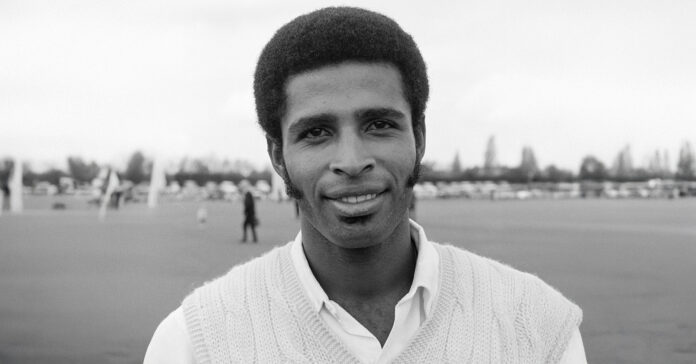
PORT OF SPAIN, Trinidad — The West Indies cricket community is mourning the passing of Bernard Julien, one of the region’s most gifted all-rounders and a proud member of the legendary team that captured the inaugural Men’s Cricket World Cup in 1975.

Julien, who combined elegance at the crease with guile and precision as a left-arm seamer, passed away on Saturday night at his home in Valsayn, north-west Trinidad, at the age of 75, a family member confirmed.
The outpouring of tributes from across the Caribbean spoke not only to Julien’s sporting brilliance but to the warmth of his character and the enduring mark he left on generations of players and fans alike.

Unified tributes for a cricketing pioneer
From Sir Clive Lloyd, his former captain and long-time friend, to Cricket West Indies (CWI) and the West Indies Players’ Association (WIPA), the tributes formed a single chorus of respect for a man whose career embodied both triumph and complexity.
Together, they hailed Julien as a cricketer of rare talent and deep integrity — a man who not only helped shape the West Indies’ early dominance in world cricket but also navigated the sport’s most challenging moral crossroads with humanity and grace.
Sir Clive Lloyd: “He always gave over 100 percent”
Leading the tributes, Sir Clive Lloyd remembered Julien as a dependable, selfless teammate and a cornerstone of the World Cup-winning side.
“He always gave you over 100 percent,” Lloyd recalled. “He never shirked his duties, and I could always rely on him with bat and ball. He gave his all every time … what a fine cricketer.”
The former West Indies captain also spoke fondly of Julien’s spirit and humility.
“We all had total respect for him. He enjoyed himself and was loved by everyone around. I remember we won the Test match at Lord’s and stood there signing autographs for a long time. He was good for us and was held in high regard everywhere we went.”

CWI: “A quiet legend of the 1975 World Cup”
In a moving statement, Cricket West Indies (CWI) President Dr. Kishore Shallow reflected on Julien’s dual legacy — his cricketing excellence and the social complexities that defined his era.
“The passing of Bernard Julien invites reflection on both the brilliance of his cricketing life and the complex times through which he lived,” Shallow said. “His career reminds us that the story of West Indies cricket is not only about triumphs on the field but about the choices and circumstances that shaped generations of players and the region itself.”
Shallow described Julien as “one of the quiet legends of the 1975 World Cup,” noting that the tournament — half a century ago — brought a sense of Caribbean unity and joy like no other.
“His skill and composure were central to that victory,” Shallow added. “To the family, friends, and loved ones of Bernard Julien, we extend our deepest condolences.”
WIPA: “We honor his lasting contribution”
The West Indies Players’ Association (WIPA) also expressed deep sorrow, extending sympathy to Julien’s family and loved ones.
WIPA president and CEO, Wavell Hinds, said: “WIPA expresses sincere condolences to the friends and family of former West Indies cricketer Bernard Julien. May you find strength and peace amid your grief. We honor Bernard Julien’s lasting contribution to the game we love; may his soul rest in peace.”
A career of brilliance and depth
Born in Carenage, Trinidad, in 1950, Bernard Julien’s cricketing journey began at 18, when he made his first-class debut. By 23, he was wearing the maroon cap for the West Indies on their 1973 tour of England — a series in which he announced himself with flair and authority.
At Lord’s, the “Home of Cricket,” he scored a magnificent 121 off 127 balls, sharing a record partnership with Sir Garfield Sobers, who remained unbeaten on 150. It was the kind of innings that signaled the arrival of a player of rare poise and power.
Two years later, Julien’s all-round brilliance shone again on the world stage. During the 1975 World Cup, he delivered match-winning spells of 4 for 20 against Sri Lanka and 4 for 27 against New Zealand in the semi-final at The Oval — performances that propelled the West Indies into the final, where they defeated Australia to lift cricket’s first world crown.
In total, Julien played 24 Test matches, scoring 866 runs at an average of 30.92 and taking 50 wickets at 37.36. In One-Day Internationals, he claimed 18 wickets at 25.72.
A complex chapter and an enduring legacy
Julien’s international career came to an early close following his participation in the 1982–83 rebel tours to South Africa — a decision that resulted in a life ban from West Indies cricket at the height of the apartheid boycott.
Dr. Shallow acknowledged the moral and personal struggles of that period, noting that such choices reflected “the difficult realities of that era and the pressures faced by players navigating competing demands of opportunity, conscience, and circumstance.”
Yet for all the turbulence, Julien’s contributions remain woven into the tapestry of West Indian cricket — his artistry with bat and ball, his quiet dignity, and his place among the pioneers who laid the foundation for future generations.
Remembering a gentleman of the game
For the Caribbean cricket family, Bernard Julien will be remembered as more than a statistic or a scorecard entry. He was part of the West Indies’ coming of age — a cricketer whose performances embodied a people’s pride and whose life mirrored the struggles and triumphs of his time.
As Sir Clive Lloyd put it, “He gave his all every time.”
That spirit — of effort, excellence, and enduring grace — is what will forever define Bernard Julien, one of West Indies cricket’s quiet giants.