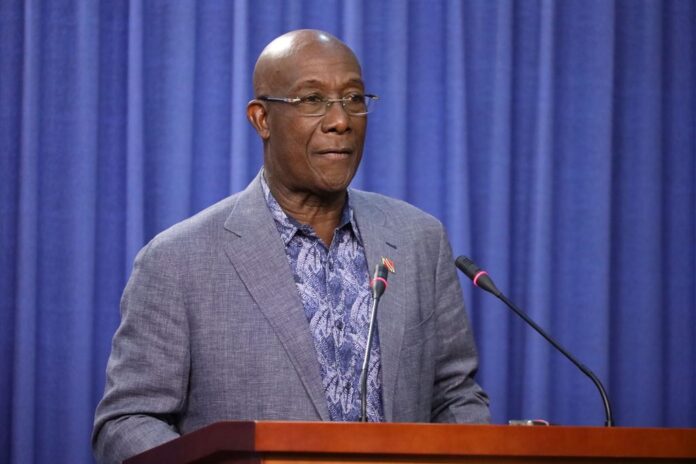
PORT OF SPAIN, Trinidad – In a pointed rebuttal, former Prime Minister of Trinidad and Tobago, Dr. Keith Rowley, has dismissed recent remarks made by Cricket West Indies (CWI) President Dr. Kishore Shallow, who claimed that CARICOM governments have failed to adequately support the region’s cricket development.
Dr. Rowley, who once chaired CARICOM’s Prime Ministerial Sub-Committee on Cricket, expressed deep surprise at what he described as misdirected criticism from the head of the regional governing body for cricket.
“Shocked” by Shallow’s accusations
“I am quite surprised that Dr. Shallow, in the face of a management disaster at Cricket West Indies, could identify CARICOM governments as the problem,” Dr. Rowley said during an interview on Isports on i95.5 FM. “I don’t want to pretend to speak for CARICOM, as I no longer hold those positions, but I must say — that is not a fair assessment.”

His comments come in response to statements made by Dr. Shallow on WESN TV’s Face of Sports, where the CWI President argued that regional infrastructure was lagging and insufficient focus had been placed on grassroots, school, and club-level cricket.
Dr. Shallow contended that CWI did not have the resources to overhaul these fundamental areas on its own and that such development “is not the responsibility of CWI or the territorial boards.” Instead, he argued, national governments needed to step up and do more.
Governments have already shown support, says Rowley
Dr. Rowley rejected the notion that governments had been absent from the cricket development conversation. Instead, he pointed to recent collaborative efforts involving regional heads of state and CWI.
“As far as I am aware, CARICOM governments — when I was involved — including Dr. Keith Mitchell of Grenada, Prime Minister Ralph Gonsalves of St. Vincent, and President Irfaan Ali of Guyana, all worked alongside CWI,” he noted.
He referenced a high-level meeting hosted in Trinidad during his tenure, which brought together key stakeholders to chart a way forward for Caribbean cricket. “That was a unique situation,” he recalled. “We brought a lot of people here… and tried to untangle the web that is West Indies’ confusion in cricket.”
Infrastructure and development are government-led by nature
Rowley emphasized that much of the cricket infrastructure across the region — particularly at the junior and school levels — already depends heavily on state funding and management.

“Cricket in the Caribbean at school level and junior level is largely a government thing,” he said. “The facilities, the infrastructure, in most cases are government-owned, and governments give tremendous support.”
His remarks underscored a central theme: that CARICOM’s role has been supportive, not obstructive, and that the real introspection must occur within CWI itself.
A call for accountability at the top
While Dr. Rowley stopped short of directly assigning blame to CWI, his comments reflected a broader frustration with leadership deflection. “I am not sure exactly what CWI is expecting from CARICOM governments,” he said pointedly, “as they run the show of trying to compete in international Test cricket.”
The debate continues
The exchange has reignited long-standing discussions about who holds responsibility for the decline and revival of West Indies cricket. As the region continues to search for answers to its cricketing decline, one thing is clear: the path forward demands unity, transparency, and accountability — not finger-pointing.