
Why Your Website Gets Traffic but No Phone Calls

Key Points(5)
- You're paying for 900 visits a month and getting three calls.
- Last Tuesday you stared at the analytics dashboard and felt that specific, quiet irritation of watching people walk into your store, look around, and leave without saying a word.
- Here's the part that stings: your site probably isn't broken.
- It's just answering a question nobody asked.
- Most traffic problems that look like traffic problems are actually attention problems, and they almost always live in one of three spots.
You're paying for 900 visits a month and getting three calls. Last Tuesday you stared at the analytics dashboard and felt that specific, quiet irritation of watching people walk into your store, look around, and leave without saying a word.
Here's the part that stings: your site probably isn't broken. It's just answering a question nobody asked. Most traffic problems that look like traffic problems are actually attention problems, and they almost always live in one of three spots. The path a stranger takes from the search bar to the dial screen.
Good agencies fix this without rebuilding your site. A solid Internet Marketing Service spends its first hour mapping where visitors actually land, then checking whether the page earns a click or a call before it tries to earn more of either.
Agree first: traffic isn't the problem
If people are arriving, you solved the hard part. Someone typed a query, saw your snippet in a crowded results page, and chose you over nine competitors. That's a real decision. It means your message matched their intent at the moment of the search.
Then the page loads and the match breaks. I see this constantly with local service businesses, and it's rarely a design flaw. It's a mismatch between what the ad or search snippet promised and what the page opens with.
The page you drive traffic to has one job. Give a stranger a reason to raise their hand in under 15 seconds. Every minute you spend chasing rank while that job goes unserved is money you're donating to a funnel with a hole in the bottom.
Where the click dies
The headline talks about you
Open your top landing page. Find the largest text. If it starts with a company name, a founding year, or the word "Welcome," you've found the leak. Your visitor doesn't care about you yet. They care about whether their problem gets solved today.
Swap the headline for the outcome. Not "Award-Winning Plumbing Since 1998." Something like "Same-Day Repairs in Richmond, Booked Before Noon." Same business, different door.
The call-to-action asks for the wrong size of commitment
A phone call is a big ask from someone who just met you. A quote form is a medium ask. A text-your-photo option is small. If every road leads to the same giant button, you lose the cautious visitor who'd happily test you with a low-stakes move.
Give them a ladder. Two or three entry points at different commitment levels, each one clearly labeled. Here's the thing though: more buttons is not the answer. I've watched sites triple their CTA count and convert worse, because a confused visitor defaults to the back button.
Nobody can find the phone number
One of the longest-running findings in web usability work concerns how quickly visitors decide whether a page is worth their time. Before anyone reads anything, they scan. Getting found fast on mobile starts with basic markup practices that keep your number tappable, a subject the W3C covers extensively. The rule I follow: your number should be visible without scrolling on a phone, in a color that isn't gray.
The 20-minute audit you can run today
You don't need a consultant to spot most of this. Set a timer and do these four things on your own phone, not your laptop.
- Search for your main service plus your city in a private browser window. Click whatever appears first of yours. Time how long until you'd know what to do next.
- Scroll slowly. Count how many seconds pass before you see a phone number or a form.
- Fill out your own contact form. Note how long the confirmation takes, and whether you'd trust it as a customer.
- Call the number on a Saturday. Whatever happens to you is happening to your next customer.
Most owners find at least two failures in that pass. That's not a reason to panic. It's a reason to stop buying more traffic until the door works.
A concrete example from a real pattern
A tree removal company I worked with spent months building up a beautiful service page. It ranked well. Visitors averaged about a minute on it. Almost nobody called.
The page opened with a photo of a crane and three paragraphs about certifications. Genuinely impressive, and completely backwards. Homeowners with a fallen oak in the yard need two things: how fast can someone get here, and what will it roughly cost.
We moved a short "Storm damage? We answer until 9 p.m." line above the fold, added a two-tap photo uploader, and left everything else alone. Calls jumped within weeks. Same traffic. Same ad budget. The path got shorter.
That's the part most agencies skip. The Nielsen Norman Group has documented for years that visitors leave pages quickly when clarity is missing, and adding design polish does nothing to fix that. Your problem is nearly always ordering, not decoration.
The Trust Ladder
Here's the framework I use when a client's traffic converts and their calls don't. Think of every visitor as a climber. They need to hit each rung in order, and skipping one sends them back down.
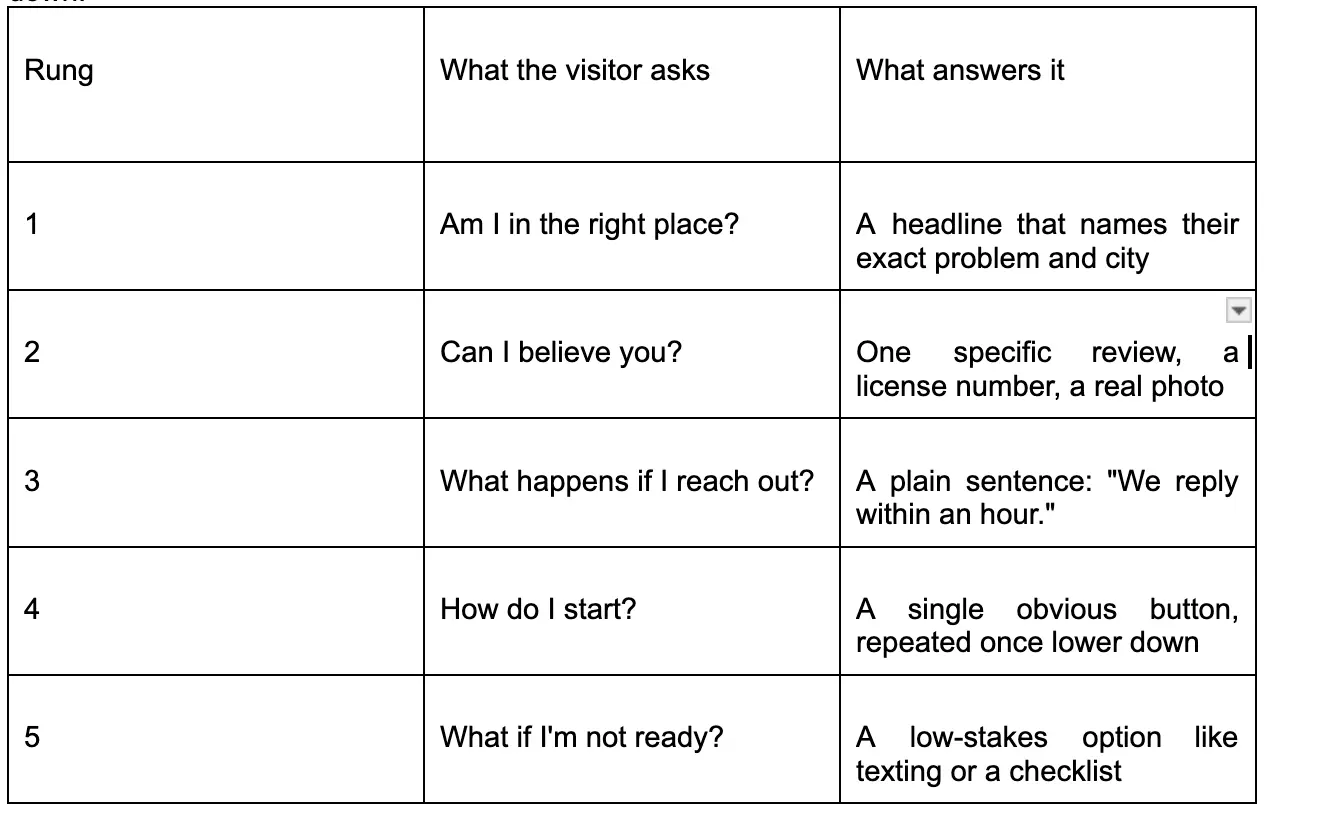
Walk your own page against those five rungs. Where does your eye stall? That's your fix. Most sites I audit fail at rung three, because owners assume visitors know what a phone call leads to. They don't.
One more thing people forget
Your visitors are probably on a phone, and they're probably distracted. Broad research from the Pew Research Center has shown for years that most Americans now do their browsing on mobile devices. That single fact reframes everything. Speed matters more than prose. Big tap targets beat elegant type. And a page that works on your desktop but loads slowly on a phone is quietly costing you every lead you thought you were generating.
Test your page on a weak connection, not office Wi-Fi. If you get bored waiting, so did they.
What to do next
You opened this because the phone is quiet and the dashboard is busy. The fix isn't a bigger ad budget, a redesign, or a new analytics tool. It's shortening the walk from arrival to action, then getting out of the way.
Pick one rung from the ladder above and fix it tonight. Then run the 20-minute audit again next week and see whether the number moved. If it did, you'll know exactly where the rest of your budget should go.
And if it didn't, what's the one sentence a stranger would need to read before they'd feel comfortable calling you?