

Why an Obvious Hazard May Not Defeat Your Florida Fall Claim
Key Points(5)
- Picture a Fort Lauderdale shopper who notices moisture beside a grocery cooler and slips before she can step around it.
- Can that shopper still recover under Florida's open-and-obvious doctrine?
- Florida law lets an obvious hazard weaken or even eliminate a property owner’s duty to warn, but the separate duty to maintain reasonably safe premises remains.
- The injured person still has to prove any notice the law requires, and that person’s share of fault can cut into recovery or bar it entirely.
- Florida Statutes §§ 768.0755 and 768.81 govern notice for business establishments and comparative fault.
Picture a Fort Lauderdale shopper who notices moisture beside a grocery cooler and slips before she can step around it. Can that shopper still recover under Florida's open-and-obvious doctrine?
Yes. Florida law lets an obvious hazard weaken or even eliminate a property owner’s duty to warn, but the separate duty to maintain reasonably safe premises remains. The injured person still has to prove any notice the law requires, and that person’s share of fault can cut into recovery or bar it entirely.
Florida Statutes §§ 768.0755 and 768.81 govern notice for business establishments and comparative fault. For covered actions filed after March 24, 2023, Florida’s modified comparative-negligence rule generally controls. Your own conduct still counts.
What Open and Obvious Doctrine Do Florida Courts Apply?
The doctrine generally narrows an owner’s duty to warn to dangers a reasonable person would notice through ordinary perception and judgment.
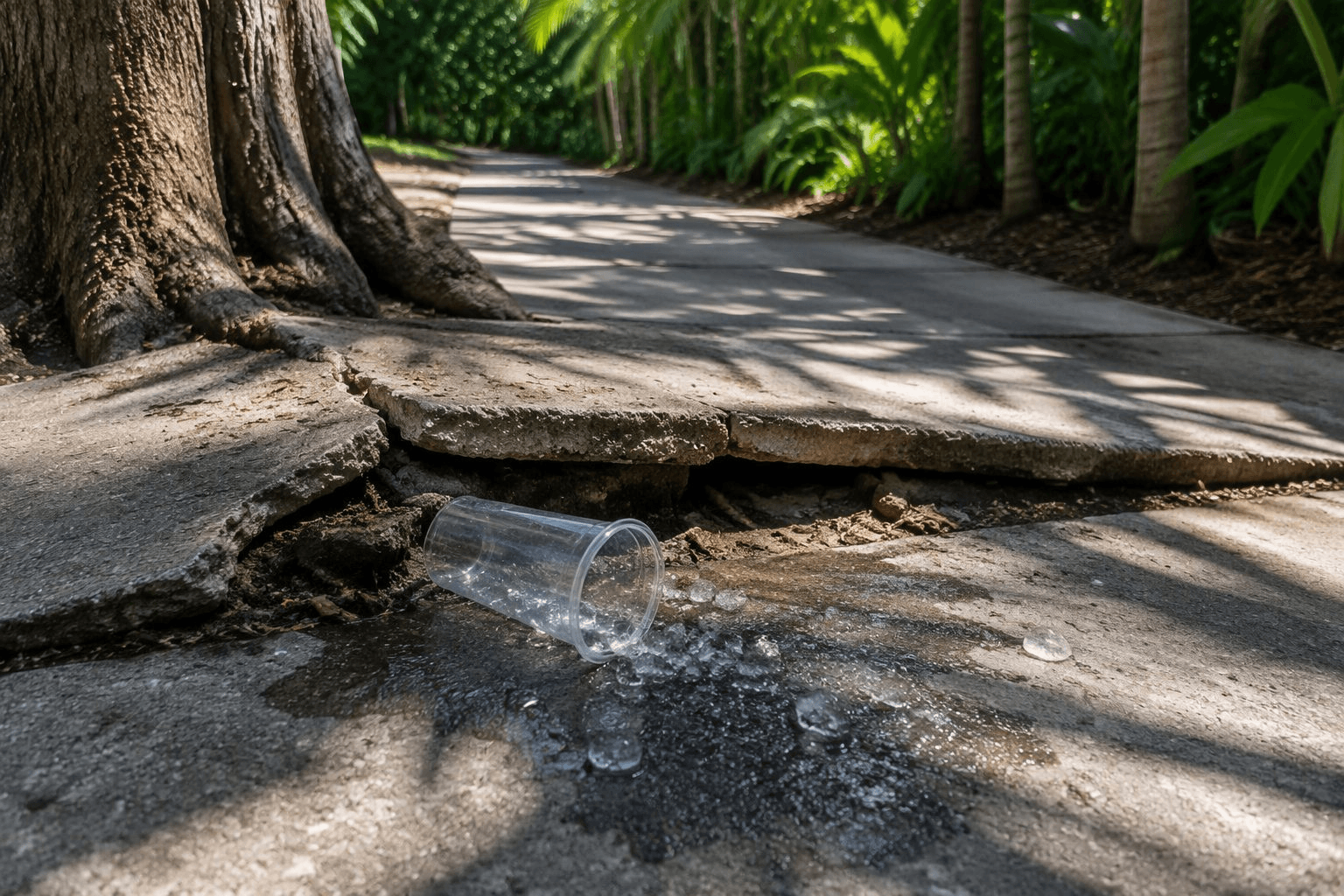
Obviousness is an objective inquiry; a visitor who saw the condition did not necessarily see its danger. Lighting and contrast can decide whether a reasonable visitor would have recognized the danger in a wet floor or a raised slab of pavement.
Does Florida Premises Liability Require Warning for Obvious Hazards?
An owner generally need not warn about a danger that is open and obvious to a reasonable visitor. Maintenance responsibility can survive, though, when the owner should expect injury despite the condition’s visibility.
Ashcroft v. Calder Race Course, Inc., 492 So. 2d 1309 (Fla. 1986), recognized potential liability where harm should have been anticipated despite obviousness. Aaron v. Palatka Mall, L.L.C., 908 So. 2d 574 (Fla. 5th DCA 2005), and Lotto v. Point East Two Condominium Corp., 702 So. 2d 1361 (Fla. 3d DCA 1997), draw a line between warning duties and premises maintenance.
Once an owner proves the hazard was visible, the warning argument tends to fall away, and the fight usually moves to maintenance. In its treatment of HL Law Group, P.A. says Florida's open and obvious doctrine, HL Law Group, P.A., a Florida firm, works through how that shift plays out in a slip and fall case, including what a store must still answer for when it argues a spill sat in plain view the whole time.

Does an Open and Obvious Hazard Bar Recovery in Florida?
No. Visibility alone does not sink every Florida fall claim. Courts weigh warning and maintenance duties case by case, including how the visitor acted around the hazard.
Duty to Warn Versus Duty to Maintain
A visible spill might support an argument that a customer should have steered around it. If employees walked past that same spill for an hour, though, the proof can cut the other way: it can suggest the store failed to maintain the premises.
Can Distraction Shift Blame for a Visible Hazard?
Sometimes. The anticipated-harm principle in Ashcroft allows consideration of circumstances in which an owner should expect visitors to encounter danger despite its visibility.
A shopper following overhead store signs may approach a floor condition partly screened by merchandise. Ordinary inattention excuses little on its own; the evidence must address the aisle's expected use.
When Must the Injured Person Prove the Business Knew About the Hazard?
To recover damages after slipping on a temporary spill or debris in a Florida business, an injured party must demonstrate that the property owner either knew about the hazard or should have discovered it through reasonable care, yet neglected to clean it up or issue a timely warning.
Florida Statutes § 768.0755(1) spells out this requirement. Actual knowledge means the business or one of its employees knew the substance was present.
Constructive knowledge can be established through circumstantial evidence showing that the substance remained long enough for ordinary care to discover it, or that the condition occurred regularly enough to make its presence foreseeable.
Does the Same Notice Rule Apply to Every Fall?
No. Section 768.0755 concerns transitory foreign substances in business establishments, such as spilled drinks. It leaves permanently uneven walkways and most residential-property falls outside its scope.
A fixed defect follows the common-law analysis. Florida Statutes § 768.0755(2) preserves common-law duties owed by those who possess or control business premises.
Surveillance footage may establish how long a spill remained. Inspection records can document checks, and photographs may show tracks or drying edges. No one detail settles how long the substance sat on the floor.
How Does Florida’s 51% Rule Affect a Visible-Hazard Claim?
Florida Statutes § 768.81 reduces damages according to the injured person’s share of fault. In covered negligence actions, a plaintiff found more than 50% responsible generally cannot recover damages.
At exactly 50% fault, the plaintiff may recover the remaining half of proven damages. At 51%, the plaintiff crosses the statutory threshold. The nickname is shorthand: the legal bar is more than 50%, not “50% or more.”
Take $100,000 in proven damages with 30% plaintiff fault. The recovery comes to $70,000 before other applicable adjustments.
Obviousness can support an argument that the visitor failed to watch the walking surface. But poor lighting or an unavoidable route may affect that assessment, alongside evidence of inadequate maintenance.
A visible hazard does not dictate a particular percentage. When material facts remain disputed, a jury may weigh the competing evidence about the spill and the visitor’s route.
What Counts as an Open and Obvious Danger in Florida?
A danger may be open and obvious when a reasonable person would recognize both the condition and its risk. Spotting an object and recognizing its danger are separate mental steps.
Clear liquid on glossy flooring can be nearly invisible; glare and footprints change what a shopper approaching the cooler could see. A raised walkway edge presents a different issue: it may stand out against the pavement or vanish into shadow, depending on its height and appearance. Warning signs carry weight of their own: a readable cone beside the spill says more than a cone parked several feet away, and a sign placed after the fall warned nobody. Fixed obstacles span the same range, from a planter in a well-lit entry to an obstruction half-hidden behind displays, where a safe alternative route can swing the assessment.
Visibility protects an owner only so far.
Photographs taken from the walking direction can show details missing from a close-up captured after the fall.
Common Questions About Florida Negligence Claims
What Four Proofs Establish Negligence?
A claimant generally must prove duty, breach, legal causation, and damages. Clay Electric Cooperative, Inc. v. Johnson, 873 So. 2d 1182 (Fla. 2003), identifies these elements; the Florida Standard Jury Instructions in Civil Cases explain negligence and causation. A qualifying business-substance claim also carries the statutory notice burden.
Are There Only Three Types of Negligence?
Florida premises-liability law categorizes visitors as invitees, licensees, or trespassers. Civil Instructions 401.4 and 401.22 address negligence and comparative negligence separately. Ordinary negligence concerns a failure to use reasonable care; comparative negligence concerns the injured person’s own responsibility. Those are two distinct questions, not three categories that settle every claim.
What Is a Better Plain-Language Word for Negligence?
“Carelessness” is a useful plain-language substitute, but it does not state the entire legal test. Instruction 401.4 defines negligence as a failure to exercise reasonable care under the circumstances. A claimant must still connect a breached duty to harm and cannot rest only on evidence that someone behaved carelessly near the walking surface.
What Is the Hardest Injury to Prove After a Fall?
Civil Instructions 401.12 and 501.5 address legal causation and aggravation of existing conditions. Medical records documenting symptoms before and after a fall can help distinguish new harm from an earlier complaint, including worsening pain from a prior condition.
What to Remember After a Fall on Florida Property
An obvious hazard raises two questions for any claim: what the owner knew and what you could have done about it. Photographs, surveillance footage, inspection logs, and witness accounts provide evidence for both questions.
Florida fall cases rarely turn on one side proving every point. They hinge on the duty the evidence addresses and the resulting allocation of fault.

