When the storms keep coming: How the Caribbean keeps rebuilding stronger
Key Points(5)
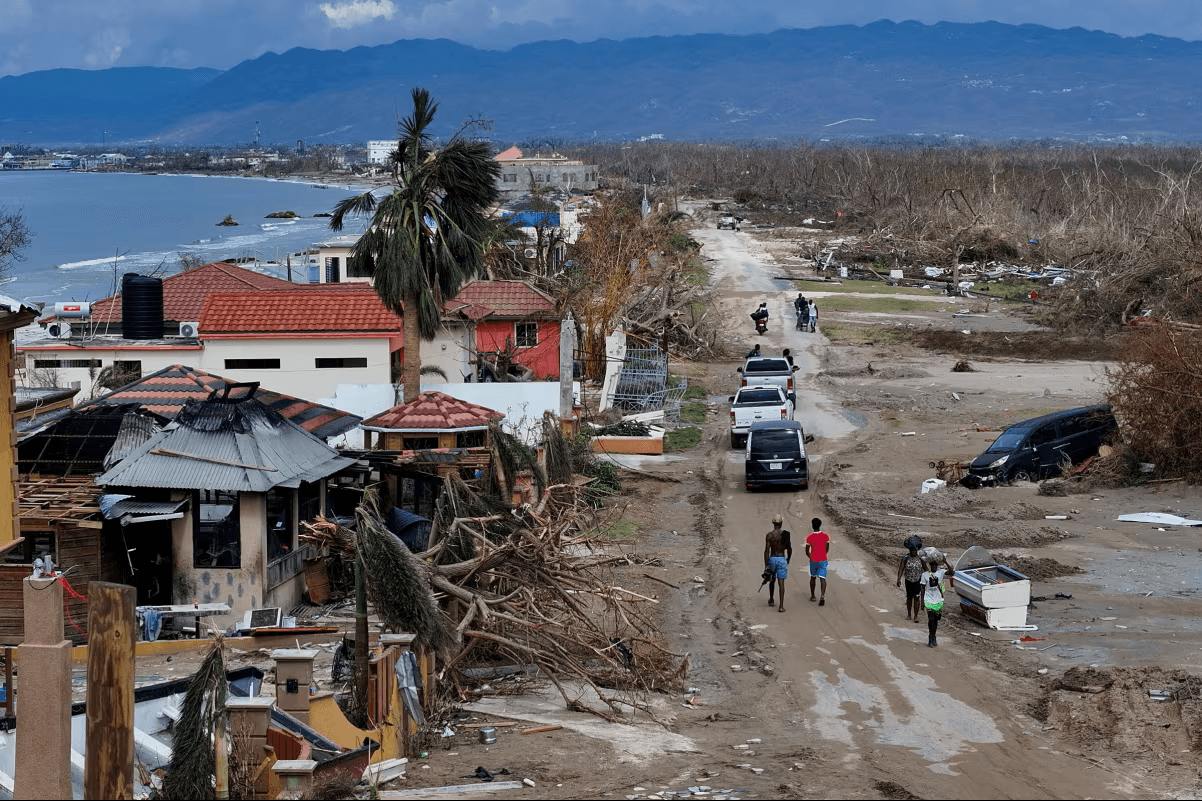
- As Hurricane Melissa approached Jamaica in October 2025, Mona-Lisa was busy with a desperate, unusual task.
- To save her family’s only source of income, she and her three children carried 1,200 chickens, batch by batch, from the coop into their living room.
- They shoved the furniture aside to make room for the flock.
- As Melissa roared outside, the night was a blur of noise and fear.
- When the storm subsided, her chickens were safe, mostly.
As Hurricane Melissa approached Jamaica in October 2025, Mona-Lisa was busy with a desperate, unusual task. To save her family’s only source of income, she and her three children carried 1,200 chickens, batch by batch, from the coop into their living room. They shoved the furniture aside to make room for the flock. As Melissa roared outside, the night was a blur of noise and fear.
When the storm subsided, her chickens were safe, mostly. In the days that followed, the flock dwindled to 840. She faced a setback, but her business did not die.
This story captures something particular about the Caribbean: when resources are thin and life’s storms approach, people find a way. For the five years I have spent working in the region, I saw governments doing the same thing.
When I arrived in Jamaica in 2021 as the World Bank's first Director based in the region, the global landscape was dominated by an immediate, singular crisis—COVID-19. The assumption was that the storm would pass, and we would return to a predictable 'normal.' But the reprieve never came. Instead, we entered an era of cascading shocks: the conflict in Ukraine, an inflation surge, a volcanic eruption, and a relentless succession of climate events, including Hurricane Beryl in 2024, and then Hurricane Melissa in 2025.
These were very intense years of my career. I remember the urgency of finalizing the first-ever Climate Resilient Debt Clause for Barbados, which the country signed just hours before Hurricane Beryl. The clause gives Barbados and now 8 other Caribbean countries an option to defer debt service payments for up to two years following a disaster, freeing up critical cash – an initiative for which Prime Minister Mottley advocated. I also remember the complex negotiations that helped Belize and Suriname secure access to concessional financing, unlocking much-needed resources to strengthen resilience.
What became clear across those years is that resilience is not an end in itself. It is the precondition for growth. A country that spends its energy recovering cannot invest in the jobs, education, and infrastructure that raise living standards. Our work in the Caribbean has been guided by that logic: helping governments stabilize their fiscal position so they can pursue a long-term agenda — one centered on growth, employment, and economic transformation.
Working alongside Caribbean governments, the World Bank Group has made its mark on several areas— each helping to expand the space for investment, productivity, and job creation.
The first is a financial architecture that provides the “space to choose.” A government that faces a hurricane with no pre-arranged financing has no real choices. Jamaica changed that. When Melissa hit Jamaica in October 2025, within days, US$91.9 million arrived from CCRIF and the catastrophe bond paid out US$150 million. With the disbursement of the World Bank-financed Catastrophe Deferred Drawdown Option (Cat DDO) and of other development partners, total pre-arranged financing reached US$650 million. Prime Minister Holness said it was the first time Jamaica did not have to scramble for money post-disaster.
Jamaica is the clearest example, but not the only one. Nine countries across the region now hold contingent financing available through the Cat DDO, giving them immediate access to emergency funds within 48 hours. And the World Bank Crisis Preparedness and Response Toolkit, approved in 2024, allows them to double that financing if required after a disaster or public health emergency. Most World Bank projects in the region also now include a contingency component that allows governments to redirect funds into disaster relief within days rather than months. Together, this is a financing architecture that did not exist a decade ago. It enables governments to activate a pre-negotiated plan the morning after a disaster, and it supports the country in securing long-term investments.
The second is regional scale. For small states, a regional approach changes the cost of almost everything. Infrastructure built regionally costs less per country. Countries negotiating as a bloc secure terms no single island could get alone. Over time, that compounds into a stronger economic position: broader markets, lower costs for citizens, more credible institutions – outcomes the new World Bank Group small states strategy seeks to achieve. And it is precisely that stronger economic base that gives governments room to maneuver when shocks arrive.
High energy costs are among the most significant constraints on private investment and job creation in the Caribbean. Electricity prices in the region are among the highest in the world, putting Caribbean businesses at a structural disadvantage and limiting the kinds of industries that can take root. And while renewable energy is an obvious answer given the region’s natural gifts of sun, wind and geothermal energy, no single island in the Eastern Caribbean has projects large enough to attract premier international investors. Working with the Eastern Caribbean Central Bank, we established a US$235 million facility to accelerate the energy transition to affordable, resilient and clean energy.
By providing risk mitigation and guarantees for renewables, and pooling small projects across islands, the facility creates the scale needed to attract global investors. This is complemented by investments in grid modernization to strengthen resilience. Lower, more stable energy costs make the region more competitive — for tourism, manufacturing, and the growing digital economy — and directly affect the cost of doing business for the small entrepreneurs who drive employment.
This regional approach extends beyond energy. We supported the Caribbean Public Health Agency in building a shared laboratory network so one specialist can provide diagnostics for twelve countries. Similarly, through the Caribbean Digital Transformation Project, the Organization of Eastern Caribbean States (OECS) harmonized fintech and cybersecurity regulation across borders, creating a digital market where a small entrepreneur on one island can reach customers on another.
The third element is people. When La Soufrière erupted in St. Vincent and the Grenadines, physical infrastructure was gone within days. But the knowledge and skills of the people remained. Human capital is the most precious asset of any country. This is why our partnership with Caribbean governments has increasingly shifted toward investing in people. Together we are working on improving foundational learning in Barbados, Sint Maarten, and Guyana, aligning secondary education in Jamaica with the demands of a changing labor market, and strengthening secondary and post-secondary education in the Eastern Caribbean. A population with technical knowledge and adaptive capacity provides a strong basis to keep the economy moving.
Leaving the region today, I know there are still challenges ahead. But Caribbean governments, and their people, like Mona-Lisa, have shown they can prepare for what they cannot prevent.
I’m thankful to have worked alongside the innovative, dedicated and passionate people of the Caribbean, to help build resilience and a better Caribbean.