
What Should a Chiropractic Examination Include After a Car Accident?
Key Points(5)
- After a car accident, patients may be dealing with pain, disrupted routines, appointments, and unfamiliar paperwork.
- It can be difficult to distinguish the clinical evaluation from the administrative process surrounding an injury claim.
- The examination's first purpose is healthcare: understanding the patient's concerns, identifying findings, determining whether further evaluation is needed, and developing an appropriate plan.
- For patients seeking chiropractic care in Providence after a collision, a useful evaluation should also make clear what the available information supports and what it does not.
- Address urgent medical concerns first A chiropractic appointment is not a substitute for emergency assessment.
After a car accident, patients may be dealing with pain, disrupted routines, appointments, and unfamiliar paperwork. It can be difficult to distinguish the clinical evaluation from the administrative process surrounding an injury claim.
The examination's first purpose is healthcare: understanding the patient's concerns, identifying findings, determining whether further evaluation is needed, and developing an appropriate plan.
For patients seeking chiropractic care in Providence after a collision, a useful evaluation should also make clear what the available information supports and what it does not.
Address urgent medical concerns first
A chiropractic appointment is not a substitute for emergency assessment.
If a collision leaves you with weakness, difficulty walking, signs of a head injury, significant neurological symptoms, or pain that is severe or escalating, get medical attention right away. Call 911 or go to an emergency department; do not wait for an outpatient visit.
Begin with a careful history
The clinician needs an account of the event and what followed it.
Relevant questions may address when the collision occurred, the patient's position, initial symptoms, subsequent changes, and any emergency or medical care already received.
The history should also include:
• Relevant prior symptoms or injuries.
• Existing medical conditions.
• Medications and previous treatment.
• Changes in work and daily activities.
• Symptoms that have improved, persisted, or worsened.
Accuracy is more useful than certainty. If you do not remember a detail, say so; do not guess.
Distinguish symptoms from findings
Clear documentation separates different types of information.
A symptom is what the patient reports, such as pain or tingling. A finding is something identified through an examination or test. A functional limitation describes difficulty performing an activity.
These categories can inform one another, but they are not interchangeable. Consider this fictional illustration:
• The patient reports discomfort when turning the head.
• The clinician documents the relevant movement assessment.
• The patient describes difficulty checking traffic while driving.
• The clinician considers the combined information when planning the next step.
At reassessment, the clinician can compare the patient's reported driving difficulty with updated movement measurements and other relevant findings. This helps connect treatment decisions to both measured changes and real-world function.
The example illustrates documentation categories. It does not establish a diagnosis or prescribe treatment.
What tests are used in a post-collision examination?
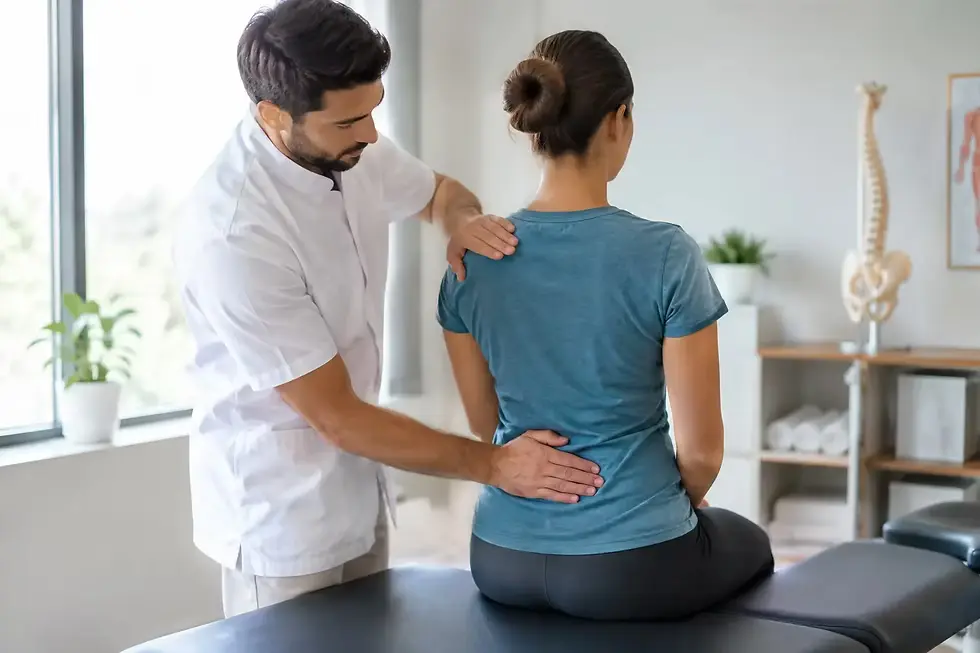
A post-collision examination may include assessment of spinal movement, neurological function, muscle strength, joint function, and relevant orthopedic findings. Depending on the patient's complaints, the clinician may also evaluate balance, visual or oculomotor function, or symptoms suggesting possible concussion. The examination should be directed by the patient's presentation, not by a predetermined testing package.
When clinically indicated at Cityside Chiropractic, I may use:
• Dual inclinometry to quantify spinal movement.
• Dynamometry for selected strength assessments.
• Algometry for pressure-pain thresholds.
• Standardized disability questionnaires.
• Targeted balance or oculomotor testing.
Objective measurements can establish quantified reference points for selected aspects of physical function. When repeated appropriately, they may help identify improvement, persistent impairment, or changes requiring further investigation. Their usefulness depends on proper administration, interpretation, and consistency with the broader clinical picture.
Each measure addresses a specific clinical question; no single test independently proves the cause of an injury. Findings that suggest a need for another setting or professional should change the next step.
Patients can ask what each part of the examination is intended to establish. A longer list of procedures is not, by itself, evidence of a better evaluation.
What about possible concussion?
Patients reporting headaches, dizziness, difficulty concentrating, visual disturbances, or other symptoms following a collision may require additional screening for possible concussion or associated neurological problems. Selected symptom questionnaires, balance assessments, and oculomotor testing can contribute information, but no single test establishes or excludes concussion. Findings may warrant referral for further medical evaluation.
Do you need X-rays or an MRI after a car accident?
Not always. Musculoskeletal ultrasound can help evaluate selected accessible muscles, tendons, ligaments, and superficial soft tissues. X-ray and MRI answer different questions. Testing is most useful when its results are likely to clarify a clinically important concern or change management.
NHS patient guidance notes that tests and scans are not usually required to diagnose whiplash; the need depends on the clinical assessment.
If testing is recommended, ask:
• What question is being investigated?
• How could the result change management?
• What are the test's limitations?
• Are other evaluations needed first?
Testing should not be presented as a routine method of proving every injury or resolving every question about causation.
Document daily function
Pain descriptions alone may not explain the practical effects of a problem.
A useful history includes specific activities the patient finds difficult: driving, lifting, sitting, sleeping, or completing work tasks. "Difficulty working" is less informative than identifying the particular task and how it has changed.
Any work-related recommendation should reflect the clinician's assessment and applicable professional responsibilities, not simply the presence of an insurance claim.
Establish a plan and a reassessment point
The evaluation should lead to an explanation of the findings and an appropriate next step. That might include conservative care, rehabilitation, additional assessment, referral, or a combination. Patients should understand the proposed goals and how the response will be reviewed.
Follow-up assessment may compare symptoms, physical findings, and activity limitations with the initial baseline. Improvement, persistent limitations, and new or worsening concerns should all be recorded accurately, along with the rationale for modifying care.
Understand the limits of documentation
A clinical record should explain what was reported, what was found, and how the clinician interpreted the available information.
The fact that symptoms were reported after a collision is one part of the history. It does not automatically resolve every question about diagnosis, causation, prognosis, or legal responsibility.
Likewise, an imaging finding does not independently answer every question about when a problem developed or what treatment is appropriate.
Putting qualifications in context
Collision-related evaluation and injury documentation are the focus of my practice at Cityside Chiropractic. My qualifications include postgraduate board certifications in chiropractic sports medicine (DACBSP®) and chiropractic rehabilitation (DACRB), along with credentials in musculoskeletal sonography (RMSK®) and impairment rating (CIR®).
Ask how a clinician's qualifications inform your particular evaluation. A credential does not guarantee a diagnosis or an outcome.
A useful post-collision examination is ultimately about clear reasoning: what the clinician knows, what remains uncertain, what action is appropriate, and how the patient's condition will be followed.
About the author
Mark J. Mulak, DC, MBA, MS, DACBSP®, DACRB, RMSK®, CIR®, is the founder and clinical director of Cityside Chiropractic. In practice since 2002, he holds postgraduate board certifications in chiropractic sports medicine and rehabilitation, along with professional credentials in musculoskeletal sonography and impairment rating. His clinical approach emphasizes musculoskeletal evaluation, objective and functional assessment, rehabilitation planning, and appropriate referral. Cityside Chiropractic has offices at 480 Broadway, Providence, RI 02909, and 900 Reservoir Avenue, Cranston, RI 02910. Phone: (401) 272-5710.