US reaffirms support for Guyana's border with Venezuela amid Essequibo controversy
Key Points(5)
- The United States has reaffirmed its support for the 1899 Arbitral Award establishing the land boundary between Guyana and Venezuela, following a Reuters report that a former senior U.S.
- official discussed the possibility of territorial concessions involving the disputed Essequibo region.
- In a statement issued Thursday, Nov.
- Embassy in Georgetown emphasized that Washington's longstanding position on the border controversy remains unchanged.
- “The policy on the land boundary between the two countries has not changed,” the embassy stated.
The United States has reaffirmed its support for the 1899 Arbitral Award establishing the land boundary between Guyana and Venezuela, following a Reuters report that a former senior U.S. official discussed the possibility of territorial concessions involving the disputed Essequibo region.
In a statement issued Thursday, Nov. 19, the U.S. Embassy in Georgetown emphasized that Washington's longstanding position on the border controversy remains unchanged.
“The policy on the land boundary between the two countries has not changed,” the embassy stated.
“The United States reaffirms its support for the 1899 Arbitral Award that determined the land boundary between Venezuela and Guyana, which should be respected unless or until a new boundary is set by a competent legal body or with the consent of both parties.”
The clarification followed an earlier statement from Guyana's Ministry of Foreign Affairs and International Cooperation, which said it had received assurances from Washington that U.S. policy toward the territorial dispute had not changed.
The diplomatic statements came after Reuters reported that Jeremy Lewin, a former U.S. State Department official, had raised the possibility of Venezuela gaining partial control of Guyana's Essequibo region during discussions with Guyanese officials.
According to Reuters, Lewin discussed the proposal with Guyana's Foreign Secretary Robert Persaud during a September meeting in Washington. He also offered to help facilitate talks with Venezuela's acting president, Delcy Rodríguez.
Lewin acknowledged to Reuters that he had held preliminary discussions with officials from Guyana and Venezuela, saying the contacts were authorized by the White House. He departed the State Department in October.
Guyana's Foreign Ministry confirmed that the border controversy was discussed during the September meeting but said the conversation focused on the pending International Court of Justice (ICJ) ruling and continued U.S. support for the judicial process.
According to Reuters, the discussions followed a letter that Rodríguez reportedly sent to U.S. President Donald Trump in May, requesting American assistance in facilitating direct negotiations with Guyana. Lewin said Rodríguez also raised the issue during a meeting in Caracas in July. Reuters could not independently verify the letter's authenticity.
The White House referred questions about the discussions to the State Department, which maintained that U.S. policy on the Guyana-Venezuela boundary had not changed.
Long-running dispute over Essequibo
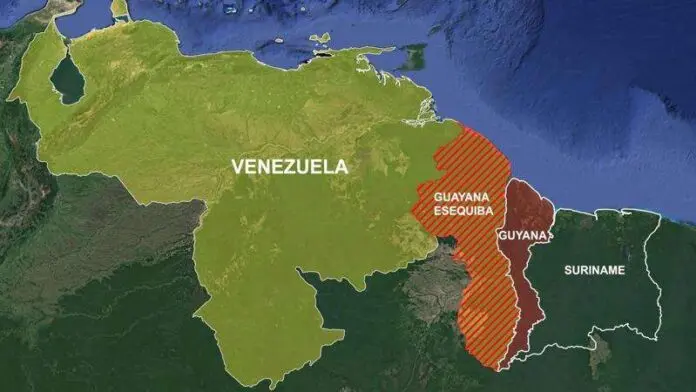
The Essequibo region covers approximately two-thirds of Guyana's territory and is rich in natural resources, including gold, diamonds and bauxite. Although administered by Guyana, the territory has been claimed by Venezuela for more than 180 years.
The dispute intensified following major offshore oil discoveries in 2015, which transformed Guyana into one of the world's fastest-growing oil-producing economies.
Guyana maintains that the 1899 Arbitral Award legally established its boundary with Venezuela, while Caracas has challenged the award's validity and called for negotiations over the territory.
In 2018, Guyana brought the dispute before the International Court of Justice, seeking a ruling affirming the validity of the 1899 award and the boundary it established. The court held hearings in May 2026, but a final ruling remains pending.
Guyana has repeatedly maintained that its sovereignty over Essequibo is not open to negotiation and that the controversy should be resolved through the ICJ.
The latest developments come amid improving relations between Washington and Caracas following the U.S. capture of former Venezuelan President Nicolás Maduro earlier this year.
Despite those diplomatic developments, Washington has publicly maintained its support for Guyana's territorial integrity and the international judicial process.
The U.S. Embassy's latest statement reinforces that position, even as questions remain about the nature and scope of the preliminary discussions involving Lewin and Venezuelan officials.