UN reports more than 1,000 killed in Haiti as gang violence persists
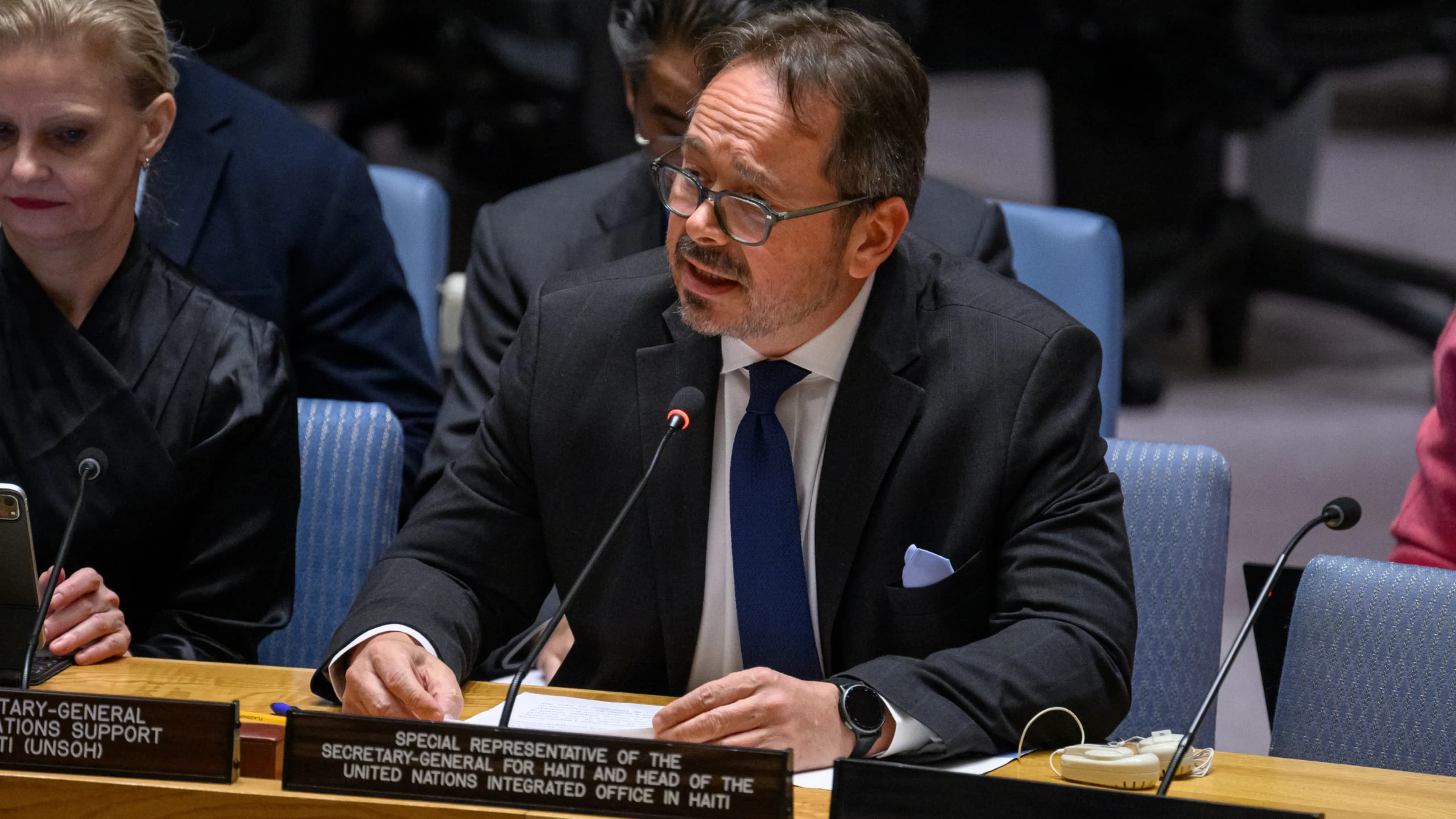
The Special Representative of the Secretary-General and Head of the United Nations Integrated Mission in Haiti, Carlos Ruis Massieu, briefs the Security Council. UN Photo / Loey Felipe
Key Points(5)
- More than 1,000 people were killed in Haiti between July and September as armed gangs continued to challenge state authority, according to the United Nations, which is calling for sustained international support to strengthen security operations and advance the country’s political transition.
- Carlos Ruiz Massieu, the UN secretary-general’s special representative for Haiti, presented the figures to the Security Council on Monday, October 19, saying the UN Integrated Office in Haiti (BINUH) had also documented more than 100 kidnapping victims during the three-month period.
- He warned that sexual violence remained widespread and self-defence groups continued to expand as gangs adapted their tactics in response to intensified security operations.
- “On the ground, we are witnessing increasing reliance on retaliatory violence against communities, including hostage-taking and other forms of intimidation,” Ruiz Massieu said, adding that gangs were seeking to undermine state authority, maintain territorial control and spread fear.
- He condemned the violence and urged Haitian authorities to strengthen national security institutions and take measures to protect communities.
More than 1,000 people were killed in Haiti between July and September as armed gangs continued to challenge state authority, according to the United Nations, which is calling for sustained international support to strengthen security operations and advance the country’s political transition.
Carlos Ruiz Massieu, the UN secretary-general’s special representative for Haiti, presented the figures to the Security Council on Monday, October 19, saying the UN Integrated Office in Haiti (BINUH) had also documented more than 100 kidnapping victims during the three-month period.
He warned that sexual violence remained widespread and self-defence groups continued to expand as gangs adapted their tactics in response to intensified security operations.
“On the ground, we are witnessing increasing reliance on retaliatory violence against communities, including hostage-taking and other forms of intimidation,” Ruiz Massieu said, adding that gangs were seeking to undermine state authority, maintain territorial control and spread fear.
He condemned the violence and urged Haitian authorities to strengthen national security institutions and take measures to protect communities.
The briefing came as the international Gang Suppression Force (GSF) expanded its presence in metropolitan Port-au-Prince and the Artibonite Department, supported by additional troop deployments.
Ruiz Massieu welcomed the expansion but said the force’s full deployment remained critical to addressing the security crisis. He also acknowledged the Haitian government’s decision to increase funding for national security institutions, including the Haitian National Police and the Armed Forces of Haiti.
The latest security concerns coincide with an attack on Salvadoran personnel serving with the GSF. Four Salvadoran aviation technicians went missing after their armoured vehicle was attacked with explosives and set on fire in Croix-des-Bouquets, near Port-au-Prince, on Sunday, October 18.
The technicians escaped the burning vehicle, but their whereabouts remained unknown as efforts to reach the area were hampered by intense fighting. The incident has highlighted the dangers facing international personnel operating in gang-affected areas.
Guatemala also announced the deployment of a new contingent of military police to support the GSF. The move forms part of international efforts to reinforce security operations in Haiti.
Despite the security challenges, preparations for elections have continued. Ruiz Massieu told the Security Council that more than 35 political parties and groupings and more than 3,500 candidates had registered, marking significant progress after more than a decade without elections.
A revised electoral decree published on October 6 introduced measures including an extended candidate registration period, provisions intended to facilitate women’s candidacies and online voter registration.
However, Ruiz Massieu cautioned that election dates must be based on realistic assessments of security and logistical conditions.
“The repeated announcement of electoral dates without a realistic assessment of their feasibility can only erode public confidence and the credibility of Haitian institutions,” he said.
He also called for stronger national mechanisms to address allegations of crime and corruption, saying the rule of law and judicial system would be essential to restoring public confidence in state institutions.
Meanwhile, the humanitarian crisis continues to deepen. Renewed insecurity displaced more than 17,000 people over the preceding three months, bringing the number of internally displaced people in Haiti to nearly 1.5 million, including more than 740,000 children.
The country’s economic outlook also remains bleak, with the economy projected to contract for a seventh consecutive year in 2026. Ruiz Massieu said less than half of the humanitarian response plan for the year had been funded, warning that the gap between humanitarian needs and available assistance could widen without additional international support.
He stressed that security operations alone would not deliver lasting stability, calling for a Haitian-led approach combining the recovery of territory with a sustained state presence, justice initiatives and programmes to disarm, dismantle and reintegrate armed groups, with particular attention to children recruited by gangs.
Ruiz Massieu urged UN member states to maintain their support for Haiti, including contributions to the GSF trust fund and the Haiti Peace Dividend Fund.
He said progress in security, politics and election preparations would need to advance together to help restore democratically elected institutions and lay the foundations for lasting peace and stability.