Trinidad says objection to CARICOM SG reappointment is 'neither personal nor political'
Key Points(5)
- Trinidad and Tobago says its objection to the reappointment of Dr.
- Carla Barnett as secretary-general of the Caribbean Community (CARICOM) is "neither personal nor political," insisting its concerns center on the legality of the process used to grant her a second term.
- "Regional unity cannot rest upon expediency and irregular practices masquerading as precedent.
- It must rest upon adherence to the rules which every Member State has freely accepted and undertaken to uphold," Persad-Bissessar wrote in the letter, a copy of which has been obtained by the Caribbean Media Corporation (CMC).
- The issue has emerged as a major topic of discussion during the 51st CARICOM Heads of Government Summit in St.
Trinidad and Tobago says its objection to the reappointment of Dr. Carla Barnett as secretary-general of the Caribbean Community (CARICOM) is "neither personal nor political," insisting its concerns center on the legality of the process used to grant her a second term.
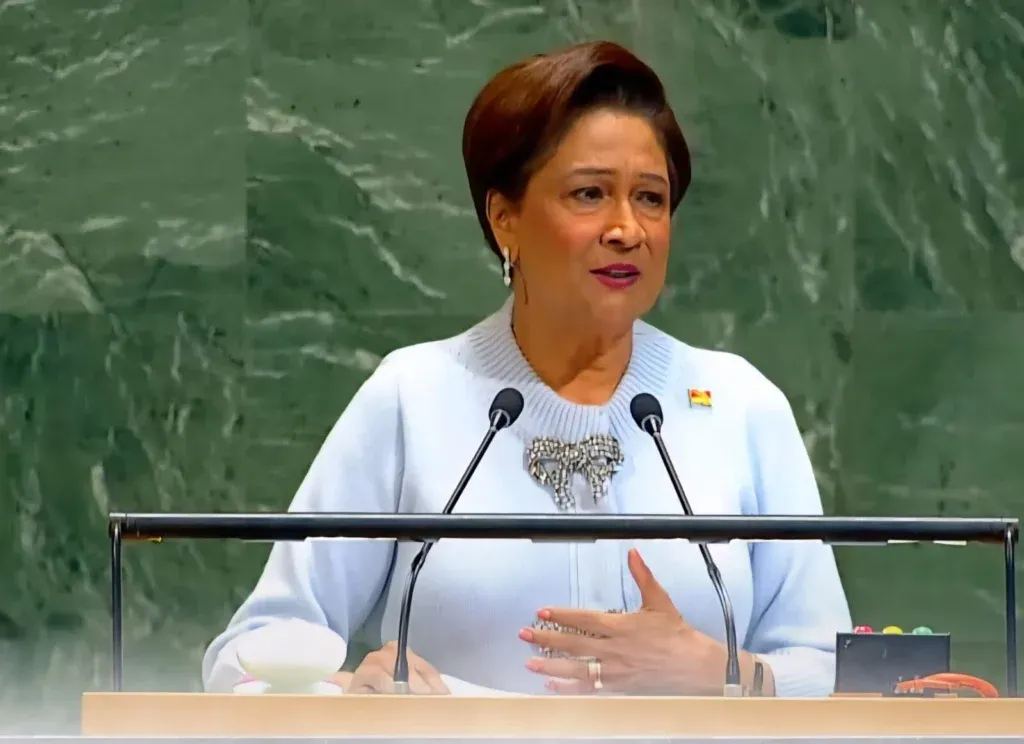
In a 22-page letter dated July 3 to regional leaders, Prime Minister Kamla Persad-Bissessar said Port of Spain's position "is not directed towards any individual" but rather concerns "the legality of the process adopted, the integrity of our institutions and the faithful observance of the constitutional framework established by the Revised Treaty of Chaguaramas."
She said her administration "does not accept the process by which the Secretary General was purportedly reappointed and, consequently, is unable to recognise the validity of the purported second term of the Secretary General."
"I wish to be very clear: our position is not held to create division within the Community, but to preserve the constitutional order upon which the legitimacy and credibility of Caricom ultimately depend.
"Regional unity cannot rest upon expediency and irregular practices masquerading as precedent. It must rest upon adherence to the rules which every Member State has freely accepted and undertaken to uphold," Persad-Bissessar wrote in the letter, a copy of which has been obtained by the Caribbean Media Corporation (CMC).
The issue has emerged as a major topic of discussion during the 51st CARICOM Heads of Government Summit in St. Lucia, where regional leaders entered retreat on the first working day of the four-day meeting chaired by St. Lucia Prime Minister Philip J. Pierre.
Persad-Bissessar is urging leaders to seek an advisory opinion from the Trinidad-based Caribbean Court of Justice (CCJ) on the matter and has proposed that Barnett remain in office on a month-to-month basis until the court rules on the dispute.
"Such an interim extension should be expressly stated to be without prejudice to the legal rights or positions of any Member State, and should not be construed as affirming the validity of the impugned reappointment process.
"Pending the determination of the advisory proceedings: (a) the incumbent Secretary General shall fully recuse herself from the exercise of any authority whatsoever or from taking any decision, directly or indirectly, regarding the said advisory proceedings. Responsibility for such action shall be vested entirely in the Deputy Secretary General or some other independent person or body.
"The General Counsel shall recuse herself from the matter of the advisory opinion in light of her primary role as an adviser to the Secretary General, who is the subject of the proposed advisory opinion."
She also called for the questions arising under the Revised Treaty of Chaguaramas to be urgently referred to the CCJ under Article 212 of the treaty.
"Given the constitutional significance of the issues and their implications for the governance of the Community, the Court should be requested to hear and determine the reference on an urgent basis," she wrote.
Barnett, the first woman to serve as CARICOM secretary-general, assumed office on Aug. 15, 2021. Her reappointment was announced during the CARICOM summit in St. Kitts and Nevis in February.
Persad-Bissessar arrived at the summit's opening ceremony on Sunday after Barnett had already delivered her remarks. During the ceremony, St. Kitts and Nevis Prime Minister Dr. Terrance Drew praised Barnett's leadership of the Guyana-based CARICOM Secretariat.
"You have understood the importance of preserving the impartiality of the Secretariat while faithfully implementing the decisions of Heads of Government," Drew said. "That balance has strengthened this Community, and for this I offer, on behalf of all of us, our sincerest gratitude."
In her letter, Persad-Bissessar said her government had "set out our proposals for a final and conclusive determination of the issues arising therefrom by the Caribbean Court of Justice by way of an advisory opinion, as well as proposals for interim measures."
She argued that Article 24 of the Revised Treaty "expressly gives the power to appoint and reappoint the Secretary General to the Conference, not to a Retreat, caucus or informal gathering of Heads of Government."
"While a Retreat may lawfully facilitate confidential discussion, it cannot replace the constitutional institution designated by the Revised Treaty to exercise the power of appointment."
Persad-Bissessar maintained that the Rules of Procedure govern how the Conference conducts its deliberations but do not alter the authority established under the treaty.
"Accordingly, where the decision itself was taken at the Heads-only Retreat rather than by the Conference acting in accordance with Articles 11 and 24 of the Revised Treaty, the reappointment was made by a body lacking the constitutional competence to exercise that power and was therefore inconsistent with the Revised Treaty."
She further argued that the Heads of Government retreat did not legally constitute a Conference "and/or indeed a caucus" for the purposes of exercising the power to reappoint the secretary-general under Article 24(1).
"It is clear that the Retreat of Heads was seen as something separate and apart from the plenary session of the Conference or a caucus under Rule 19(3) of the Rules of Procedure for Meetings of the Conference of Heads of Government of Caricom.
"The powers conferred by a constitutive treaty upon an institutional organ must ordinarily be exercised in the manner prescribed by the treaty. Caricom organs possess only those powers conferred by the Revised Treaty and must exercise them consistently with its institutional framework.
"Where a treaty creates an organ and specifies how that organ is composed and how it acts, compliance with those requirements is ordinarily a condition of validity rather than administrative convenience. Substance prevails over nomenclature. A body cannot avoid treaty obligations merely by changing labels. Equally, a gathering cannot acquire treaty powers merely because participants overlap with those who ordinarily constitute the treaty organ."
Persad-Bissessar also questioned the absence of any reference to Barnett's reappointment in the communiqué issued after the February meeting.
She said the March 1, 2026, communiqué only noted that leaders had agreed to establish a special committee comprising the leaders of Barbados, Dominica, Guyana and Jamaica to review the governance and financing of Community institutions.
"That omission deprived Member States of the opportunity to prepare for deliberation upon a matter affecting one of the highest constitutional offices within the Community. Any suggestion that past practice dispenses with the need to identify such an important constitutional question expressly on the agenda cannot be reconciled with the principles of openness, legality and informed participation which underpin the Revised Treaty.
"Further, wrong past practice cannot be used to validate present wrong practice – two wrongs do not make a right."
The prime minister also argued that the reappointment process failed to comply with Article 24, which she said establishes a mandatory sequence requiring the Community Council to first make a recommendation before the Conference can appoint or reappoint a secretary-general.
"No recommendation was sought or obtained from the Community Council before the purported reappointment. This requirement is neither procedural nor optional. It forms an essential constitutional safeguard intended to ensure that the Conference exercises its appointing authority only after receiving the institutional advice contemplated by the Revised Treaty."