

Strength Training for Soccer Players: Why Strong Legs Alone Aren't Enough
Key Points(5)
- Soccer places high demands on the entire body.
- Rapid sprints, abrupt changes of direction, physical duels, and jumps require not only endurance and technique but also strength, stability, and coordination.
- Training often focuses heavily on the legs.
- However, strong thighs and calves alone do not make a fully resilient soccer player.
- A balanced strength training program should therefore incorporate various muscle groups and align with the demands of the game.
Soccer places high demands on the entire body. Rapid sprints, abrupt changes of direction, physical duels, and jumps require not only endurance and technique but also strength, stability, and coordination. Training often focuses heavily on the legs. However, strong thighs and calves alone do not make a fully resilient soccer player. A balanced strength training program should therefore incorporate various muscle groups and align with the demands of the game.
Why Strong Legs Are Important for Soccer Players
Leg muscles undoubtedly form a crucial foundation for many soccer-specific movements. Whether accelerating, sprinting, stopping, or shooting, the thighs, glutes, and calves are constantly engaged. Exercises such as squats or lunges can help build the strength needed for these actions.
However, the key is not simply the ability to lift heavy weights. Soccer players must be able to apply force quickly while maintaining body control. Therefore, training should address movement quality and stability alongside raw muscle strength.
The Upper Body Plays an Underestimated Role
In soccer, the upper body often receives less attention than the legs, yet its strength is highly relevant to the game. A stable posture helps maintain balance during physical duels, when shielding the ball, or in aerial challenges.
Exercises targeting the back, shoulders, chest, and arms can thus be a valuable addition to standard leg training. The goal is not necessarily maximizing muscle size, but rather developing a capable body that can execute various movements with control.
A Strong Core Connects the Upper and Lower Body
The core plays a special role. Trunk muscles stabilize the body and link the upper and lower body together. After all, sprinting, making rapid changes of direction, or taking a shot requires force to be coordinated across multiple areas of the body.
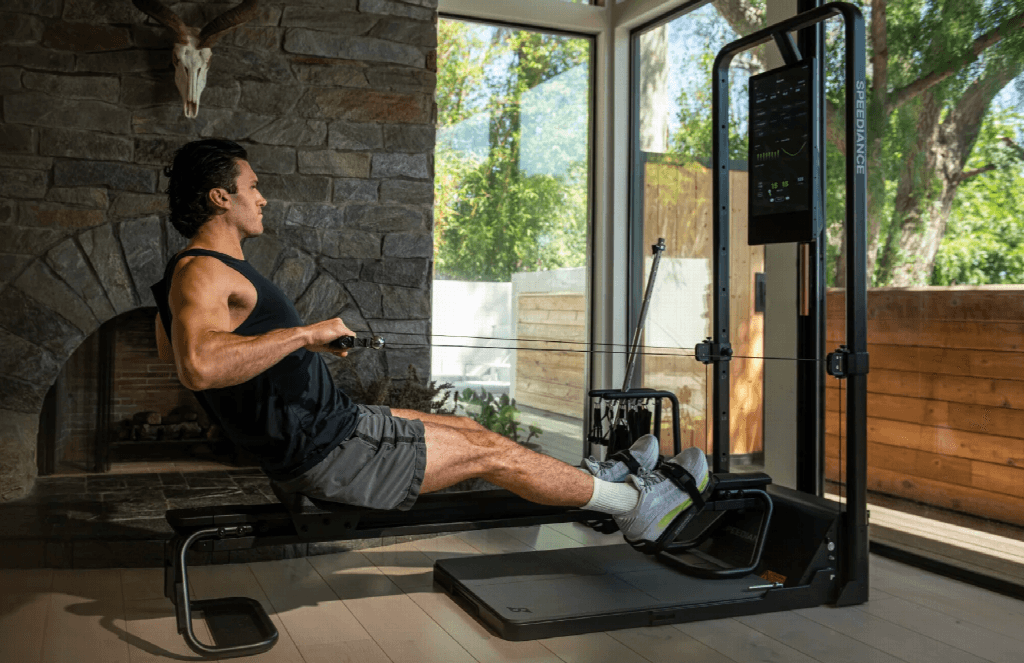
Regular core training can therefore be a valuable supplement to soccer training. Exercises such as planks, side planks, or controlled rotational movements can be performed without requiring much space. Players wishing to fit strength training in at home—alongside their club training—can also use home gym equipment from Speediance to target various muscle groups. For amateur soccer players in particular, easily incorporating such exercises into their daily training routine can be highly beneficial.
Integrating Strength, Explosiveness, and Mobility
Footballers do not need strength that works only in the gym; the ability to apply that strength in dynamic situations is far more important. A good training program should therefore combine strength with explosiveness, mobility, and coordination.
Squats and lunges, for instance, can form the foundation for leg strength. Complementary jump exercises can train rapid force development, while core exercises support stability. Mobility should not be overlooked either, ensuring that various movement patterns can be executed with maximum control.
However, more training is not automatically better. The workload should align with the individual's fitness level and the rest of the training schedule.
Strength Training Outside the Club
Training time is often limited, especially in amateur football. Between team training and match days, there is not always much time left for additional strength training. Consequently, it can be practical to flexibly integrate individual sessions into daily life.
Home training equipment offers a way to perform various exercises independently of club facilities. Modern systems can provide a range of resistance levels and movement patterns within a compact footprint. For example, Speediance Gym Monster 2 can be used for versatile home strength training when planning extra sessions alongside team practice.
The primary advantage of such a solution is flexibility. Instead of having to visit a gym for every workout, additional strength training can be more easily integrated into one's daily routine.
How Footballers Can Effectively Integrate Strength Training into Their Weekly Schedule
Strength training should always be viewed in the context of the entire weekly schedule. After an intense match, the priority might initially be recovery. Conversely, an additional strength session could be beneficial on a day off from team training.
Particular care should be taken to avoid excessive strain before an important match. Intense leg training immediately prior to a game, for example, can impair recovery. Therefore, training volume and intensity must be adjusted accordingly. A potential weekly schedule might consist of team training, match day, recovery, and one or two supplementary strength training sessions. The exact nature of these sessions depends on factors such as age, performance level, the match schedule, and individual fitness.
Holistic fitness makes the difference
Strong legs remain a crucial foundation for footballers. However, they are only one part of the physical attributes required on the pitch. A high-performance football physique also demands a stable core, a robust upper body, coordination, and the ability to apply power quickly and in a controlled manner.
Consequently, a holistic strength training program can be a valuable addition to regular football training. By targeting various muscle groups and sensibly coordinating the workload with matches and team sessions, players create the conditions not only to build strength but also to apply it effectively during on-field movements.


