Shaq hands FAU students the credit playbook he wishes he’d had in college
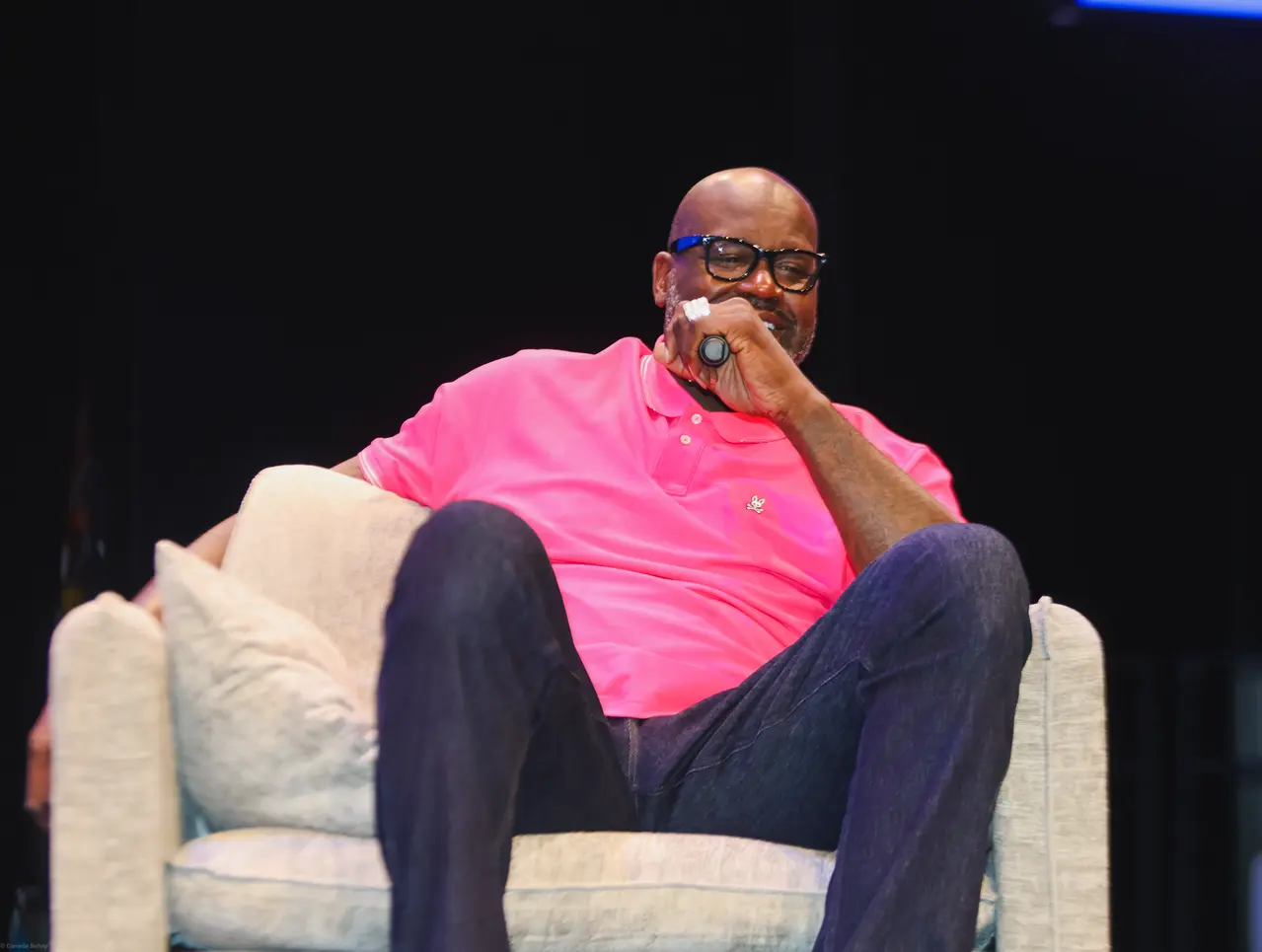
Shaquille O’Neal shares a laugh during the Credit One Bank Credit Tip Off Tour at Florida Atlantic University’s Carole & Barry Kaye Auditorium in Boca Raton on Nov. 9. He told students how he turned an early credit setback into a lesson, fixing his credit so he could buy his mother a house as an Orlando Magic rookie. Photo by Danielle Domond-Bishop
Key Points(5)
- A student near the front of the Carole & Barry Kaye Auditorium came prepared.
- He had written on his white T-shirt in black marker, in big, shaky capitals: SHAQ SIGN A BALL FOR MY BROTHER.
- He held up a ball and a Sharpie, just in case.
- Asking for something on behalf of someone you love turned out to be the thread of the night at Florida Atlantic University on Nov.
- The man on stage had done the same thing once, at a bank, and he’d been told no.
A student near the front of the Carole & Barry Kaye Auditorium came prepared. He had written on his white T-shirt in black marker, in big, shaky capitals: SHAQ SIGN A BALL FOR MY BROTHER. He held up a ball and a Sharpie, just in case.
Asking for something on behalf of someone you love turned out to be the thread of the night at Florida Atlantic University on Nov. 9. The man on stage had done the same thing once, at a bank, and he’d been told no. More than three decades later, he came to Boca Raton to help a room full of college students hear yes when their turn comes.
The FAU stop was the fourth and final date of the Credit One Bank Credit Tip Off Tour, a free college series hosted by Shaquille O’Neal as the bank’s “Credit Professor.” The tour opened Sept. 14 at Southern Methodist University in Dallas, then visited Georgia State University in Atlanta and Fred’s Bar in Baton Rouge before closing in Boca Raton.
Media personality Brianna “Chickenfry” LaPaglia hosted the night alongside O’Neal and Credit One Bank Chief Marketing Officer Michael Coleman.
Coleman introduced his co-panelist as “Dr. Shaquille O’Neal.” He has earned the title. O’Neal received his doctorate in education from Barry University in Miami Shores in 2012.
‘Not up to par’
LaPaglia asked O’Neal whether one lesson from his own credit journey had stuck with him. He went back to his rookie year.
“When I got drafted to the Orlando Magic, I wanted to buy my mom a house,” he said.
He didn’t need a loan, but he applied for one anyway because, as he put it, “that was a smart thing to do.” The banker turned him down and told him his credit was “not up to par.”
“I thought because you have a lot of capital, it means you automatically have great credit,” O’Neal said. “That’s not the case at all.”
The trouble had started in college, with his first credit card.
“I wish they would have told me a credit card wasn’t free money,” he said. “I was saying to myself, ‘I’ll pay it back later.’ And I missed a couple payments, and then when I tried to buy my mom a house, reality kicked in.”
“As a kid, it was a dream to get her house,” O’Neal said. “I was supposed to deliver it on that day.”
He fixed his credit. The delay cost him about a week, and his mother got her house.
“You don’t know what you don’t know,” he told the students. “But I’m the type that when I get certain information that’s gonna better me, for business, for personal reasons, I take advantage of it.”
He was about their age when he made those mistakes. That’s why he tells the story.
Why a bank paid for the lesson
LaPaglia noted that many students in the room were hearing these lessons for the first time and that credit can affect everything from apartment rentals to interest rates and car loans.
Coleman was upfront about why a credit card company would invest in a tour like this.
“It’s not something that’s taught in school, and many times your parents aren’t teaching you,” he said. “We’re good at giving access.”
The Las Vegas-based issuer, in business since 1984, has given 40 million people access to credit, Coleman said, and what it has learned is that “pairing access with education is where you get empowerment.”
The partnership with O’Neal grew out of Credit One sponsoring one of his Shaq’s Fun House Super Bowl parties.
“He understands finances, understands credit,” Coleman said. “And I think people tend to listen to him more than me.”
Meet the Credit Wreckers
Credit One built the tour around the Credit Wreckers, four fuzzy cartoon characters, each acting out a common mistake. Coleman took the students through them one at a time, and each came with an easy fix.
Miss Payment is the bill that slips by. Turn on autopay for at least the minimum payment, and she’s handled.
Max Out is trickier. Say the bank gives you a $1,000 credit line. Coleman’s advice was to use up to about $300 of it, pay it back and repeat, staying under 30% of the limit. Even if you never miss a payment, a balance that sits at $800 or $900 can hold your score down.
Cancelina is the one Coleman called counterintuitive. She pays off a card and closes it, which feels responsible.
“What these credit bureaus want to see is that you have long relationships with banks,” Coleman said.
So keep the old card open, even if it lives in a drawer.
One Track Jack has only one kind of credit. Over time, a card plus something like a car loan or a home loan shows lenders you can handle more than one type.
Nobody on stage claimed to be perfect, least of all the host. LaPaglia called herself “probably the Max Out guy” and admitted to a Cancelina moment, too, when she paid something off and assumed she could cancel it.
“Wrong,” she said. “I’m still paying for it now.”
You are your own business
O’Neal had the whole auditorium chanting three letters back to him.
“OPM stands for other people’s money,” he said.
Many of them won’t have the capital to buy a house or start a business on their own, he explained. When they go to the bank, it will ask for their name and Social Security number, and then it will check their credit.
“If your credit is above 700, you should have no problem getting a loan,” he told them.
Seven hundred is a great goal. It isn’t the only way in, though. FHA-insured mortgages, a common route for first-time homebuyers, accept scores as low as 580 with 3.5% down, although many lenders set higher minimums. And wherever your score sits today, raising it usually makes borrowing cheaper.
For the future entrepreneurs in the seats, Coleman put it in business terms.
“You are your own business,” he said. “Treat it like you are your business.”
LaPaglia said her own credit score wasn’t built early. Since the students are already in school and learning this, her advice was to “just hit the ground running and be smart about it.”
Coleman picked up on her point with a line that a lot of families in our community will recognize.
“You could have a lot of cash at 26, 27, 28 and no credit score, and it’s still hard to get other people’s money to do things you want to do with your life,” he said.
In a lot of Caribbean homes, saving comes first. Many of us grew up watching our parents pay cash whenever they could and save through a rotating savings club, the kind Jamaicans call a partner, Trinidadians and Guyanese call a sou-sou, and Haitians call a sòl.
Everyone pays in each week or month, and each member takes home the full pot in turn. That discipline has built a lot of homes.
What it doesn’t build is a credit history, because money saved in a partner or sou-sou never shows up on a credit report. Pair those savings habits with credit used wisely, and they can open the door to a mortgage, a business loan or a first apartment.
Shots for tuition
Then came the games.
Students played live trivia on Kahoot! from their phones, and on one question alone, the screen counted 581 answers. Three contestants on stage wrote their answers on whiteboards.
How long can a missed payment stay on your credit report? Up to seven years.
What share of your credit line should you try to stay under? 30%.
What can happen when you close an old card? Your credit history can get shorter, and your score can drop.
Every right answer earned a shot at an onstage hoop, and students in the crowd also shot for $5,000 toward tuition.
The women kept outshooting the men, and the verdict from the stage was hard to argue with: “The girls run FAU.”
During the Q&A, a student asked O’Neal whether he had ever made a bad business decision.
“Yes, I’ve made a lot of bad business decisions,” he said. “But my father was a drill sergeant, so I’m programmed not to make the same mistake twice.”
Another student asked LaPaglia what she would tell the version of herself who was just starting out on TikTok.
“I would tell her just to keep her head down and keep going,” she said. “If it’s something you want, you really have to commit to it.”
Then the lights went down
O’Neal is no stranger to FAU. He played the university’s Bonfire as DJ Diesel in 2024.
When the DJ Diesel logo lit up the screen, the seats emptied toward the stage. Phones went up. Cutouts of the Credit Wreckers bobbed over the crowd on sticks.
O’Neal, in a hot-pink polo, worked the decks with a microphone in hand while staff passed basketballs to the front row.
At one point, the whole room was singing “Don’t Stop Believin’” back to him, which felt about right.
Before the music started, Coleman gave the students one last push.
“Don’t be afraid of it,” he said of credit. “Start building those habits now.”
O’Neal had already told them where those habits lead. Earlier in the night, he’d told them, “I know smart kids when I see it.”
Then he made them a promise.
“If you do that and you follow those tips, you will be successful,” he said. “Trust me.”
Where to start
Credit One Bank’s Credit Wreckers lessons are posted at creditonetipofftour.com.
If you’re thinking about buying a home, a HUD-approved housing counseling agency can review your credit with you, help you build a budget and get you mortgage-ready.
Find one by calling HUD at 800-569-4287 or by searching by ZIP code at consumerfinance.gov/find-a-housing-counselor.
HUD-approved agencies include Housing Foundation of America, a multistate organization with offices in Florida and North Carolina. It assists clients nationwide and provides counseling in English, Spanish and Creole. It can be reached at 954-923-5001 or homeapproved.org.
Disclosure: Danielle Domond-Bishop is the marketing and outreach manager at Housing Foundation of America, a HUD-approved housing counseling agency. HFA was not a sponsor or partner of the Credit Tip Off Tour.