Opinion: Elections alone won’t solve Haiti’s problems
Key Points(5)
- Haiti has general elections scheduled for July 18, 2027.
- But what difference would electing a new government make in a country where gangs rule, lawlessness is rampant, and poverty is palpable?
- What does Haiti’s future look like even with a new government if that government doesn’t exercise control?
- Elections are important, but holding an election and governing are two very different things.
- Haiti is experiencing several crises simultaneously: A security crisis, with armed gangs controlling substantial territory and intimidating the population.
Haiti has general elections scheduled for July 18, 2027. But what difference would electing a new government make in a country where gangs rule, lawlessness is rampant, and poverty is palpable? What does Haiti’s future look like even with a new government if that government doesn’t exercise control?
Elections are important, but holding an election and governing are two very different things.
Haiti is experiencing several crises simultaneously:
A security crisis, with armed gangs controlling substantial territory and intimidating the population. A political crisis, with weak institutions, corruption allegations and a prolonged absence of elected national leadership. An economic crisis, with widespread unemployment, poverty and food insecurity. A humanitarian crisis, with displacement, inadequate health care and children growing up amid violence.
These crises are related. Gangs undermine economic activity; poverty makes recruitment easier; weak institutions struggle to provide security; and insecurity makes rebuilding institutions increasingly difficult.
It’s not even certain whether the elections will be held. The first round of presidential and parliamentary elections was scheduled for Dec. 13, with a second round planned for Feb. 21, 2027. However, on Oct. 19, the U.N. reported the indefinite postponement of these elections because of security concerns.
The U.N. cautioned against setting another date without first establishing whether elections can realistically be conducted. This demonstrates that the security crisis is so serious that it’s preventing the country from completing the transition to elected government.
Relentless gang violence over the past several months has resulted in approximately 1.5 million people being displaced from their homes. More than 1,100 people were killed in gang-related violence between July and early October, and the economy is projected to contract for a seventh consecutive year.
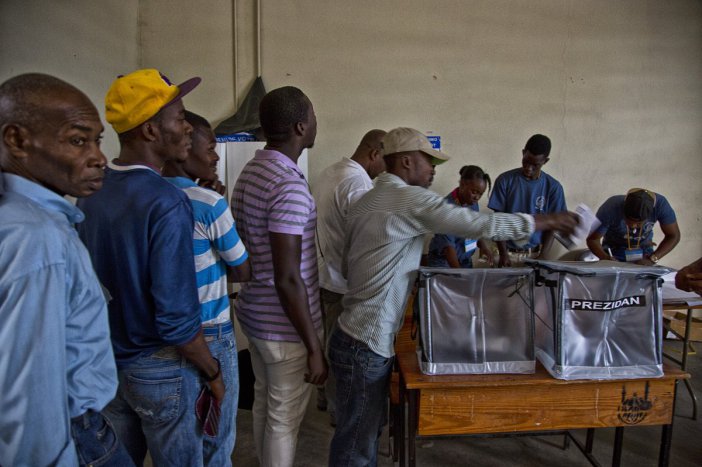
Moreover, voter participation could be very limited. In a nation with an estimated 6.5 million voters, only 759,257 potential voters had registered by Oct. 5.
Haiti needs an elected government to create legitimacy in governance. It needs a government recognized as having a democratic mandate. An elected president and parliament could begin rebuilding public confidence and provide legitimate authority for negotiating with international partners.
A legitimate government could establish clearer national priorities for the Haitian National Police, the armed forces and the international Gang Suppression Force. But it would need to do more than authorize military operations. It would need to restore police stations, courts, prisons and functioning local government.
A legitimate government could negotiate international assistance, encourage investment, rebuild infrastructure and restore basic services. A government is needed to create a functioning judiciary, an effective civil service and institutions capable of investigating corruption and prosecuting criminal activity.
A credible government can provide a constitutional foundation for rebuilding these institutions. However, violent gangs present a serious obstacle to the basic functioning of such a government.
These gangs are not ordinary criminal organizations committing isolated acts of violence. Some have developed territorial control, weapons networks and recruitment systems, and intimidate entire communities. They interfere with transportation, commerce, food distribution and access to public services.
The U.N. warned that gangs are adapting to security operations, retaliating against civilians and extending their reach beyond the capital.
A new government must not only remove gangs from communities but also restore control over these communities. If the government succeeds in removing gangs, it must protect residents, operate schools, restore public utilities and health care, and beef up security to ensure another gang doesn’t move in.
A new government must seek to provide employment for young people to curtail the pull to join criminal organizations.
If the government cannot achieve these priorities, an election victory will be meaningless.
Haiti now needs gradual recovery, with local and international security forces progressively regaining territory, elections being conducted and the elected government focusing on rebuilding the police, judiciary, schools and economy. This would be a long process, probably taking years.
Even with a new government, gangs could retain substantial territorial control, with the government operating from limited secure areas, depending heavily on international assistance and struggling to deliver services. Democracy would exist formally, but ordinary Haitians would see little improvement in their daily lives.
There’s a possibility that elections could remain delayed, transitional arrangements could continue, gangs could expand their influence and more people could flee their homes, with state institutions becoming increasingly unable to exercise authority.
If this situation prevails, coordinated and sustained international assistance will be critically needed to determine Haiti’s stability and overall recovery.
The U.S., Canada, CARICOM, the U.N. and other international partners must avoid treating military intervention as a substitute for Haitian political leadership and support the transition to democratic government.
Haiti cannot become a functioning country mainly by defeating armed gangs. It must also give its population reasons to believe peaceful, lawful participation in society offers a better future instead of repeating decades of institutional weakness, political instability, corruption, economic hardship and external dependency.
The new government’s most difficult task will be rebuilding a relationship of confidence with the people.
Haitians must regain confidence in the police, courts and government, making it possible for them and their children to live without fear, operate businesses and travel without paying gangs for permission. They need a government that represents them, not the interests of political and economic elites.
Haiti needs more than a new government. It needs a new political and social compact between its citizens, institutions and the international community.