Johnson Smith rejects Patterson's claim of parliamentary breach over Cuba vote
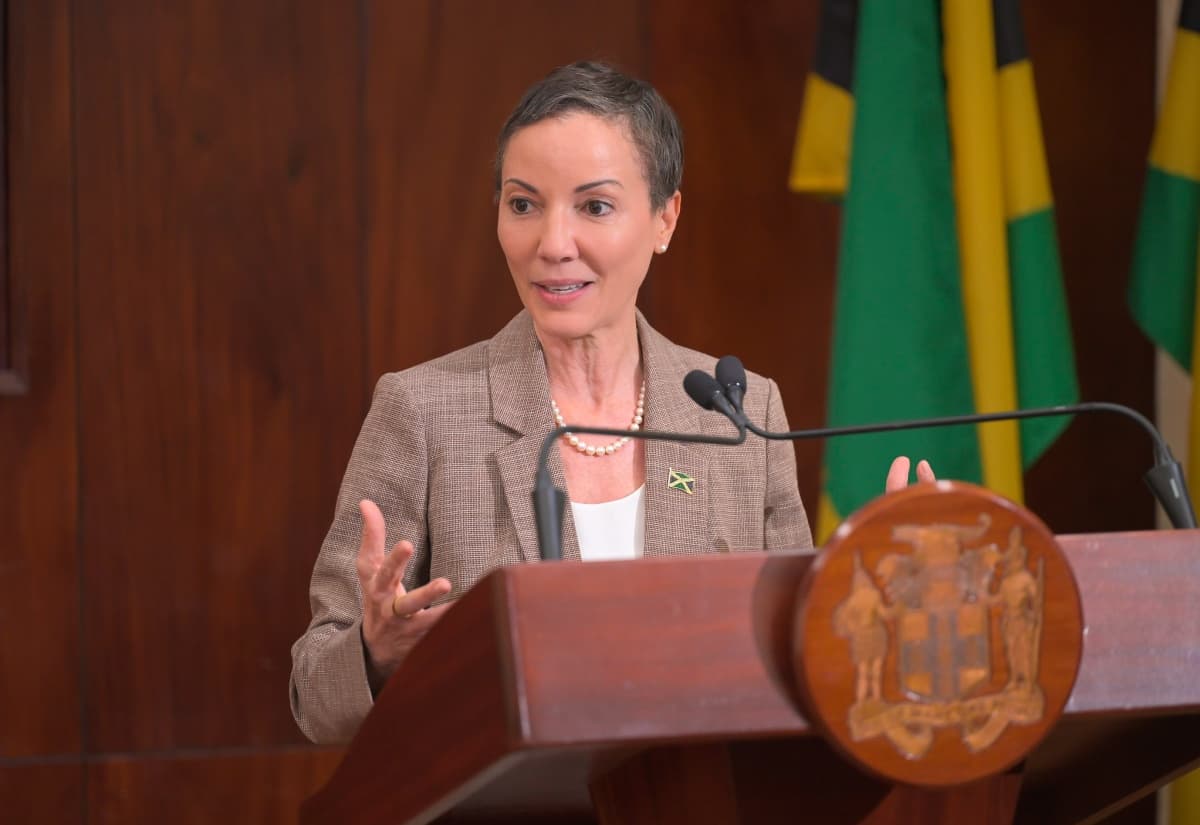
Minister of Foreign Affairs and Foreign Trade, Senator the Hon. Kamina Johnson Smith
Key Points(5)
- Jamaica's Foreign Affairs Minister Kamina Johnson Smith has rejected former Prime Minister P.J.
- Patterson's accusation that the government undermined Parliament's authority by abstaining from a United Nations (UN) vote calling for an end to the United States' economic embargo against Cuba.
- Patterson, in a statement Saturday, condemned the government's decision to abstain from the annual resolution, describing it as a departure from Jamaica's longstanding support for the measure.
- "It was a day of shame for the land of Marcus Garvey, and a stain on the record of a nation which, before we had even raised our own flag, closed its ports to trade with apartheid South Africa," Patterson said.
- He also argued that the decision disregarded a resolution unanimously passed by Jamaica's Parliament opposing the US embargo, describing the government's action as a "deplorable flouting of Parliament's constitutional authority." "This is no mere discourtesy.
Jamaica's Foreign Affairs Minister Kamina Johnson Smith has rejected former Prime Minister P.J. Patterson's accusation that the government undermined Parliament's authority by abstaining from a United Nations (UN) vote calling for an end to the United States' economic embargo against Cuba.
Patterson, in a statement Saturday, condemned the government's decision to abstain from the annual resolution, describing it as a departure from Jamaica's longstanding support for the measure.
"It was a day of shame for the land of Marcus Garvey, and a stain on the record of a nation which, before we had even raised our own flag, closed its ports to trade with apartheid South Africa," Patterson said.
He also argued that the decision disregarded a resolution unanimously passed by Jamaica's Parliament opposing the US embargo, describing the government's action as a "deplorable flouting of Parliament's constitutional authority."
"This is no mere discourtesy. It was an act of deception and a grave parliamentary offence," Patterson said.
The former prime minister added that the decision amounted to an "abominable betrayal" of Jamaica's historical position on the issue and called for parliamentary accountability.
However, Johnson Smith pushed back against the criticism in a statement Sunday, arguing that the parliamentary motion did not instruct the government to vote in favor of the UN resolution or bind the executive to a particular voting position.
She said the motion expressed concern for the Cuban people and supported constructive engagement, reduced economic restrictions and Cuba's integration into the international economic system.
Johnson Smith described Patterson's allegation of a parliamentary breach as extraordinary, maintaining that Parliament's role in debating policy and holding ministers accountable must be distinguished from the executive's constitutional responsibility for conducting government policy, including foreign relations.
"There was, therefore, no parliamentary instructions defied and no credible basis for the extraordinary allegation of a parliamentary offence," she said.
The foreign minister also defended the government's decision to reconsider its approach to the annual UN resolution, arguing that repeated expressions of solidarity had failed to achieve their central objective.
"For more than three decades, the [UN] General Assembly has called for an end to the embargo, yet it remains in place and the circumstances facing the Cuban people have deteriorated," she said.
"Surely, it is reasonable to consider whether a broader approach might better serve the objective I presume we all share – an improvement in the lives of the Cuban people."
Johnson Smith stressed that Jamaica's position against the embargo had not changed, while acknowledging Cuba's contributions to the island, particularly in healthcare and education.
"What has changed is our assessment of whether continued support for an annual resolution addressing only one dimension of Cuba's circumstances represents the most constructive approach," she said.