Holness urges Caribbean parliaments to balance technology with democratic values
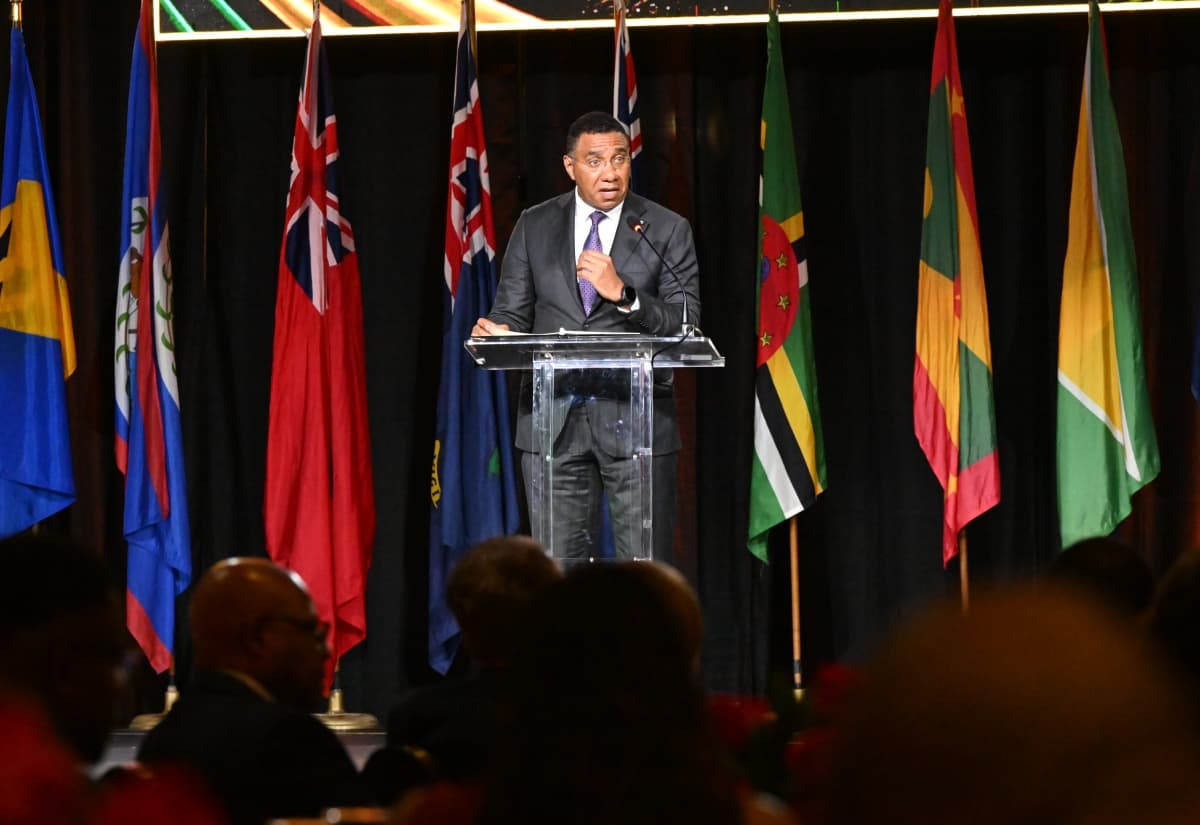
Prime Minister, Dr. the Most Hon. Andrew Holness, addresses delegates during the opening ceremony for the 48th Regional Conference of the Commonwealth Parliamentary Association (CPA), Caribbean, Americas and Atlantic (CAA) Region, at Moon Palace Jamaica in St. Ann on Monday (August 31).
Key Points(5)
- Prime Minister Andrew Holness has urged parliaments across the Caribbean and wider Commonwealth to embrace technological advances without allowing them to replace human judgment or undermine the principles at the heart of democracy.
- Holness made the call Monday during the opening ceremony of the 48th Regional Conference of the Commonwealth Parliamentary Association Caribbean, Americas and Atlantic Region at Moon Palace Jamaica in St.
- The prime minister said parliamentarians are operating in an increasingly digital environment in which citizens expect immediate access to information and real-time responses from their elected representatives.
- However, he cautioned that as legislatures modernize, they must remain grounded in representation, deliberation and public trust.
- “Technology must remain the servant of democracy, not its master,” Holness said.
Prime Minister Andrew Holness has urged parliaments across the Caribbean and wider Commonwealth to embrace technological advances without allowing them to replace human judgment or undermine the principles at the heart of democracy.
Holness made the call Monday during the opening ceremony of the 48th Regional Conference of the Commonwealth Parliamentary Association Caribbean, Americas and Atlantic Region at Moon Palace Jamaica in St. Ann.
The prime minister said parliamentarians are operating in an increasingly digital environment in which citizens expect immediate access to information and real-time responses from their elected representatives.
However, he cautioned that as legislatures modernize, they must remain grounded in representation, deliberation and public trust.
“Technology must remain the servant of democracy, not its master,” Holness said.
He described Parliament as the institution through which democracy finds expression, providing a forum where competing ideas are debated, governments are held accountable, laws are enacted and public resources are authorized on behalf of citizens.
Strong parliaments, he said, remain the foundation of modern democracy, and that strength should not be sacrificed in the push toward digitization.
Holness pointed to the evolution of mobile technology as an example of how quickly parliamentary practices have had to change. Commercial mobile phones were once large devices that had to be carried in a suitcase, while parliamentary rules later tightly restricted their use in legislative chambers.
Today, he noted, legislatures such as the United Kingdom's House of Commons have amended their rules to accommodate mobile devices, while parliaments worldwide are considering issues such as livestreaming proceedings from chambers and committee meetings.
Caribbean legislatures, including those in Barbados, Saint Lucia and Antigua and Barbuda, are facing similar pressures to incorporate emerging technologies and digital platforms into their operations, Holness said.
“The challenge before us is larger than simply digitising Parliament. The challenge before us is how do we incorporate technology as a kind of renewal of the parliamentary process but, at the same time, preserve representative democracy,” he said.
Holness acknowledged that technology can make parliamentary proceedings more accessible, improve communication between lawmakers and their constituents, and strengthen legislative research and committee work.
He also highlighted the potential of artificial intelligence to accelerate information gathering and document drafting but cautioned against allowing such tools to take over functions that require human judgment and democratic accountability.
“Efficiency is valuable, and I am the greatest proponent of efficiency,” Holness said. “[However, democracy] must preserve the dignity of the people.”