Haiti’s World Cup dream fueled by pride, resilience, and belief
Key Points(5)
- Long before Haiti kicks a ball at the FIFA World Cup, the nation has already achieved something remarkable.
- In a country grappling with political instability, violence, and widespread displacement, the national football team's qualification for the world's biggest sporting event has emerged as a powerful symbol of resilience.
- Now, as the Grenadiers prepare for their opening match against Scotland in Boston on Saturday, they are determined to prove their presence on the global stage is about more than simply making up the numbers.
- For the players, this World Cup is an opportunity to give Haitians something precious: hope.
- A return more than half a century in the making Haiti enters the tournament as one of its most compelling underdog stories.
Long before Haiti kicks a ball at the FIFA World Cup, the nation has already achieved something remarkable.
In a country grappling with political instability, violence, and widespread displacement, the national football team's qualification for the world's biggest sporting event has emerged as a powerful symbol of resilience. Now, as the Grenadiers prepare for their opening match against Scotland in Boston on Saturday, they are determined to prove their presence on the global stage is about more than simply making up the numbers.
For the players, this World Cup is an opportunity to give Haitians something precious: hope.
A return more than half a century in the making
Haiti enters the tournament as one of its most compelling underdog stories.
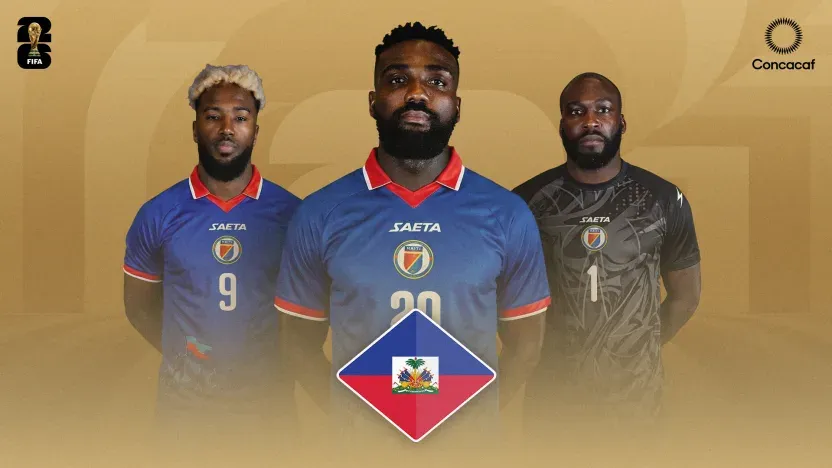
Ranked 83rd in the world, the Caribbean nation is appearing at the World Cup for the first time since 1974. Drawn into a challenging group featuring Scotland, Brazil, and Morocco, few outside the squad expect them to advance.
Inside the camp, however, belief remains strong.
The players understand the magnitude of the challenge, but they also recognize the significance of representing a nation that has endured extraordinary hardship.
Midfielder Jean-Ricner Bellegarde says the opportunity extends far beyond football.
“I feel pride for the people of Haiti. We know people might have a bad image of our country, that it has lots of problems, but this will do the country, the people, my family so much good.”
Bellegarde, who was born in the suburbs of Paris and has accumulated more than 80 English Premier League appearances with Wolverhampton Wanderers, has become one of the team's key figures.
He played an important role in Haiti's impressive qualification campaign, during which the Grenadiers finished ahead of Costa Rica, quarter-finalists at the 2014 World Cup.
Taking it one match at a time
Despite the excitement surrounding Haiti's return to the tournament, the squad remains grounded.
The focus is not on grand predictions but on maximizing every opportunity.
“Now we are just going to go one game at a time, give our best and see where that takes us,” Bellegarde said after training at the team's base at Stockton University near Atlantic City.
That measured approach reflects the mindset instilled by head coach Sebastien Migne, who has assembled a talented squad featuring several foreign-born players with Haitian roots.
Together, they have transformed Haiti into one of the most intriguing teams in the competition.
Playing for a nation that cannot be present
One of the most emotional aspects of Haiti's World Cup journey is the reality that many supporters will be unable to attend.
Travel restrictions have prevented large numbers of fans from making the trip from Haiti, a nation where gang-related violence and instability continue to affect daily life.
The United Nations recently estimated that nearly 1.5 million Haitians have been displaced by the ongoing crisis.
Yet despite those challenges, the team expects substantial support from the vibrant Haitian diaspora throughout the United States.
The players experienced that passion firsthand during recent friendly matches in Florida.
According to winger Derrick Etienne, the atmosphere served as a reminder of how deeply the national team resonates with Haitians everywhere.
“The country does so well supporting the team. I think a lot of people were able to see that when we played in Fort Lauderdale, when we played in Miami, the support that we had and the atmosphere they created.”
A mission bigger than football
For Etienne, who was born in Virginia and currently plays for Toronto FC, the World Cup represents an opportunity to shine a spotlight on Haiti while helping unite its people.
“To not be able to play at home is obviously difficult, but we ultimately wanted to do something for the country to help get things going and bring awareness to what’s going on there and change the status quo.”
The 29-year-old was part of the Haitian team that reached the semi-finals of the Concacaf Gold Cup in 2019, one of the greatest achievements in the country's football history.
Now he hopes to help author an even bigger chapter.
Chasing a historic first
Haiti's previous World Cup appearance ended in disappointment.
At the 1974 tournament, the team lost all three matches and conceded 14 goals.
This generation is determined to create a different legacy.
“We’re trying to do something that’s never been done before,” Etienne said.
“We understand it’s a hard task, but we have a lot of belief in ourselves. We don’t really have anything to lose, we have everything to gain, so that’s what we’re going to try to do.”
The mission is straightforward: secure Haiti's first-ever World Cup victory and demonstrate that the team belongs among football's elite nations.
A dangerous underdog emerges
If any opponents are tempted to underestimate Haiti, recent performances suggest that would be a mistake.
The Grenadiers delivered a powerful statement with a 4-0 victory over New Zealand last week, showcasing the attacking threat that has become a hallmark of the team.
Among their most dangerous weapons is striker Wilson Isidor.
The 25-year-old forward, who was born in France and made his Haiti debut in March, has quickly emerged as a key figure in the attack.
Etienne believes Isidor possesses all the qualities needed to trouble World Cup defenses.
“He’s direct, strong, good technically and can finish. So, the fact he’s playing with Haiti is amazing.”
Isidor, who scored six Premier League goals last season, says representing his father's homeland carries special meaning.
“I’m very proud to represent the country of my Dad.”
And he believes the team's mission extends beyond results.
“I hope I am going to have some amazing adventures with the national team. We have come to deliver a message and show we are not only a small nation that has trouble.”
More than a team, a symbol
As Haiti prepares to face Scotland before later meeting Brazil and Morocco, the squad understands that every performance will be watched closely by supporters yearning for something positive to celebrate.
The Grenadiers arrive as outsiders, but they also arrive with purpose.
In a tournament often defined by footballing giants, Haiti offers a different narrative, one rooted in resilience, identity, and national pride.
Whether they advance or not, their presence at the World Cup already stands as a testament to perseverance. What comes next, they hope, will be history.