Haiti capital ‘paralysed and isolated’ by gang violence, UN Security Council hears
Key Points(5)
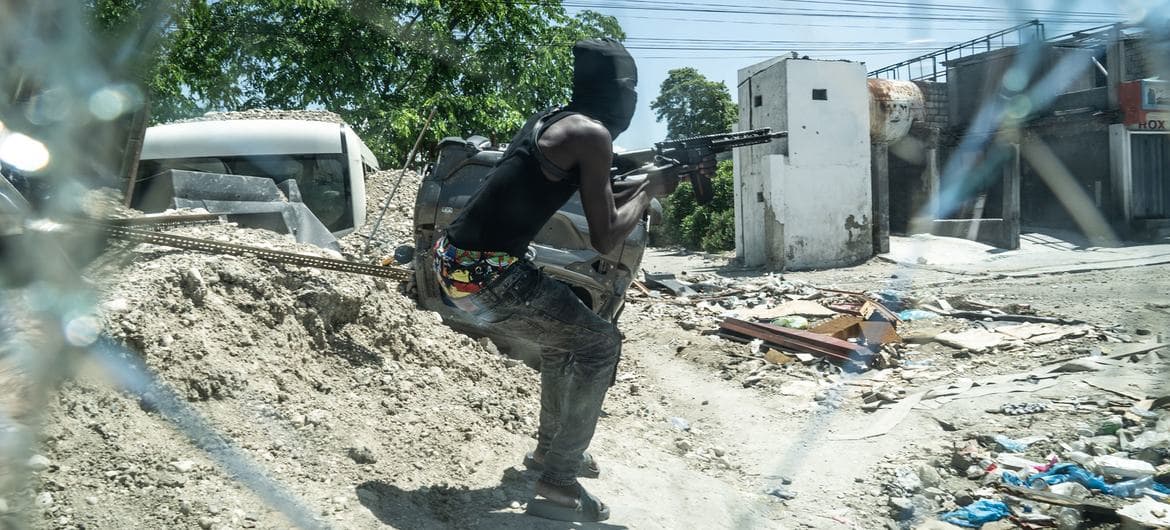
- More than 1.3 million people have been displaced across Haiti amid escalating gang violence and lawlessness that have left the population, particularly women and girls, increasingly vulnerable to exploitation and sexual violence.
- Since the start of 2025, the UN Integrated Office in Haiti (BINUH) has recorded over 4,000 deliberate killings — a 24 percent rise compared to the same period last year.
- “As gang control expands, the state’s capacity to govern is rapidly shrinking, with social, economic and security implications,” she said.
- While some form out of urgent community protection needs, many operate outside legal frameworks, sometimes engaging in extrajudicial actions and even colluding with gangs.
- This rise in vigilante groups is driving demand for guns and military-grade weapons, “fuelling illicit arms markets and raising the risk of licit weapons being diverted to criminal elements,” Waly warned.
More than 1.3 million people have been displaced across Haiti amid escalating gang violence and lawlessness that have left the population, particularly women and girls, increasingly vulnerable to exploitation and sexual violence.
Since the start of 2025, the UN Integrated Office in Haiti (BINUH) has recorded over 4,000 deliberate killings — a 24 percent rise compared to the same period last year.
“The capital city was for all intents and purposes paralysed by gangs and isolated due to the ongoing suspension of international commercial flights into the international airport,” Miroslav Jenča, Assistant Secretary-General for the Americas at the UN Department of Political and Peacebuilding Affairs (DPPA), told the Security Council on Wednesday.
Having recently visited Haiti, Jenča warned that gangs have only “strengthened their foothold,” now controlling all communes of the Port-au-Prince metropolitan area and beyond, “pushing the situation closer to the brink.”
He urged the international community to act swiftly, cautioning that the “total collapse of state presence in the capital could become a very real scenario.”
Ghada Fathi Waly, Executive Director of the UN Office on Drugs and Crime (UNODC), delivered a similar warning during her briefing from Vienna.
“As gang control expands, the state’s capacity to govern is rapidly shrinking, with social, economic and security implications,” she said. Waly added that this erosion of state legitimacy has “cascading effects,” paralyzing legal commerce as gangs control major trade routes, and worsening “already dire levels of food insecurity and humanitarian need.”
In response to the growing insecurity, “vigilante” or self-defence groups are gaining popularity among the public. While some form out of urgent community protection needs, many operate outside legal frameworks, sometimes engaging in extrajudicial actions and even colluding with gangs. This rise in vigilante groups is driving demand for guns and military-grade weapons, “fuelling illicit arms markets and raising the risk of licit weapons being diverted to criminal elements,” Waly warned.
The deteriorating security and economic situation has also intensified human rights violations. Despite under-reporting due to fear, stigma, and distrust in institutions, BINUH has noted a recent increase in sexual violence committed by gangs.
In a related development, Haitian police raided a medical facility in Pétion-Ville in May, suspected of involvement in illicit organ trade amid emerging allegations of trafficking in persons for the purpose of organ removal.
With conditions worsening, Jenča emphasized the urgency: “There is not a moment to lose.”
The Security Council continues to monitor the crisis, as Port-au-Prince remains gripped by violence and isolation, with the fate of Haiti’s capital—and state authority—hanging in the balance.