Guyana breaks ground for regional law school after decades of talks
Key Points(5)
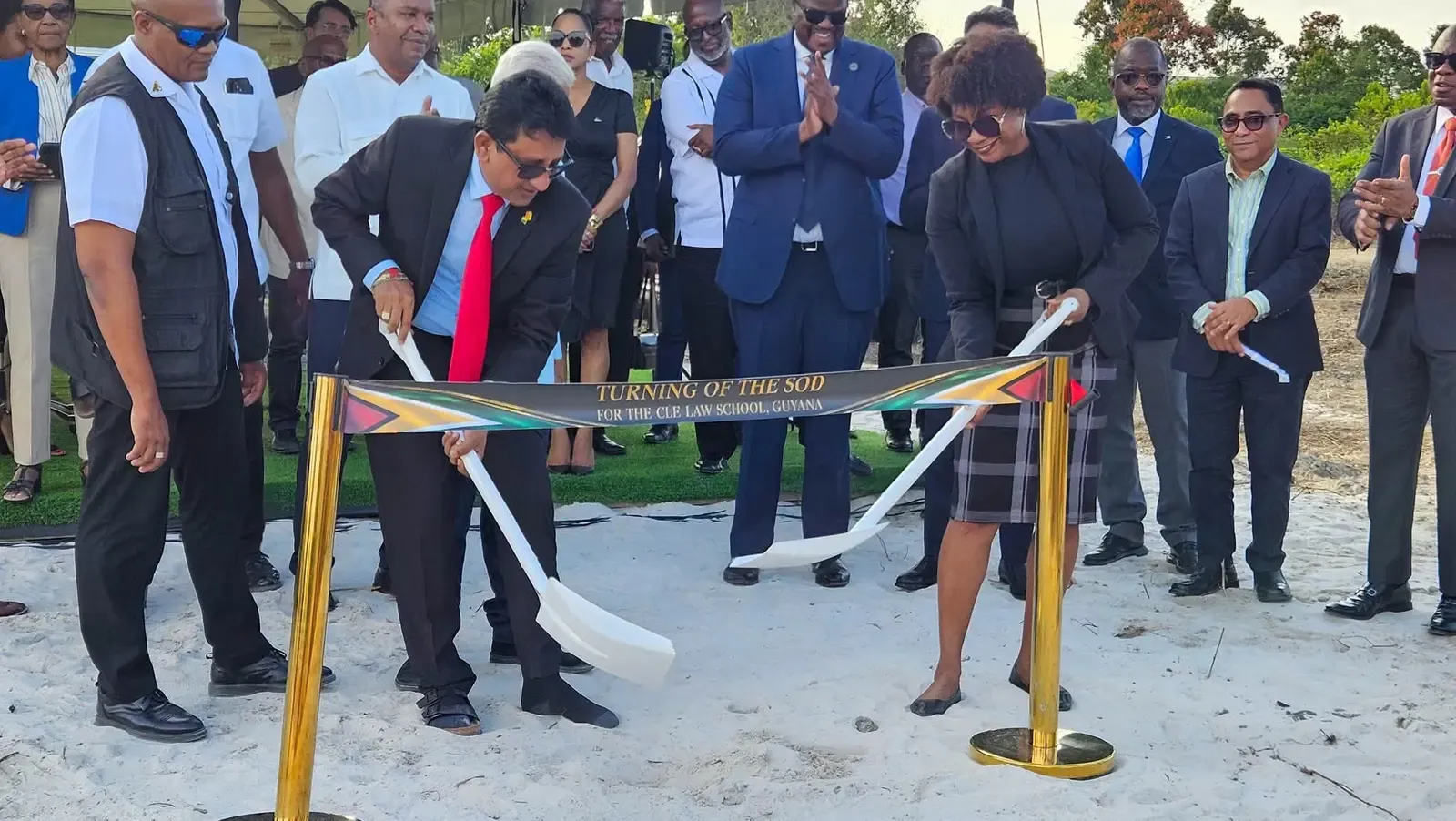
- Guyana has officially broken ground for a new regional law school at the University of Guyana, moving forward with a project that has been discussed for nearly three decades.
- The sod was turned Thursday for the Caribbean’s fourth Council of Legal Education (CLE) law school, which will be constructed on an eight-acre site at the university’s Turkeyen Campus.
- The new institution will join the Norman Manley Law School in Jamaica, Hugh Wooding Law School in Trinidad and Tobago and Eugene Dupuch Law School in The Bahamas.
- Attorney General and Minister of Legal Affairs Anil Nandlall described the groundbreaking as a significant moment following decades of efforts to establish the institution.
- “It is a simple and symbolic ceremony, but a ceremony of great historical and futuristic significance,” Nandlall said.
Guyana has officially broken ground for a new regional law school at the University of Guyana, moving forward with a project that has been discussed for nearly three decades.
The sod was turned Thursday for the Caribbean’s fourth Council of Legal Education (CLE) law school, which will be constructed on an eight-acre site at the university’s Turkeyen Campus.
The new institution will join the Norman Manley Law School in Jamaica, Hugh Wooding Law School in Trinidad and Tobago and Eugene Dupuch Law School in The Bahamas.
Attorney General and Minister of Legal Affairs Anil Nandlall described the groundbreaking as a significant moment following decades of efforts to establish the institution.
“It is a simple and symbolic ceremony, but a ceremony of great historical and futuristic significance,” Nandlall said.
The proposal for a law school in Guyana dates back to 1996 under the administration of then-President Cheddi Jagan and emerged partly because University of Guyana law graduates faced difficulties securing places at regional institutions to complete their professional legal training.
An arrangement was later established allowing 25 Guyanese nationals graduating from the University of Guyana to enter Hugh Wooding Law School without sitting the entrance examination. However, access remained limited.
Efforts to establish a law school in Guyana gained momentum again in 2002, when the CLE established a task force to examine the proposal. By 2005, the University of Guyana’s Turkeyen campus had been proposed as a location, but the project did not advance to construction.
The initiative resurfaced over the years but faced questions surrounding demand, financing, infrastructure and regional approval.
The latest push gained momentum in 2024 when the Guyana government and the CLE established a collaborative committee to conduct a feasibility study.
CLE Chairman Liesel Weekes said representatives met several times between September 2024 and September 2025 to determine whether a fourth regional law school would be viable and sustainable.
The completed feasibility report was presented to the Council in September 2025, with Weekes saying Guyana had “ticked all the boxes.”
The CLE formally approved the establishment of the law school at its September 2025 meeting in The Bahamas and authorised negotiations for a framework agreement with the Guyana government.
Nandlall announced during the 2026 Budget debate in February that construction was expected to begin this year, while the design procurement process advanced to the National Procurement and Tender Administration Board by July.
The final construction cost has not yet been determined and will depend on the completion and approval of the design.
Officials stressed that the institution will operate as a regional law school rather than one exclusively for Guyanese students.
Nandlall said Guyanese graduates would no longer face the existing numerical restriction associated with access to Hugh Wooding Law School, while students from other Caribbean countries would also be encouraged to study in Guyana.
The government has said the new institution will help meet growing demand for professional legal education across the Caribbean and expand the capacity of the region’s existing law school system.