Florida could have its first Black governor and senator
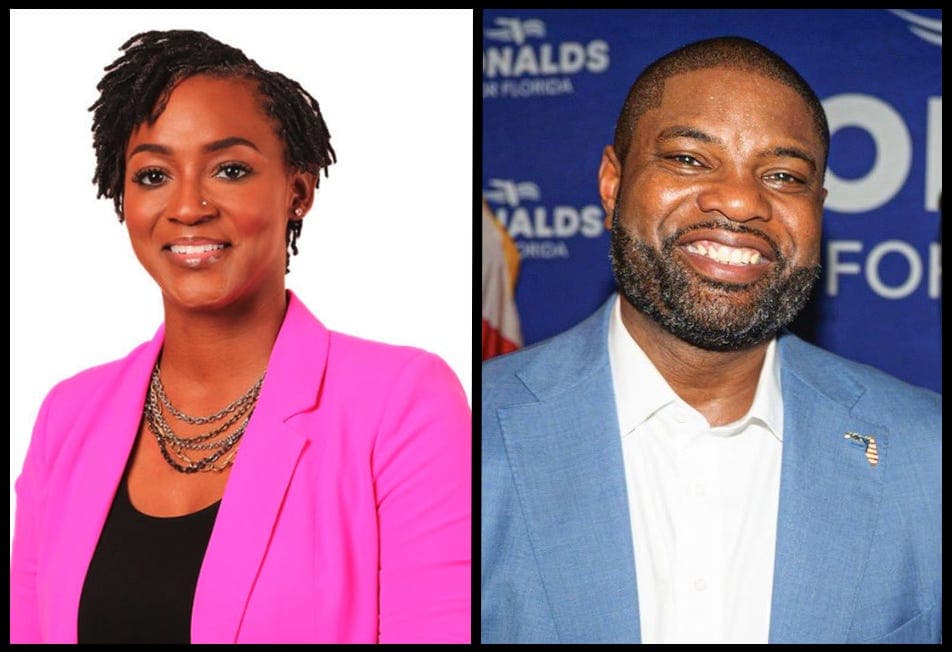
Key Points(5)
- Florida’s primary elections on August 18 were highlighted by strong victories by two African Americans.
- Byron Donalds, the son of a Jamaican mother and a Panamanian father, overwhelmingly won the Republican primary for governor with about 48%.
- He now faces David Jolly, who won the Democratic primary.
- In the biggest upset of the night, Angie Nixon, a progressive, defeated Alex Vindman 56% to 44%, despite being dramatically outspent in the Democratic primary for the U.S.
- Nixon will now face Republican Ashley Moody in November.
Florida’s primary elections on August 18 were highlighted by strong
victories by two African Americans. Byron Donalds, the son of a
Jamaican mother and a Panamanian father, overwhelmingly won the
Republican primary for governor with about 48%. He now faces David
Jolly, who won the Democratic primary. In the biggest upset of the
night, Angie Nixon, a progressive, defeated Alex Vindman 56% to 44%,
despite being dramatically outspent in the Democratic primary for the
U.S. Senate. Nixon will now face Republican Ashley Moody in
November.
Should either Donalds or Nixon win in November, they would make Florida history. Donalds would become the state’s first Black governor, while Nixon would become Florida’s first Black U.S. senator.
Donalds is in a strong position for November because Florida remains a
heavily Republican state, and Democrats have not won a Florida
gubernatorial election since 1994.
Nixon’s surprise victory indicates there is considerable dissatisfaction
with the traditional Democratic establishment. In her primary
campaign, she mobilized labor, Black churches and progressive voters
across the state.
President Donald Trump’s endorsement helped Donalds tremendously,
but several Trump-backed candidates elsewhere in Florida lost,
including Catalina Lauf, who lost her congressional race, while scandal-
plagued Republican Congressman Cory Mills was also defeated.
Donalds’ and Nixon’s results were fascinating because they
simultaneously showed continued Republican dominance and growing
dissatisfaction with establishment politics on both sides.
A Black Republican winning the governorship of Florida would be an
extraordinary historical development. It would indicate how much
Florida’s political coalition has changed since the days when it was
considered a genuine swing state.
South Florida voters supported both Donalds and Nixon heavily,
although voter turnout in the region was low. Donalds received 58% of
the vote in Miami-Dade, 54% in Broward, and 59% in Palm Beach
County. Nixon received 60% in Miami-Dade and 56% in Broward, but
44.6% in Palm Beach County, where she lost to Vindman, who received
55.4%.
Nixon’s primary victory shows Democrats can still generate substantial
enthusiasm among their core voters. She defeated Alex Vindman
despite being dramatically outspent, having raised less than $1 million
compared with Vindman’s roughly $16 million.
Despite the racial factor, both Donalds and Nixon did well in Northern
Florida. In Brevard County, for example, Donalds received 46.1%, and in
Lake County, 45.18%. His strong performance among conservative
Republicans outside South Florida is actually one of the more
encouraging aspects of this election from the standpoint of racial
politics.
A Black Republican didn’t merely squeak through a Republican primary
because of Black or minority voters. He won the Republican nomination
in a predominantly white, strongly conservative state. That is
historically significant.
Angie Nixon, who is from Jacksonville, won Florida’s Democratic
primary with substantial support in North Florida, particularly in and
around Jacksonville. This is important because North Florida is generally
much more conservative and whiter than South Florida. Nixon’s victory
therefore indicates that a significant portion of North Florida
Democrats turned out for her. Her background as a Jacksonville state
representative and community organizer gave her an enormous
advantage in name recognition and grassroots organization there.
Donalds demonstrated that a Black Republican can win substantial
support among predominantly white conservatives in North Florida.
Nixon demonstrated that a Black progressive woman can mobilize Black
and Democratic voters in that same region.
The primary elections indicate that North Florida has two very strong
and very different political constituencies: conservative white
Republicans, who overwhelmingly favor Donalds and the Republican
ticket; and Black and progressive Democrats, particularly around
Jacksonville and other population centers, who strongly supported
Nixon.
Political analysts believe that if Nixon can expand that
Jacksonville/Black-voter coalition into a much larger statewide coalition
among independents, young voters and moderate Democrats, the
November race could become considerably more competitive than the
conventional “safe Republican” assessment suggests.